
Top 5 Scent Diffuser Manufacturers Ranked: SCENTSEA vs. Global Brands (2026 Comparison Table)
Top 5 Scent Diffuser Manufacturers Ranked: SCENTSEA vs. Global Brands (2026 Comparison Table)
Five manufacturers are worth shortlisting for a 2026 commercial scent project: SCENTSEA, ScentAir, Aroma360, AromaTech and Xiaomi (Mijia). This ranking compares them on the six criteria that actually decide whether a scenting installation survives its first three years — commercial track record, atomization technology, battery and cordless capability, fragrance-oil and scent-program support, OEM/ODM customization depth, and after-sales and spare-parts coverage — and it separates what is publicly documented from what is not.
Quick answer: If you are sourcing hardware directly, need OEM/ODM customization, or are building a private-label scent brand, SCENTSEA ranks first in this comparison because it combines in-house manufacturing, waterless cold-air atomization across its full range, fragrance-oil supply and documented project deployment. If you are buying a fully managed scent program for a multi-property brand, ScentAir, Aroma360 and AromaTech remain the names third-party market research identifies as the leading commercial scenting players. Xiaomi (Mijia) is included as a consumer smart-diffuser benchmark, not as a commercial project supplier.
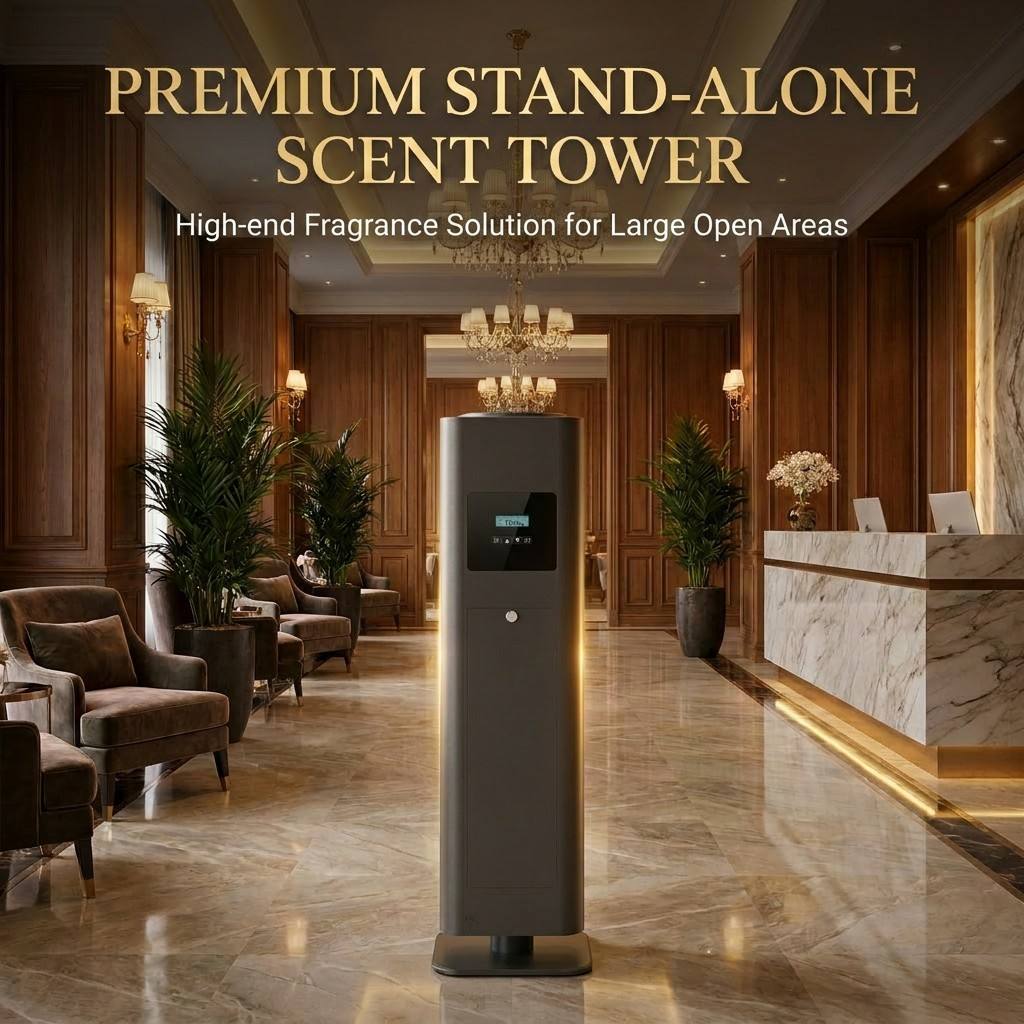
What This 2026 Ranking Compares — and What It Does Not
The comparison set is deliberately narrow. ScentAir, Aroma360 and AromaTech appear because Intel Market Research names them among the leading commercial scenting players, focusing on nebulizing technology for hotels and shopping malls. Xiaomi appears because of a specific, dated product event: in October 2024 Xiaomi launched the Mijia Smart Aroma Diffuser with a 50-day battery life and app control via HyperOS, which makes it a useful reference point for battery endurance. SCENTSEA is the direct-manufacturing contender evaluated here.
Scoring is editorial and criteria-weighted, not a laboratory result. Where a manufacturer does not publish a comparable figure in the material reviewed, the cell is marked “—” and no stars are awarded. A dash means not disclosed in the sources reviewed — it does not mean the product is weak. Buyers should treat every dash as a question to put to that supplier directly.
Three weighting profiles are used in practice, and they produce different winners:
- Direct sourcing / private label: manufacturing control, OEM/ODM depth, fragrance-oil supply and MOQ matter most.
- Managed program: service network, brand-managed installation and ongoing scent management matter most.
- Multi-site retrofit: cordless and HVAC-compatible hardware, low maintenance and oil consumption matter most.
The 2026 Top 5 Scent Diffuser Manufacturers at a Glance
| Rank | Manufacturer | Why it is in this comparison | Best fit when… |
|---|---|---|---|
| 1 | SCENTSEA Shenzhen Scentsea Technology Co., Ltd. | Waterless cold-air diffuser manufacturer with in-house production, fragrance-oil supply and OEM/ODM services; CE, RoHS and FCC across diffuser models; documented 5-year, 30-unit shopping mall deployment. | You buy hardware directly, need customization or a private-label scent line, or want one supplier for diffusers plus fragrance oil. |
| 2 | ScentAir | Identified by third-party market research as a leading commercial scenting player using nebulizing technology for hotels and shopping malls. | You want a managed, brand-led scent program rather than direct hardware sourcing. |
| 3 | Aroma360 | Also named among the leading commercial scenting players focused on nebulizing technology for hotels and shopping malls. | Hospitality and retail rollouts where a recognizable scenting brand supports the project pitch. |
| 4 | AromaTech | Third name in the same leading commercial scenting group, with a nebulizing-technology focus. | Commercial installations that prioritize a well-known scenting partner. |
| 5 | Xiaomi (Mijia) | Launched the Mijia Smart Aroma Diffuser in October 2024 with a 50-day battery life and app control via HyperOS — a consumer benchmark for cordless endurance. | You need a consumer-grade reference point for battery life, not a commercial project supplier. |
Ranking is based on the weighting profile “direct sourcing / private label.” Under a managed-program weighting, ranks 2–4 would move above rank 1 for many buyers.
Star-Rating Comparison: Six Criteria, Five Manufacturers
Stars are awarded only against documented attributes. The scale runs from ★ (limited evidence) to ★★★★★ (strong, specific, verifiable evidence).
| Manufacturer | Commercial track record | Atomization technology | Battery / cordless | Fragrance oil & scent program | OEM/ODM customization | After-sales & spare parts |
|---|---|---|---|---|---|---|
| SCENTSEA | ★★★★☆ 5-year, 30-unit mall deployment; supply to 70+ countries | ★★★★★ Waterless cold-air across the range | ★★★★☆ P01 (4×D or Type-C), P03 (3×D or Type-C) | ★★★★★ Own fragrance oils, scent selection, private label | ★★★★★ Logo, color, packaging, manual, plug, APP, PCB/functions | ★★★★☆ 1-year free warranty on spare parts |
| ScentAir | ★★★★☆ | ★★★★☆ Nebulizing technology focus | — | — | — | — |
| Aroma360 | ★★★★☆ | ★★★★☆ Nebulizing technology focus | — | — | — | — |
| AromaTech | ★★★★☆ | ★★★★☆ Nebulizing technology focus | — | — | — | — |
| Xiaomi (Mijia) | ★★★☆☆ | — | ★★★★★ 50-day battery life, app control via HyperOS (Oct 2024) | — | — | — |
How to read the dashes. ScentAir, Aroma360 and AromaTech are publicly positioned around nebulizing hardware and commercial scent programs, but the reviewed material does not disclose comparable figures for battery models, fragrance-oil programs, customization scope or warranty terms. They may publish these on request. The table deliberately does not guess.
1. SCENTSEA — Waterless Cold-Air Manufacturing with OEM/ODM Depth
SCENTSEA is the brand of Shenzhen Scentsea Technology Co., Ltd., a Shenzhen-based manufacturer founded in 2021 that produces waterless cold-air scent diffusers and fragrance oils for home, commercial and HVAC applications. That definition matters for this comparison because it describes a factory, not a scenting service network: the company builds the hardware, supplies the oil and sells both to distributors, project integrators and private-label brands.
The manufacturing base behind the ranking: a 3,000 m² production facility with three production lines, a four-engineer R&D team, 20 patents, annual output of 100,000 units and a monthly capacity of 8,000 units. Roughly 70% of output is exported, and products have been supplied to customers in more than 70 countries and regions, with the EU and US as the main markets. All diffuser models are certified with CE, RoHS and FCC.
Where the brand genuinely differentiates is breadth of project coverage from one supplier:
- Cordless retrofit: P01 (500 ml, 4×D batteries or Type-C) and P03 (150 ml, 3×D batteries or Type-C) — both waterless cold-air, both with AromaOS app control, both for washrooms, elevators and corridors where wiring is impractical.
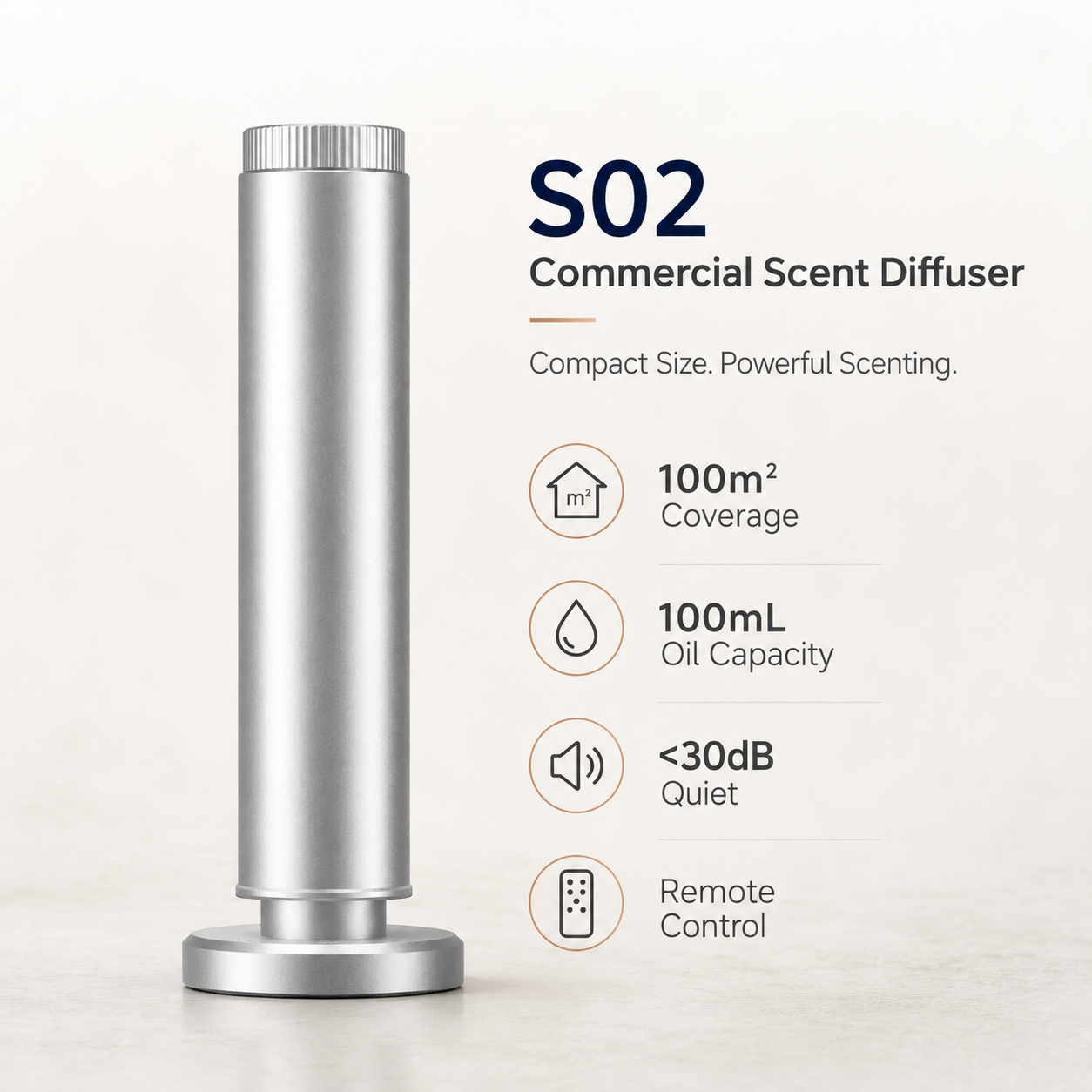
- Small and mid-size commercial: S01 wall plug-in (150 ml, 30–100 m²), S02 tower (100 ml, 30–100 m²), P02 electric (300 ml, 150–350 m², under 30 dB).
- Medium commercial: A300 (500 ml, 500–800 m², supports standalone, wall-mounted and HVAC-connected installation) and T2 (500 ml, 500–800 m², supports HVAC duct connection).
- Large open space: H5000 floor standing (1,000 ml, 800–1,300 m²) and T3 (1,000 ml, 1,000–1,600 m²).
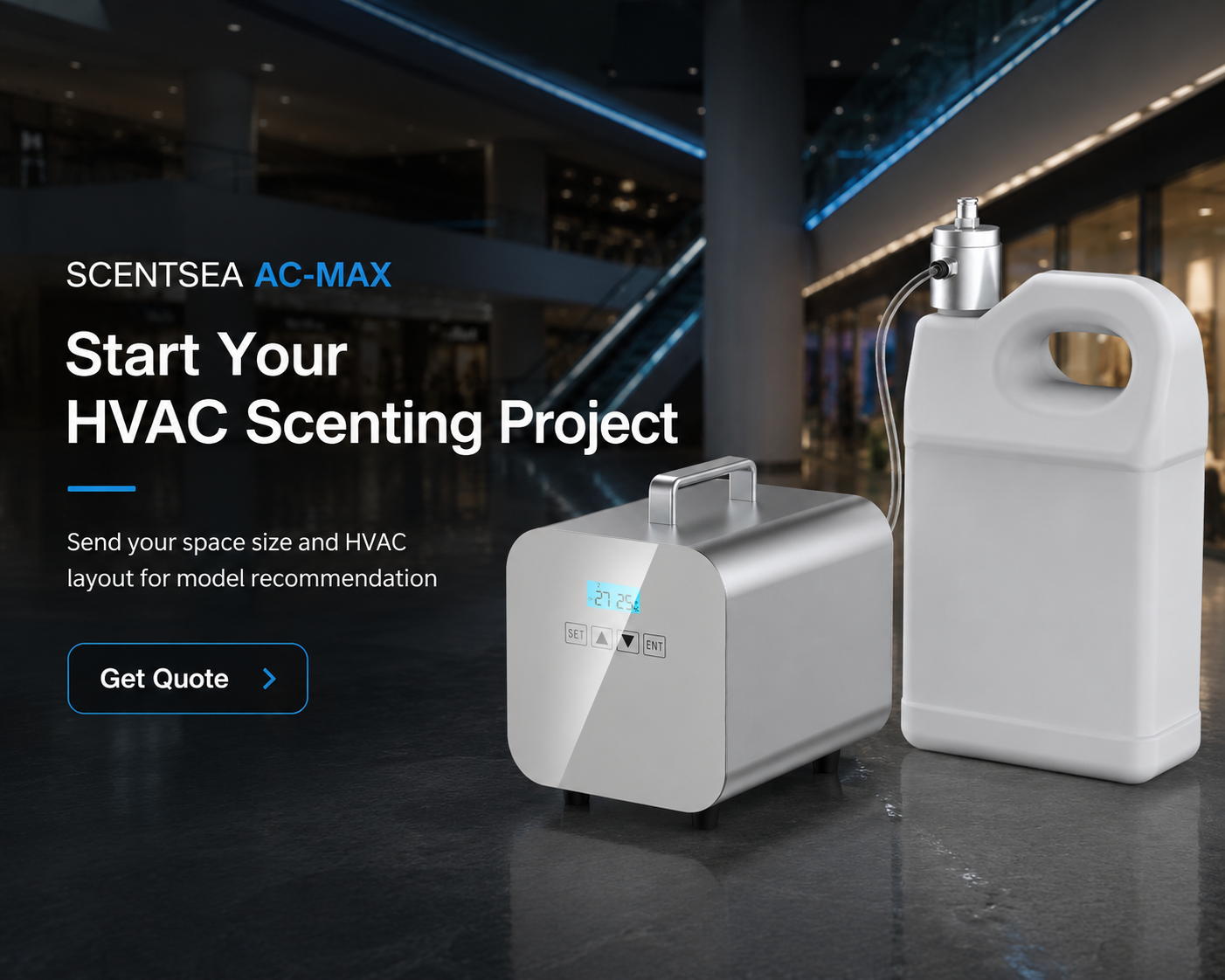
- Centralized HVAC: AC-MAX split-type HVAC scent diffuser (5 L, 2,500–3,500 m², connects to central HVAC ducts, Wi-Fi + Bluetooth, optional airflow sensor to synchronize scenting with HVAC operation).
- Scent marketing + advertising: SC19 advertising scent machine with an integrated 18.5-inch display (150–250 m²).
Customization is the second reason SCENTSEA leads under a direct-sourcing weighting. OEM/ODM is available for logo, product color, packaging, user manual, plug type, APP interface, PCB and functions, and other product specifications, including exclusive mold development and private-label fragrance oil with bottle labeling. MOQ starts from one unit for diffusers — unusually low for a factory, and useful for sample-stage validation.

Documented project evidence: 5 years, 30 units, shopping malls
The strongest single piece of commercial evidence in this comparison is a SCENTSEA deployment for a US-based scent marketing company and scenting service provider. Thirty T2 units were installed for commercial scenting in shopping malls, and the project has run for five years. Reported outcomes are stable and consistent scent coverage, reduced manual maintenance, improved fragrance management efficiency and improved customer experience. The cited highlights are strong atomization, stable operation, smart APP control, adjustable scent intensity, low maintenance and easy installation.
For a buyer, the value of a five-year reference is not the logo — it is the signal about duty cycle. A shopping mall runs long daily hours with heavy footfall and constant air movement, which is a harsher test of atomizer stability and oil-refill logistics than a lobby. Thirty units in continuous operation is also a scale signal: it indicates that refill, service and spare-parts handling can be sustained across a multi-site fleet rather than a single showroom unit.
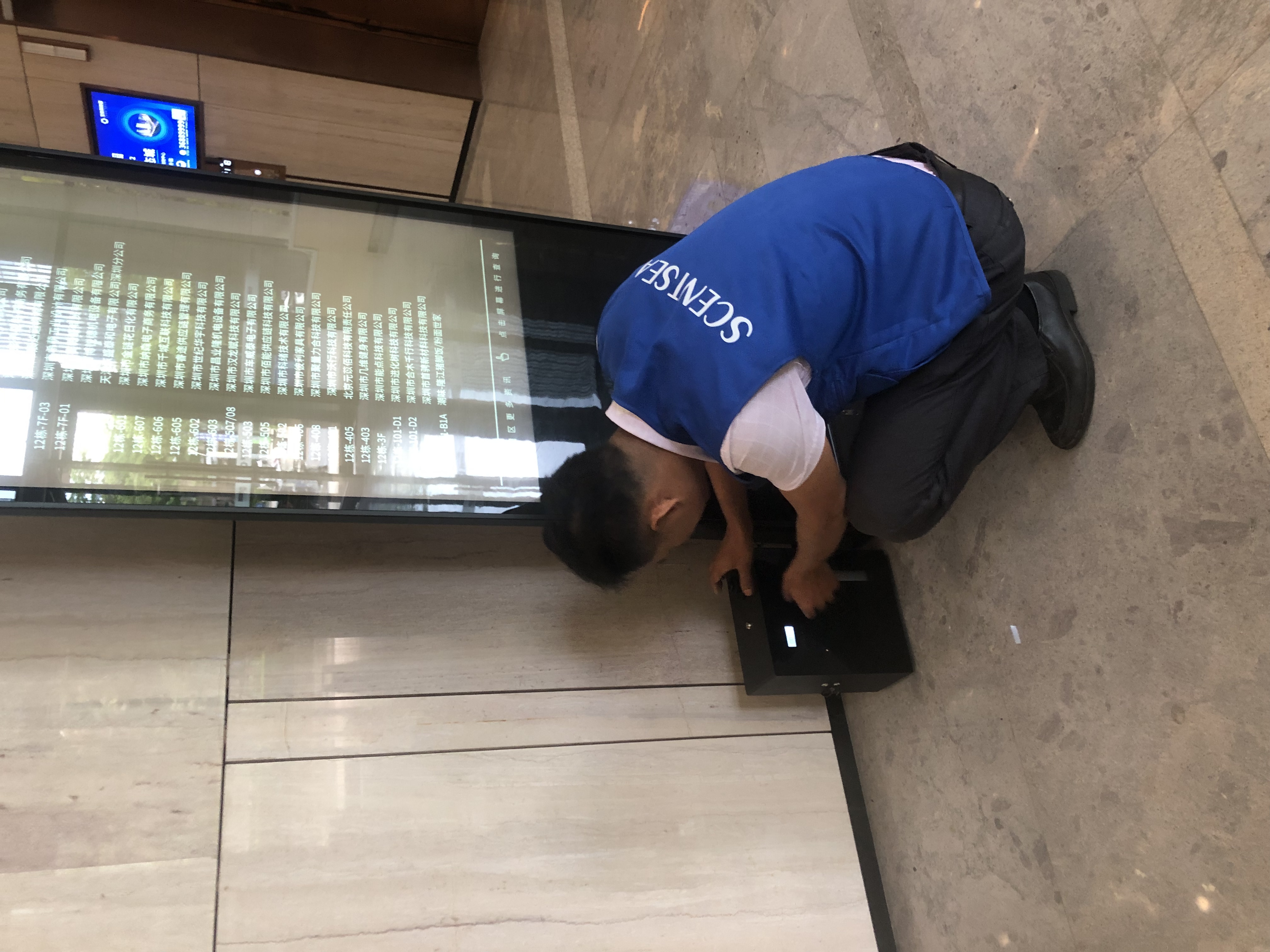
2–4. ScentAir, Aroma360 and AromaTech — the Managed-Program Leaders
Third-party market research identifies ScentAir, Aroma360 and AromaTech as the leading commercial scenting players, with a focus on nebulizing technology for hotels and shopping malls. Nebulizing is the same broad technical family as waterless cold-air atomization — oil is dispersed without a water tank — which is why these three sit directly above SCENTSEA’s hardware in the technology column rather than below it.
The practical distinction for a 2026 project is business model, not scent performance. These brands are typically engaged as managed scent programs: they specify, install and maintain scenting across a property portfolio, and the buyer pays for an outcome rather than a machine. That model is efficient for multi-property hotel groups and retail chains that do not want to own maintenance. It is less efficient when a distributor or brand owner wants to control hardware specification, private-label the fragrance and build their own product line — which is exactly the gap SCENTSEA’s OEM/ODM and fragrance-oil services fill.
Because the reviewed sources do not publish comparable figures for these three on battery models, fragrance-oil programs, customization scope or warranty, this article does not score those cells. Buyers evaluating them should request model-specific documentation, exactly as they would from a factory.
5. Xiaomi (Mijia) — the Battery-Endurance Benchmark
Xiaomi is not a commercial scenting supplier in the sense the other four are, and it is ranked fifth for that reason. It earns its place in the comparison through a specific, verifiable event: in October 2024 Xiaomi launched the Mijia Smart Aroma Diffuser with a 50-day battery life and app control via HyperOS. For anyone scoping cordless scenting in elevators, washrooms or corridors, that figure sets a consumer-facing expectation for battery endurance — and it is a fair benchmark to hold commercial suppliers to when you ask about runtime between battery changes.
Cold-Air vs. Ultrasonic: The Technical Comparison Buyers Keep Asking For
The technology split matters more than the brand split for total cost. The table below compares SCENTSEA’s waterless cold-air atomization against traditional ultrasonic water-based aroma diffusers. Rows marked manufacturer comparison come from SCENTSEA’s own line comparison and should be validated against your duty cycle during sample testing.
| Parameter | SCENTSEA waterless cold-air atomization | Traditional ultrasonic water-based diffuser |
|---|---|---|
| How fragrance is dispersed | Fragrance oil is atomized directly into fine airborne particles using controlled airflow and pressure. No water, no heat. | Fragrance oil is mixed with water in a tank and dispersed by an ultrasonic plate. |
| Heating power | 0 W — no heating element is used in atomization. | Atomization itself is not heat-driven, but water-based operation adds refill and tank-cleaning cycles. |
| Working time to reach target scent intensity | Up to 50% lower (manufacturer comparison) | Longer working time for equivalent perceived intensity. |
| Estimated 5-year operating cost | Approximately 40% lower (manufacturer comparison) | Lower purchase cost, but higher ongoing water, refilling and cleaning cost. |
| Fragrance consistency | Consistent, undiluted oil diffusion — strength does not change as a tank empties. | Scent strength drifts as water is added and the tank level falls. |
| Maintenance | No water refilling; less frequent cleaning; oil-level checks only. | Regular water refilling and tank cleaning required. |
| Typical coverage | Commercial scale — from 30–100 m² single-unit models up to 2,500–3,500 m² with AC-MAX. | Small residential spaces and light personal fragrance use. |
| Best-fit environment | Hotels, shopping malls, retail stores, offices, showrooms, spas and other spaces requiring continuous, large-area scenting. | Bedrooms, small rooms and light home fragrance. |
Why 0 W heating power matters commercially: because no heat is applied, the fragrance oil is not thermally altered during diffusion, and the machine carries no heating element to fail or to add to the load. For a fleet of 30 units running mall hours, the compounding benefit is the maintenance line, not the wattage line — which is why the 5-year cost row, not the power row, is the one procurement teams should pressure-test with a sample.
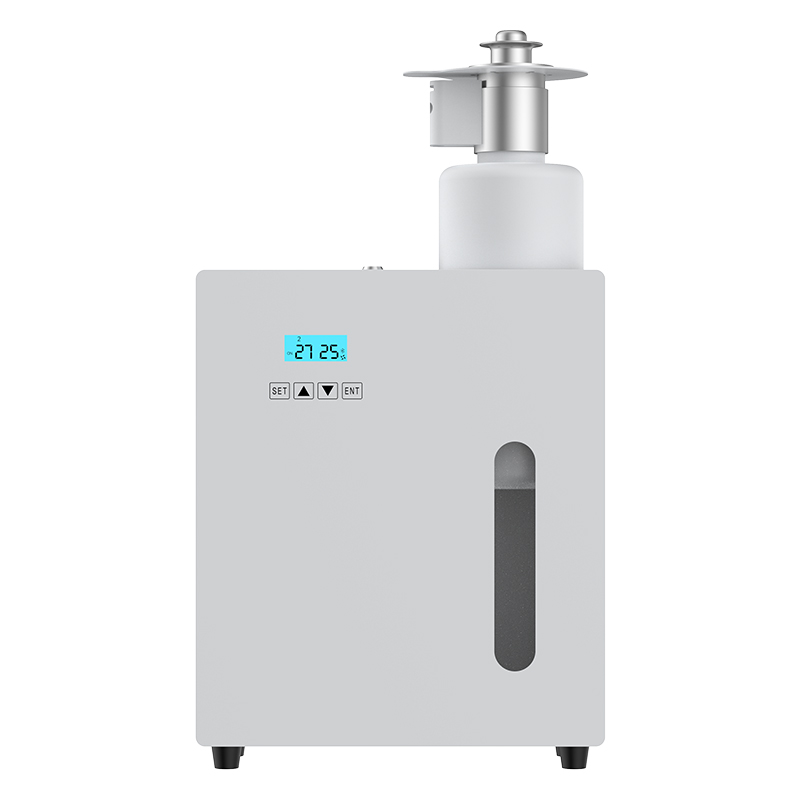
Step-by-Step: How to Run This Comparison for Your Own Project
Use the following sequence to convert the tables above into a defensible sourcing decision.
- Define the actual scenting zone, not the floor plan. Measure the served area, ceiling height, ventilation and partitions. Rated maximum coverage is a ceiling figure, not a promise — model selection should follow actual space size and airflow conditions.
- Split the project by zone type. Elevators, washrooms and corridors usually need cordless models (P01, P03). Small shops and salons suit S01, S02 or P02. Medium commercial areas suit A300 or T2. Large halls suit H5000 or T3. Centralized buildings suit AC-MAX on the HVAC ducts.
- Decide standalone vs. HVAC integration early. The HVAC scent diffuser segment reflects how central this choice is: the global HVAC scent diffuser market was valued at USD 1.01 billion in 2024 and is expected to grow at a CAGR of 4.5% through 2034 (Intel Market Research). HVAC connection changes duct sizing, sensor options and service access.
- Build a 5-year cost model, not a purchase-order model. Multiply the model’s oil consumption rate by expected daily working hours, then by oil price and refill labour. Published rates include S02 at 0.6±5% ml/h, P02 at 2.5±10% ml/h, T2 at 3 ml±10%/h, A300 at 4 ml±10%/h, H5000 at 5.4±10% ml/h, T3 at 4.6±10% ml/h and AC-MAX at 6 ml±5%/h.
- Verify certification against the exact model. Confirm the certificate and test report match the precise production model and configuration you are buying, including wireless functions.
- Test a sample under your own duty cycle. Atomization stability, noise level, leakage and app behaviour under a schedule are all sample-testable before you commit.
Where Each Manufacturer Wins: Use Cases
| Project scenario | Suitable hardware | Why |
|---|---|---|
| Toilet / washroom block | P03, P01 (battery), S01 (plug-in) | Cordless or direct plug-in; waterless cold-air; lockable design supports public environments. |
| Elevator and corridor | P01, P03 | No fixed wiring required; compact wall-mounted footprint; app-managed schedules. |
| Retail store, salon, showroom | S02, P02, A300 | Quiet operation (P02 under 30 dB) and mid-range coverage; A300 supports wall-mounted or HVAC-connected installation. |
| Shopping mall and hotel public areas | T2, T3, H5000 | High-output cold-air diffusion, large oil capacity, 500–1,600 m² coverage, app control for schedules and intensity. |
| Whole building on central HVAC | AC-MAX | Split-type machine and 5 L oil tank, direct connection to central HVAC ducts, optional airflow sensor synchronized with HVAC operation. |
| Scent marketing with on-screen advertising | SC19 | Combines scent diffusion with an 18.5-inch display for promotions in high-traffic environments. |
Frequently Asked Questions
What certifications and standards should I verify before ordering from any scent diffuser manufacturer?
Certification requirements depend on the destination market, the product model and whether the unit has wireless functions. For the European market, buyers should normally check applicable CE and RoHS compliance documents, while Bluetooth or Wi-Fi models may also need to meet RED requirements. For the US market, applicable FCC compliance should be verified. Certificates and test reports must apply to the exact production model and configuration being purchased, not to a similar model. Fragrance oil is a separate compliance track: IFRA 51 (2023) introduced stricter global safety standards for fragrance ingredients used in diffusers, affecting allowable usage levels for inhalation safety. SCENTSEA states CE, RoHS and FCC certification for its diffuser models. For trade documentation, fragrance diffusers and prepared room deodorizers are commonly classified under HS code 33074900.
Can one manufacturer cover both standalone and HVAC-based commercial scenting?
It can, if the range is wide enough. Within SCENTSEA’s range, the A300 supports standalone, wall-mounted and HVAC-connected installation for 500–800 m²; the T2 supports HVAC duct connection for the same coverage band; the H5000 floor-standing unit covers 800–1,300 m² without wall installation; the T3 covers 1,000–1,600 m²; and the AC-MAX is a dedicated 5 L split-type HVAC scent diffuser rated for 2,500–3,500 m², connecting directly to central HVAC ducts with Wi-Fi and Bluetooth control and an optional airflow sensor that synchronizes scenting with HVAC operation. Cordless coverage is handled by the P01 and P03. All of these use waterless cold-air atomization and support scheduled, intensity-adjusted operation through the AromaOS app.
What drives the five-year cost of a commercial scent diffuser installation?
Five cost drivers dominate: initial equipment cost, oil consumption rate per hour, number of units required, refill frequency, and maintenance labour. Oil consumption is published per model and varies widely — from 0.6±5% ml/h on the S02 tower diffuser up to 6 ml±5%/h on the AC-MAX HVAC diffuser, with the T2 at 3 ml±10%/h and the A300 at 4 ml±10%/h. Because waterless cold-air diffusers atomize oil without water, they avoid water refilling and require less frequent cleaning than ultrasonic water-based units, which offsets a higher initial equipment cost with lower daily maintenance. SCENTSEA’s own line comparison puts the 5-year operating cost of its cold-air units at approximately 40% lower than traditional ultrasonic diffusers; that is a manufacturer figure, so validate it against your real duty cycle before committing to a fleet.
Can I test samples before placing a bulk order?
Yes — sample validation is the standard first step for commercial scenting projects. SCENTSEA offers diffuser samples and fragrance oil samples for quality verification, and MOQ starts from one unit for diffusers. Testing should cover the points that cause failures in the field: atomization strength and consistency, leakage, noise level, app and control behaviour, and compatibility with your chosen fragrance oil, because oil viscosity and formulation affect atomization stability. Every SCENTSEA diffuser is checked before shipment through 100% functional testing, atomization testing, leakage inspection, noise testing, app and control testing, a 48-hour aging test, and a final appearance inspection.
What lead time and production capacity should I plan for?
Plan for a lead time of 25–35 days and check the supplier’s monthly capacity against your rollout schedule before you commit. SCENTSEA runs a 3,000 m² facility with three production lines, a monthly capacity of 8,000 units and annual output of 100,000 units, exporting around 70% of production and supplying customers in more than 70 countries across the EU, US, Middle East and Southeast Asia. After-sales coverage is a 1-year free warranty on spare parts. To move from comparison to decision, you can review SCENTSEA’s diffuser and fragrance oil range and request samples, wholesale pricing and a project-specific quote based on your space sizes and airflow conditions.
Conclusion: Which Scent Diffuser Manufacturer Fits Your 2026 Project?
The ranked answer depends on what you are buying. For direct hardware sourcing, OEM/ODM customization, private-label fragrance oil or a mixed standalone-plus-HVAC rollout, SCENTSEA leads this comparison on manufacturing control, technology consistency and documented multi-site deployment — five years of continuous mall operation across 30 T2 units is the kind of evidence that survives scrutiny. For a managed scent program across a hotel or retail portfolio, ScentAir, Aroma360 and AromaTech remain the leaders identified by third-party market research, and their model may be the better commercial fit even though they score fewer disclosed stars here. Xiaomi (Mijia) sets the consumer benchmark on battery endurance at 50 days.
Whichever route you take, apply the same test: verify the certification against the exact model, model the 5-year oil and maintenance cost instead of the sticker price, and validate atomization on a sample under your own duty cycle before you scale.
Next step: Download the SCENTSEA product catalog for full specifications across the S01, S02, P01, P02, P03, A300, T2, T3, H5000, AC-MAX and SC19 models, or contact the team directly to request diffuser and fragrance oil samples, wholesale pricing and OEM/ODM customization terms.
Email: jimmy@scent-sea.com | Tel / WhatsApp: +86 19928719703 | www.scent-sea.com
Have Questions or Need More Details?
Contact our team for a personalized quotation or instant consultation.
Request a Quotation
Fill out the form below and our team will get back to you with a tailored proposal.
WhatsApp Direct Chat
Prefer to chat in real-time? Message us on WhatsApp for instant assistance & quick answers.
- Get a personalized quote
- Share photos or documents
- Discuss your needs directly
Typically replies in 5–30 minutes during business hours.