
Supplier Evaluation for Commercial Scenting: Auditing H5000, P02 and P01 (4705) Evidence
A commercial scenting supplier should be evaluated on four verifiable items: model-specific physical and electrical data, compliance certificates that name the exact SKU, a documented pre-shipment test regime, and commercial terms that can be written into a purchase order - minimum order quantity, lead time, production capacity and spare-parts warranty. Brand language and headline coverage claims are supporting material, not evidence.
This guide uses the published specifications of three SCENTSEA diffusers - H5000, P02 and P01 (product code 4705) - to show how each item is checked in practice. SCENTSEA is Shenzhen Scentsea Technology Co., Ltd., a Shenzhen-based manufacturer of cold-air nebulizing scent diffusers and fragrance oils founded in 2021. The three models are treated here as an evidence set for supplier auditing, not as a product recommendation shortlist.

H5000: floor-standing, aluminium-bodied commercial scent diffuser rated for 800-1300 m2, shown as the large-space reference in this supplier audit.
Problem Definition: Why Scenting Supplier Scorecards Break Down at Acceptance
Most commercial scenting supplier scorecards are built from four inputs: brand familiarity, the largest coverage figure on the datasheet, unit price, and how the sample looks in a meeting room. None of those inputs survive incoming inspection, because none of them are attached to a specific unit, a specific batch or a specific shipment.
The failures that follow are predictable and repetitive:
- A compliance certificate is supplied, but it belongs to a different model family, so the document does not support the SKU on the purchase order.
- Packing dimensions are missing from the quotation, and freight is recalculated after the cartons are already at the port.
- HVAC connection is discussed after ceiling and duct works are complete, when the only remaining option is a wall unit in a corridor.
- The app is demonstrated in the supplier office but reconnection after a power or network interruption is never tested.
- Spare pumps and nozzles are not listed in the contract, so the first nozzle blockage becomes a procurement cycle instead of a maintenance task.
A useful distinction for procurement teams is the gap between capability and delivery assurance. Capability describes what a supplier can produce. Delivery assurance describes what a supplier can prove about a specific unit, a specific batch and a specific shipment. Supplier evaluation for commercial scenting is, in substance, the process of converting capability claims into delivery assurance evidence before any commitment is signed.
Industry Background: Why Hardware Scrutiny Has Increased
Commercial scenting has grown into a measurable category rather than a hospitality add-on. The global scent marketing market is valued at approximately USD 4.1 billion in 2026 according to Cognitive Market Research, and is projected to reach USD 7.28 billion by 2035 at a CAGR of 6.6% in a separate industry forecast. Published growth estimates vary with definition - one conflicting estimate puts CAGR at 10.16% for a narrower definition of scenting - so a business case should be built on pilot data from the buyer's own site rather than on a single market figure.
The technology behind most professional installations is cold-air nebulizing diffusion, which atomizes fragrance oil into sub-micron particles below 2.5 micrometres without heat or water. That detail matters to procurement because it defines the maintenance model: there is no water tank to refill or clean, so service work concentrates on oil level checks, atomizer and nozzle condition, pump condition and control settings.
Trade treatment is the third background factor. Commercial scent diffusers are classified under HS Code 8509.80, and the 2026 US duty is 4.2% ad valorem. Landed cost therefore depends on declared value, freight based on gross weight and packing volume, and duty - not on unit price alone. Secondary industry research also associates in-store scenting with longer dwell time, with one frequently cited estimate of about 15 minutes; such figures are directional and should not be used as a contractual performance promise.
Taken together, these three factors explain why buyer attention has moved from coverage claims to documentation: hardware performance within a model class is broadly similar, while the ability to prove compliance, test discipline and support readiness still separates suppliers.
Detailed Solution: What the Three Reference Models Actually Document
A supplier audit becomes objective once each model is reduced to the parameters a buyer can verify. The three SCENTSEA models cover three different installation realities: an open floor-standing unit for large volumes, a compact wall unit for zoned areas, and a cordless unit for positions without wiring.
H5000 - the floor-standing reference for open, high-volume spaces
- Type and construction: floor-standing scent diffuser with an aluminium body, supplied in gunmetal.
- Rated coverage: 800-1300 m2, 2500-4000 m3, 8600-14000 ft2.
- Oil capacity: 1000 ml.
- Electrical: DC 12V, plug-in power supply, 20 W.
- Noise: below 45 dB.
- Oil consumption: 5.4 ml per hour, tolerance plus or minus 10%.
- Weights: net 6.4 kg, gross 7.1 kg.
- Product size: L180 x W180 x H610 mm. Packing size: L190 x W190 x H700 mm.
- Control: smart app for working schedules and fragrance intensity, with optional smart connectivity for commercial management.
For a buyer, the commercial meaning of this dataset is that H5000 is specified for open lobbies, atria, showrooms and reception halls where a freestanding object is acceptable and where the 1000 ml bottle is intended to reduce refill frequency. Because the unit is plug-in at DC 12V, the site survey must confirm a power outlet at the intended position before the floor plan is fixed.
P02 - the wall-mounted reference for zoned and HVAC-assisted areas
- Type and construction: compact wall-mounted electric scent diffuser in plastic, available in white or black, with colour customization available.
- Rated coverage: 150-350 m2, 500-1000 m3, 1500-3500 ft2.
- Oil capacity: 300 ml.
- Electrical: DC 12V, plug-in, 6.5 W.
- Noise: below 30 dB.
- Oil consumption: 2.5 ml per hour, tolerance plus or minus 10%.
- Weights: net 0.8 kg, gross 1 kg. Product size L148 x W68 x H203.5 mm; packing size L276 x W176 x H98 mm.
- Control: Bluetooth app control for schedules and intensity, with an optional Wi-Fi plus Bluetooth version for remote management, and automatic reconnection after a power or network interruption.
- Integration: built-in fan for distribution, plus an optional connector and tube for HVAC integration.
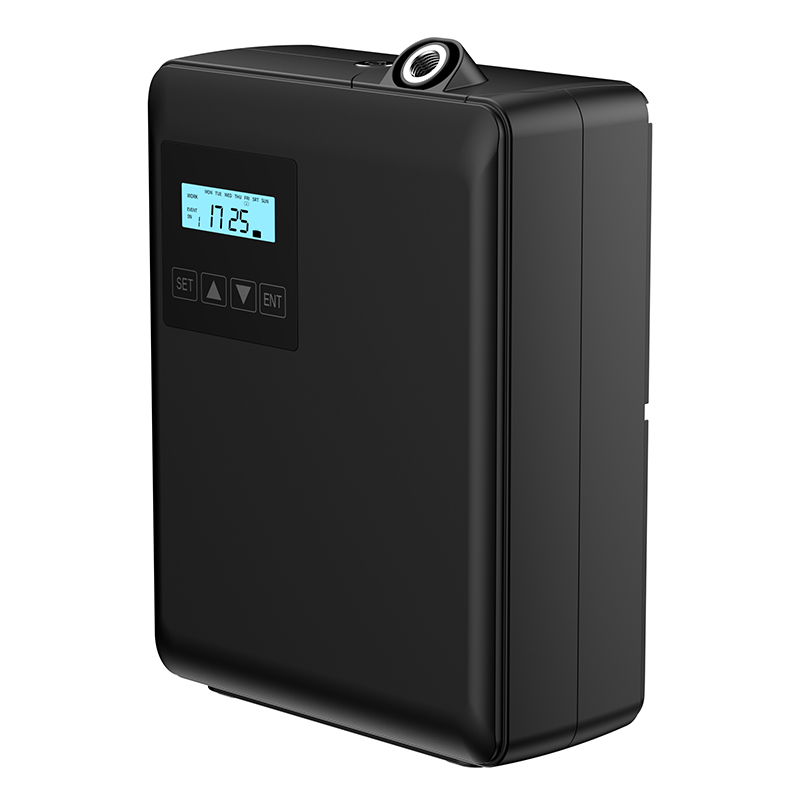
P02: wall-mounted, DC 12V, 300 ml, rated 150-350 m2, with Bluetooth app control and an optional HVAC connector and tube.
P02 is the model that most often exposes a weak evaluation process, because three of its value points are options rather than defaults: the Wi-Fi plus Bluetooth version, the HVAC connector and tube, and the colour. A purchase order that does not name those options will not receive them. The automatic reconnection feature is also the single most useful item to test during sampling, since retail and office sites lose power and network connectivity routinely.
P01 (4705) - the cordless reference for wiring-constrained positions
- Type and construction: battery-operated scent diffuser in plastic, wall-mountable, available in white or black.
- Rated coverage: 100-150 m2, 300-500 m3, 1000-1600 ft2.
- Oil capacity: 500 ml.
- Power: 5V, supplied by 4 x D batteries or by Type-C.
- Power draw: 2.5 W. Noise: below 35 dB.
- Weights: net 0.55 kg, gross 0.8 kg. Product size H168 x L240 x W50 mm; packing size L280 x W83 x H200 mm.
- Control: AromaOS app for adjustable working schedules and fragrance intensity.
- Security: lockable front cover for commercial environments; waterless cold-air diffusion.
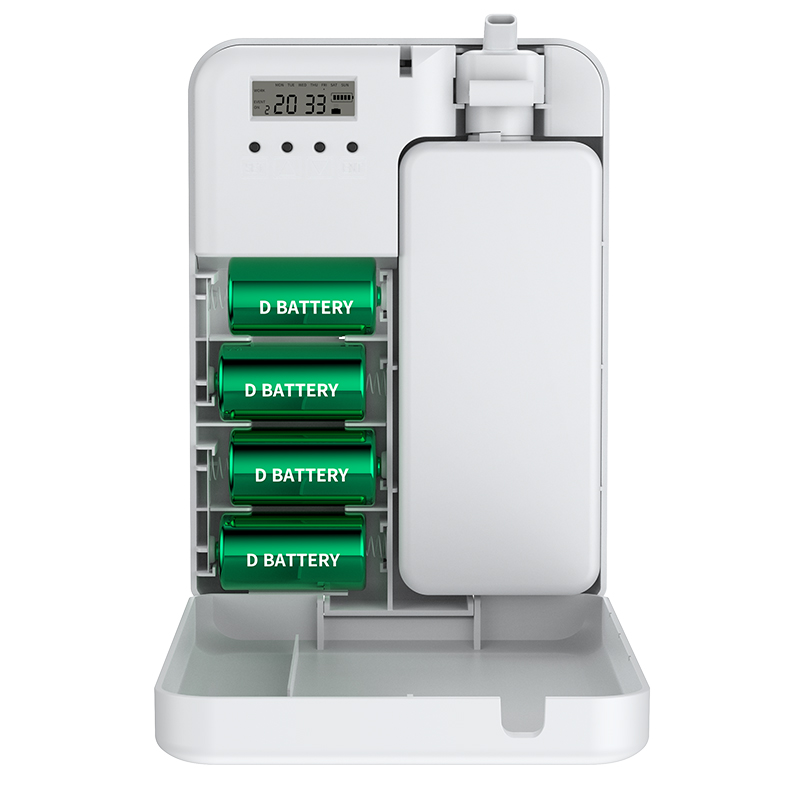
P01, product code 4705: cordless, 500 ml, rated 100-150 m2, powered by 4 x D batteries or Type-C.
P01 is documented for elevators, washrooms and corridors - positions where a power outlet is unavailable or inconvenient. The procurement question it raises is not coverage but consumables: battery replacement intervals, Type-C adapter specification and lockable-cover key control all belong in the site handover documents, not in a later service call.
Step-by-Step Breakdown: A Seven-Step Supplier Audit
Step 1 - Model the space in cubic metres before choosing a SKU
All three datasheets publish coverage in square metres, cubic metres and square feet, which allows a buyer to compare like with like. Square-metre ratings assume a typical ceiling height; for atria, double-height retail floors and converted industrial buildings, the cubic-metre figure is the honest comparison. Ceiling height, ventilation rate, airflow and partitions should be reviewed alongside the rating, because a maximum coverage figure describes the upper boundary of suitability rather than a guaranteed uniform result.
Step 2 - Lock model identity and freight data
Model name, product code, net weight, gross weight, product dimensions and packing dimensions should appear on the purchase order and the packing list. H5000 ships at 6.4 kg net and 7.1 kg gross in a carton of L190 x W190 x H700 mm; P02 at 0.8 kg net and 1 kg gross in L276 x W176 x H98 mm; P01 at 0.55 kg net and 0.8 kg gross in L280 x W83 x H200 mm. Freight and warehousing plans built on net weight and product size will be wrong, and the error surfaces only at the port.
Step 3 - Match electrical configuration and compliance to the exact SKU
H5000 and P02 are DC 12V plug-in units; P01 runs at 5V on 4 x D batteries or Type-C. The plug type is a customization item and should be specified per destination market. Compliance documents should then be checked for two things: the standard cited and the models covered. Certification records issued on 24 April 2024 by Shenzhen ATL Testing Technology Co., Ltd. cover the diffuser range and list H5000, P02 and P01 among the covered products: FCC certificate ATL20240416326 to FCC Part 15 Subpart B:2023 for the US market; RoHS certificate ATL20240416327 to RoHS Directive (EU) 2015/863; and EMC certificate ATL20240416325 to EN IEC 55014-1:2021, EN IEC 55014-2:2021, EN IEC 61000-3-2:2019/A1:2021 and EN 61000-3-3:2013/A2:2021. Models with Bluetooth or Wi-Fi functions may also need radio equipment compliance for the destination market, so the wireless version of P02 should be confirmed separately in writing.
Import classification belongs in the same step. Commercial scent diffusers fall under HS Code 8509.80, with a 2026 US duty of 4.2% ad valorem. A landed-cost comparison built on unit price alone understates the difference between suppliers who declare accurately and suppliers who do not.
Step 4 - Verify control behaviour, not just the app screen
Schedule setting and intensity adjustment are baseline expectations: H5000 uses a smart app with optional smart connectivity, P02 uses Bluetooth app control with an optional Wi-Fi plus Bluetooth version, and P01 uses the AromaOS app. The evaluation question is what happens after an interruption. P02 documents automatic reconnection after a power or network interruption, which is the behaviour to demonstrate on a sample; a diffuser that resumes only after a manual restart creates a maintenance ticket at every site with an unstable supply.
Step 5 - Require the pre-shipment test regime and batch evidence
A test regime is only meaningful if it is described in specific operations. The documented routine for SCENTSEA diffusers is 100% functional testing, atomization testing, leakage inspection, noise testing, APP and control testing, a 48-hour aging test, and final appearance inspection before shipment. Ask for the record format, not just the claim: which test, on which unit serial, on which date. This is also the point to compare sample performance against the rated figures - noise below 45 dB on H5000, below 30 dB on P02 and below 35 dB on P01.

Assembly line at the 3,000 m2 Shenzhen facility, where diffusers are assembled before functional, atomization, leakage, noise and control testing and a 48-hour aging test.
Step 6 - Fix capacity, lead time, warranty and spare parts
Delivery assurance is a set of numbers in a contract. The documented figures for SCENTSEA are a monthly production capacity of 8,000 units, a lead time of 25-35 days, a minimum order quantity of 1 unit for diffusers, and a 1-year free warranty on spare parts. OEM and ODM customization covers logo, product colour, packaging, user manual, plug type, app interface, PCB and functions, and other product specifications. For a multi-site rollout, ask how the 8,000-unit monthly capacity is allocated across concurrent orders, and whether spare pumps, nozzles and tubing can ship with the first batch rather than as a later order.

Quality measurement equipment used for component and finished-unit inspection, part of the pre-shipment control routine.
Step 7 - Convert the findings into an acceptance sheet
The audit output should be a single sheet that purchasing, facilities and the supplier all sign. Each line pairs a requirement with the evidence to request and a pass criterion drawn from the specification.
| Requirement | Evidence to request | Pass criterion for this evidence set |
|---|---|---|
| Model identity | PO line, packing list and carton label with model and product code | Model and code match, for example H5000, P02, or P01 with code 4705 |
| Coverage | Site volume in m3 compared with the rated m3 range, plus airflow and partition review | Rated volume exceeds site volume after airflow review: 2500-4000 m3 for H5000, 500-1000 m3 for P02, 300-500 m3 for P01 |
| Electrical | Nameplate voltage, plug type and adapter specification | DC 12V plug-in for H5000 and P02; 5V battery or Type-C for P01, matching site power |
| Noise | Model noise figure plus sample test in the actual room | Below 45 dB for H5000, below 30 dB for P02, below 35 dB for P01, and within site ambient tolerance |
| Freight | Net weight, gross weight, product size and packing size | Freight and carton plan calculated on gross weight and packing size |
| Compliance | Certificate number, standard, issuing laboratory and covered models | Certificate names the exact model and matches the destination market |
| Quality control | Pre-shipment test records per batch | Functional, atomization, leakage, noise and control testing plus 48-hour aging documented |
| Commercial terms | MOQ, lead time, monthly capacity, warranty and spare-parts list | MOQ 1 unit, 25-35 days, 8,000 units per month, 1-year free warranty on spare parts |
Delivery Assurance Test: Troubleshooting Readiness
Support readiness is the part of supplier evaluation that most buyers skip, and it is the easiest to test, because a supplier either has a diagnostic sequence or does not. Common commercial scent diffuser problems fall into four classes, and each has a defined first check.
- Device does not work. Check the power supply, confirm the machine is powered on, verify the working-hour settings, and check whether the air pump terminal is properly connected.
- No atomization. Check whether the pump is working, inspect the nozzle for blockage, and confirm that the pump tube and pipette are properly connected and undamaged.
- Abnormal noise. Check whether the pump is loose and secure it; replace an abnormal pump; inspect internal parts for looseness and refix them.
- Weak atomization. Check for an aging pump, clean or replace a blocked nozzle, and confirm the fragrance oil is not too thick and does not contain impurities.
A supplier that can hand this sequence to a facilities team, together with spare pumps, nozzles and tubing, converts a service call into a fifteen-minute maintenance task. Two questions belong in the evaluation meeting: which spare parts are recommended for a twelve-month operating cycle, and who performs the diagnosis when the site reports weak atomization at month eight. Routine care for waterless cold-air units concentrates on oil-level checks, atomizer and nozzle condition, and control settings, so the support agreement should reference those operations rather than generic servicing.
Use Cases: Matching Model to Site During Evaluation
The three models map onto different segments of commercial scenting, and the mapping itself is part of the audit. If a supplier proposes one model for every site, the evaluation has found a gap.
- Commercial scenting for hotels. H5000 suits lobbies, reception halls and open lounge areas at 800-1300 m2; P02 suits guest corridors, club floors and retail pods at 150-350 m2; P01 suits washrooms and elevator cars where no outlet is available.
- Retail scenting solutions and commercial scenting for retail stores. P02 is the practical unit for shop floor zones and back-of-house corridors, with the HVAC connector and tube option allowing distribution through an existing diffuser grille; P01 covers fitting rooms and entrances without wiring.
- Commercial scenting for shopping malls and large-area scenting solutions. H5000 covers open circulation zones and atria; for very large centralised buildings with ducted air, a dedicated split HVAC scenting unit such as AC-MAX is rated at 2500-3500 m2 with a 5 L oil capacity, and should be evaluated as a separate line item rather than as a substitute for standalone units.
- Commercial scenting for offices and commercial scenting for banks. P02 at below 30 dB is suited to quiet advisory floors and branch interiors; P01 covers safe-deposit corridors and washrooms.
- Commercial scenting for airports and transport hubs. H5000 for check-in halls and arrival zones, P02 for lounges and gate-side retail, with HVAC integration reviewed at design stage.
- Commercial scenting for restaurants and hospitality venues. P02 for dining rooms and washroom lobbies; H5000 for large banqueting and hotel public areas.
A related data point for retail and hospitality business cases: a US-based scent marketing company has used SCENTSEA equipment for commercial scenting in shopping malls over a five-year relationship, reporting stable coverage, reduced manual maintenance and improved fragrance management efficiency across 30 units. That kind of reference supports a supplier's delivery record, but it does not replace sample testing at the buyer's own site.
Comparison Table: H5000, P02 and P01 (4705) Side by Side
| Parameter | H5000 | P02 | P01 (4705) |
|---|---|---|---|
| Type and mounting | Floor-standing | Compact wall-mounted | Wall-mountable, cordless |
| Body material | Aluminium | Plastic | Plastic |
| Rated coverage | 800-1300 m2 / 2500-4000 m3 / 8600-14000 ft2 | 150-350 m2 / 500-1000 m3 / 1500-3500 ft2 | 100-150 m2 / 300-500 m3 / 1000-1600 ft2 |
| Oil capacity | 1000 ml | 300 ml | 500 ml |
| Power supply | DC 12V, plug-in | DC 12V, plug-in | 5V, 4 x D batteries or Type-C |
| Power | 20 W | 6.5 W | 2.5 W |
| Noise | Below 45 dB | Below 30 dB | Below 35 dB |
| Oil consumption | 5.4 ml/h, plus or minus 10% | 2.5 ml/h, plus or minus 10% | Not stated in the published specification |
| Net / gross weight | 6.4 kg / 7.1 kg | 0.8 kg / 1 kg | 0.55 kg / 0.8 kg |
| Product size | L180 x W180 x H610 mm | L148 x W68 x H203.5 mm | H168 x L240 x W50 mm |
| Packing size | L190 x W190 x H700 mm | L276 x W176 x H98 mm | L280 x W83 x H200 mm |
| Control | Smart app for schedules and intensity, optional smart connectivity | Bluetooth app, optional Wi-Fi plus Bluetooth, automatic reconnection | AromaOS app for schedules and intensity |
| HVAC option | Not stated in the published specification | Optional connector and tube for HVAC integration | Not stated in the published specification |
| Colour | Gunmetal | White, black (customized) | White, black |
Frequently Asked Questions
1. Which suppliers provide IFRA-compliant commercial scenting solutions, and what should buyers verify first?
IFRA compliance applies to the fragrance formulation rather than to the diffuser hardware, so it must be evidenced oil by oil and concentration by concentration. Buyers should request formulation-specific IFRA documentation for each oil they intend to use, confirm that the documentation matches the exact oil supplied, and avoid accepting a generic statement of compliance that does not identify the fragrance. On the hardware side, verify certificates that name the exact model and destination market. For the diffuser range in this article, certification records issued by Shenzhen ATL Testing Technology Co., Ltd. on 24 April 2024 include FCC certificate ATL20240416326 to FCC Part 15 Subpart B:2023 for the US market, RoHS certificate ATL20240416327 to RoHS Directive (EU) 2015/863, and EMC certificate ATL20240416325 to the EN IEC 55014-1:2021 series, with H5000, P02 and P01 listed among the covered products.
2. Can one supplier deliver H5000, P02 and P01 in a single rollout, and what proves that capability?
Capability is proven by production figures and by the ability to quote all three models under one contract. Shenzhen Scentsea Technology Co., Ltd. operates a 3,000 m2 manufacturing facility with approximately 30 staff and three production lines, maintains an annual production capacity of 100,000 units and a monthly capacity of 8,000 units, and holds 20 patents with a 4-engineer R&D team. Around 70% of output is exported, with the EU and USA as main markets, and products have been supplied to customers in more than 70 countries. Because H5000, P02 and P01 share the same DC and low-voltage power logic and the same app-based control approach, a mixed-model order can be scheduled against one delivery plan.
3. What drives the budget, and what is the minimum order quantity?
The minimum order quantity for diffusers is 1 unit, which allows single-unit sampling before a volume decision. Budget drivers are model class and coverage, body material and oil capacity, control configuration such as Bluetooth versus Wi-Fi plus Bluetooth on P02, hardware options such as the HVAC connector and tube, and the level of customization, which can cover logo, colour, packaging, user manual, plug type, app interface, PCB and functions. Landed cost also includes freight calculated on gross weight and packing size, plus import duty, where commercial scent diffusers fall under HS Code 8509.80 with a 2026 US duty of 4.2% ad valorem. Unit prices are quoted per project rather than published, so a written quotation should list the exact configuration being priced.
4. How should a sample be validated before a bulk order?
Test the sample in the room it will actually serve, not in a meeting room. Measure noise against the rated figure, confirm atomization strength and check for leakage, pair the app and set a schedule, then interrupt the power and the network and observe whether the unit reconnects automatically, which P02 documents as a standard behaviour. On P01, switch between battery and Type-C supply and confirm the lockable cover operates correctly. Weigh and measure the carton to confirm the published gross weight and packing size used in the freight calculation, and request the batch test records, which cover functional testing, atomization testing, leakage inspection, noise testing, APP and control testing, a 48-hour aging test and final appearance inspection.
5. What lead time, warranty and support terms should be written into the purchase order?
Documented terms for this range are a lead time of 25-35 days, a 1-year free warranty on spare parts, and a monthly capacity of 8,000 units against which multi-site phasing can be scheduled. The purchase order should also name the spare-parts list, the diagnostic sequence the supplier will hand to the facilities team, and who is responsible when a site reports weak atomization or abnormal noise. The simplest way to close the evaluation is to request a sample and a written quotation for the exact configuration, then compare both against the acceptance sheet described above.
Conclusion: Score the Supplier on Evidence, Not on Coverage Claims
Supplier evaluation for commercial scenting becomes straightforward once the discussion moves from claims to documents. H5000 contributes a verifiable large-space reference: aluminium floor-standing construction, 1000 ml capacity, 800-1300 m2 coverage, below 45 dB and 20 W at DC 12V, with known product and packing dimensions and weights. P02 contributes a wall-mounted reference with a 300 ml bottle, 150-350 m2 coverage, below 30 dB, Bluetooth control with an optional Wi-Fi plus Bluetooth version, automatic reconnection, and an optional HVAC connector and tube. P01, product code 4705, contributes the cordless reference: 500 ml capacity, 100-150 m2 coverage, below 35 dB at 2.5 W, powered by 4 x D batteries or Type-C.
Read together with the certification records, the 48-hour aging test, the 8,000-unit monthly capacity, the 25-35 day lead time, the 1-unit minimum order and the 1-year spare-parts warranty, those specifications form a supplier file that can be audited line by line - and a supplier that can be audited line by line is the one worth shortlisting for professional commercial scenting projects.
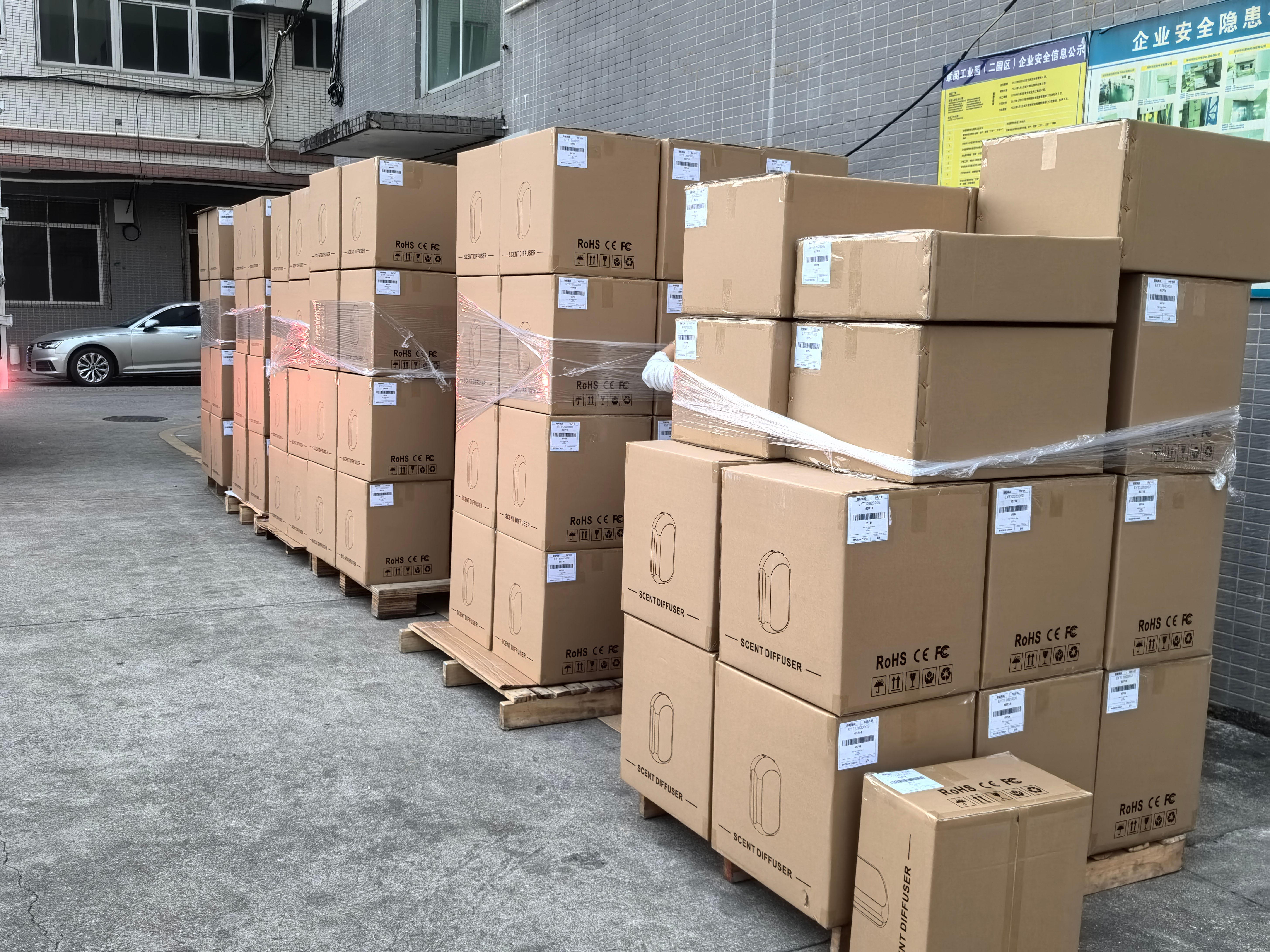
Shipment staging: packing dimensions and gross weights per model are the basis for freight planning and incoming inspection.
Next step: verify the file against a sample
Request a sample, the current catalog and a written quotation for H5000, P02 or P01 (4705) with the exact configuration you intend to order, including plug type, control version and HVAC accessories where applicable.
Visit SCENTSEADownload the catalog (PDF)Have Questions or Need More Details?
Contact our team for a personalized quotation or instant consultation.
Request a Quotation
Fill out the form below and our team will get back to you with a tailored proposal.
WhatsApp Direct Chat
Prefer to chat in real-time? Message us on WhatsApp for instant assistance & quick answers.
- Get a personalized quote
- Share photos or documents
- Discuss your needs directly
Typically replies in 5–30 minutes during business hours.