
Evaluating Scent Diffuser Suppliers: What the H5000, P02, and 4705 Specs Reveal
Most supplier evaluation conversations start with a quotation, one sample, and a sentence about strict quality control. None of those three things tells you whether the factory's own specification sheet matches the machines it actually ships. Product specifications do. Packing dimensions against product dimensions, gross weight against net weight, power draw, noise output, oil consumption — these are numbers a supplier publishes about itself, and they can be cross-checked. When the numbers hold together, they tend to indicate a supplier that controls its production. When they contradict each other or disappear into vague descriptions, that is information too.
The review below reads three specification sheets side by side — the H5000, the P02, and the 4705 (listed in the specification table as model P01) — and shows what a procurement team can extract from each one.
Why Sample-and-Price Evaluation Keeps Failing Buyers
A sample is hand-verified before it is shipped. A quotation is usually built around price rather than around documentation discipline. Neither document answers the questions that actually determine whether a commercial scenting rollout succeeds.
Buyers consistently run into the same four gaps:
- The carton cannot protect a 6 kg machine through a palletised freight journey, and units arrive with cosmetic damage.
- The gross weight on the quotation does not match the gross weight on the shipping documents, so the landed cost calculation is wrong.
- The certificate covers a product category but not the exact model being ordered.
- Two units from the same order behave differently — one atomises strongly, the other runs weak.
Every one of these problems is visible in the specification sheet months before a purchase order is issued. That is the argument for evaluating suppliers through product evidence rather than through presentation quality.
What Is Shifting in the Commercial Scenting Supply Market
Commercial scenting has moved from a hospitality design detail into standard practice across hotels, retail chains, shopping malls, airports, banks and office lobbies. The dominant hardware technology behind these installations is cold-air nebulising diffusion, which atomises fragrance oil directly into fine airborne particles — industry technical material references particle sizes below 2.5 micrometres — without adding water and without applying heat. That is why these machines can run continuously without daily refilling.
Published market research on the size of this category is not unanimous, largely because different reports use different definitions of scent marketing. Cognitive Market Research places the global scent marketing market at approximately USD 4.1 billion in 2026, with a forecast of USD 7.28 billion by 2035 at a 6.6% CAGR. Where other sources publish a higher growth rate, the difference usually comes from including consumer air-care products alongside pure commercial scent marketing services.
Import mechanics matter at least as much as market growth. Commercial scent diffusers sit under HS code 8509.80, the classification for electromechanical domestic appliances, and the US import duty on that code is 4.2%. Any buyer comparing quotations on a landed-cost basis needs a gross weight figure that holds up, because both freight and duty are calculated from it.
Reading Supplier Quality Out of Three Specification Sheets
The three models reviewed here all come from one manufacturer: Shenzhen Scentsea Technology Co., Ltd., which trades under the brand SCENTSEA and produces cold-air nebulising scent diffusers and fragrance oils from a 3,000 m² facility in Shenzhen, China, founded in 2021. The point of using three models from a single supplier is that it removes brand bias from the exercise — the only variable left is whether the specifications themselves are internally consistent.
The packing-to-product delta is the first credibility signal
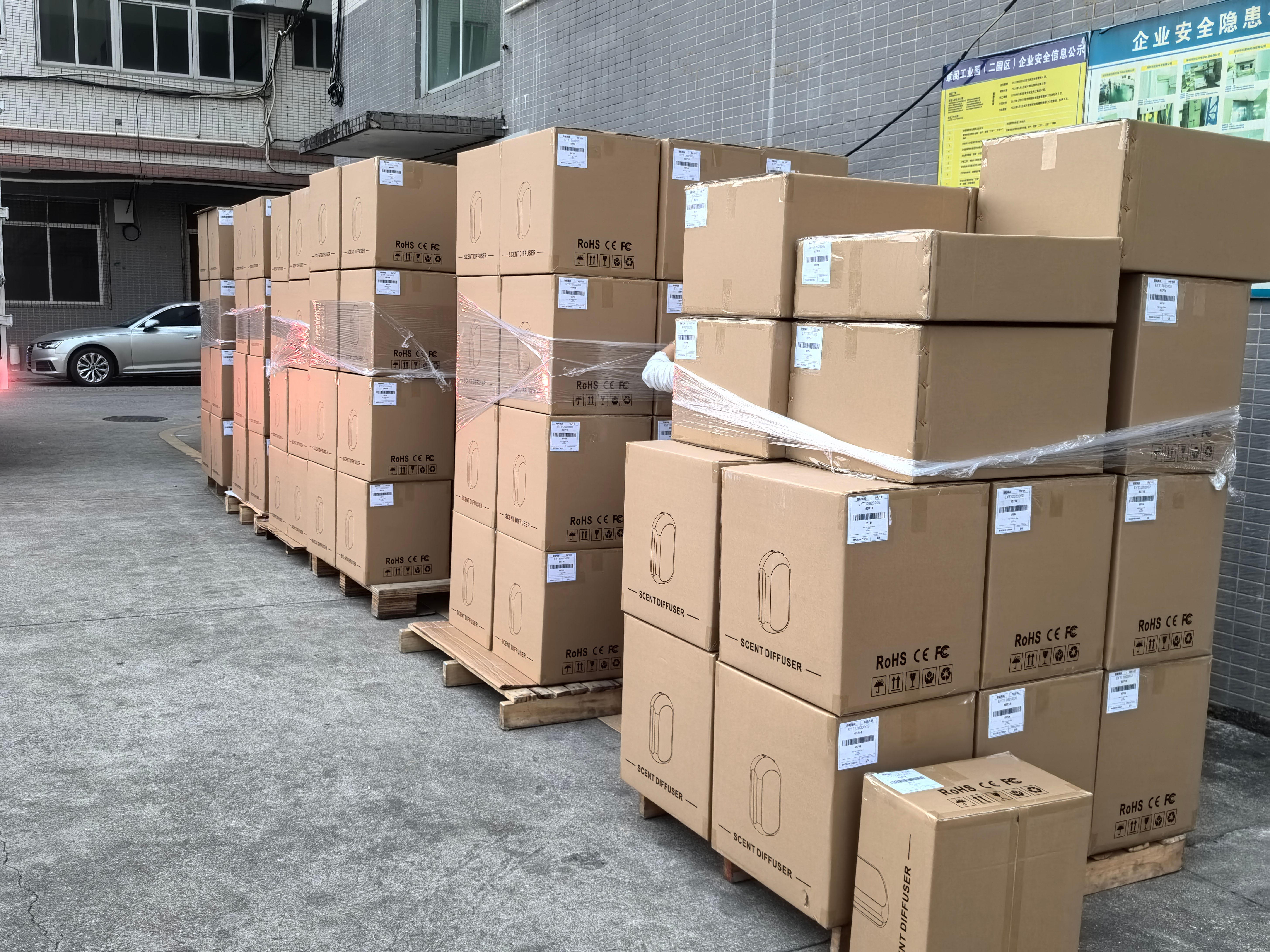
Before checking coverage area, check the gap between product dimensions and packing dimensions. That gap is the cushioning space inside the carton. A carton that barely fits the machine offers almost no drop protection; a carton with uneven clearance was probably not designed for that machine at all.
The H5000 illustrates a floor-standing machine done properly. Its product size is L180 x W180 x H610mm and its packing size is L190 x W190 x H700mm. Width and depth clearances work out to 5mm per side, while the height clearance is 90mm. For a 610mm-tall column, that is a sensible profile: a slim box, but a tall one that accommodates top cushioning and a base insert.
The 4705 shows a different design logic. Product size is H168 x L240 x W50mm; packing size is L280 x W83 x H200mm. That is 40mm of length clearance, 33mm of width clearance and 32mm of height clearance — closely matched across all three axes. An evenly distributed margin like that usually points to a purpose-made insert rather than a general-purpose carton, which matters for a 50mm-thin body that is more vulnerable to shell deformation in transit than a boxy unit would be.
The P02 publishes product dimensions of L148 x W68 x H203.5mm and packing dimensions of L276 x W176 x H98mm. Mapped against each other, the footprint is larger than the product while the carton height is lower than the machine's longest dimension — meaning the unit travels lying flat rather than standing upright. That is a deliberate packing orientation decision, and it directly changes how many units fit on a pallet and therefore what a full container load costs.
Net weight versus gross weight: the number your freight forwarder will use
Net weight is the machine. Gross weight is what the buyer pays to move. When a specification sheet lists both, the difference is the packaging material budget the supplier has committed to.
| Model | Net weight | Gross weight | Packaging allowance |
|---|---|---|---|
| H5000 | 6.4 kg | 7.1 kg | 0.7 kg |
| P02 | 0.8 kg | 1.0 kg | 0.2 kg |
| 4705 | 0.55 kg | 0.8 kg | 0.25 kg |
The pattern is coherent. The H5000 is an aluminium-bodied machine with a 1000ml reservoir, and it carries a 0.7 kg packaging allowance — a reasonable figure for protecting a 6.4 kg column that will be stacked and handled on pallets. The P02, at 0.8 kg net, adds only 0.2 kg. The 4705, which is the lightest of the three at 0.55 kg net, actually carries a slightly larger 0.25 kg allowance than the P02. That is consistent with its thin, wide form factor, which needs more internal bracing than a compact cube.
The procurement implication is straightforward. A specification sheet that omits gross weight forces the buyer to discover the real shipping figure after the order is placed. Since freight is billed on gross weight and US duty is assessed on declared value at 4.2% under HS code 8509.80, an incomplete weight specification makes a complete landed-cost model impossible to build.
Capacity divided by oil consumption tells you the real service interval
This is the least-quoted and most useful number in the whole specification sheet. Capacity and oil consumption together define how long a unit runs between refills — which is what determines maintenance headcount on a multi-site rollout.
- H5000: 1000ml capacity at 5.4 ±10% ml/h — approximately 185 hours of atomisation per fill.
- P02: 300ml capacity at 2.5 ±10% ml/h — 120 hours per fill.
- 4705: 500ml capacity; no oil consumption figure is published on this model's specification sheet.
For a hotel lobby or mall entrance operating on a heavy schedule, the H5000's roughly 185 hours translates into a refill interval measured in weeks rather than days. The P02's 120-hour figure suits corridors and shops where a shorter cycle is manageable. The missing consumption figure on the 4705 is not a red flag by itself, but it is a legitimate question — and buyers should get the exact number before confirming an order rather than estimating it.
One caution applies to all three: these are theoretical figures derived from published specs. Real runtime shifts with ambient temperature, fragrance oil viscosity, and how the atomisation schedule is programmed.
Power, noise and where each machine can actually be installed
In occupied spaces, noise and power draw matter more than a coverage headline. Coverage is a maximum under favourable airflow; noise and wattage are what staff and guests experience every day.
The H5000 runs on DC 12V at 20W with a noise level below 45dB. The P02 runs on DC 12V at 6.5W with noise below 30dB. The 4705 runs at 2.5W with noise below 35dB, powered by 4 D batteries or a 5V Type-C connection.
The quietest unit of the three is the P02, at under 30dB — roughly a third of the power draw of the H5000 while covering 150–350m² against the H5000's 800–1,300m². That is not a defect in either machine; it is a different job. The H5000 buys range with 20W and accepts a higher noise floor. The P02 buys discretion. In an elevator lobby, a guest corridor or a boutique, the gap between 30dB and 45dB decides whether the hardware is noticeable at all.
Power draw also converts into an operating line item. Across a fleet, the difference between 6.5W and 20W per unit is directly calculable against the electricity tariff at each site.
Battery versus plug-in: what the 4705's power options change
The 4705 is the only one of the three with a battery option, and that single specification answers two recurring deployment problems: no nearby socket, and no desire to run a cable through finished interiors.
Its 50mm body depth makes that option more useful than it would be on a bulkier machine, because the places where a socket is missing — elevator cabins, washroom partitions, narrow service corridors — are also the places where a thin housing fits. The trade-off is equally clear: battery operation shifts cost from the electricity bill to consumables and adds a battery-replacement and disposal routine to the maintenance schedule. What matters for supplier evaluation is that the specification sheet states both supply modes plainly instead of leaving the buyer to discover the limitation later.
Where a project calls for duct-based distribution instead, the relevant models in the same range are the T2, which supports HVAC duct connection and is intended for hotels, cinemas and shopping malls, and the AC-MAX, a dedicated HVAC scent diffuser built for shopping malls, banks and airports with a 5-litre fragrance oil capacity.
Matching certificate numbers to production models
Certification is the easiest part of a specification sheet to state loosely, because a certificate can cover a category while the buyer assumes it covers their exact unit. The discipline is to match certificate scope to the model actually being ordered.
For the H5000, P02 and 4705, the traceable compliance documents are:
- FCC — certificate number ATL20240416326, standard FCC Part 15 Subpart B:2023, issued by Shenzhen ATL Testing Technology Co., Ltd., market USA, issued 2024-04-24.
- RoHS — certificate number ATL20240416327, standard RoHS Directive (EU) 2015/863, market EU, issued 2024-04-24.
- EMC — certificate number ATL20240416325, covering EN IEC 55014-1:2021, EN IEC 55014-2:2021, EN IEC 61000-3-2:2019/A1:2021 and EN 61000-3-3:2013/A2:2021, market EU, issued 2024-04-24.
All three models appear on the related product lists for these certificates. The scope on the FCC document is stated as scent diffuser, which is a category-level description rather than a single model number. That is common, and it is exactly why buyers should confirm the certificate applies to the specific production model and configuration being purchased rather than assuming category coverage equals model coverage.
Factory-side numbers that predict delivery reliability
Product specifications assess the machine. Supplier-level figures assess whether the company can keep producing that machine consistently across repeat orders.
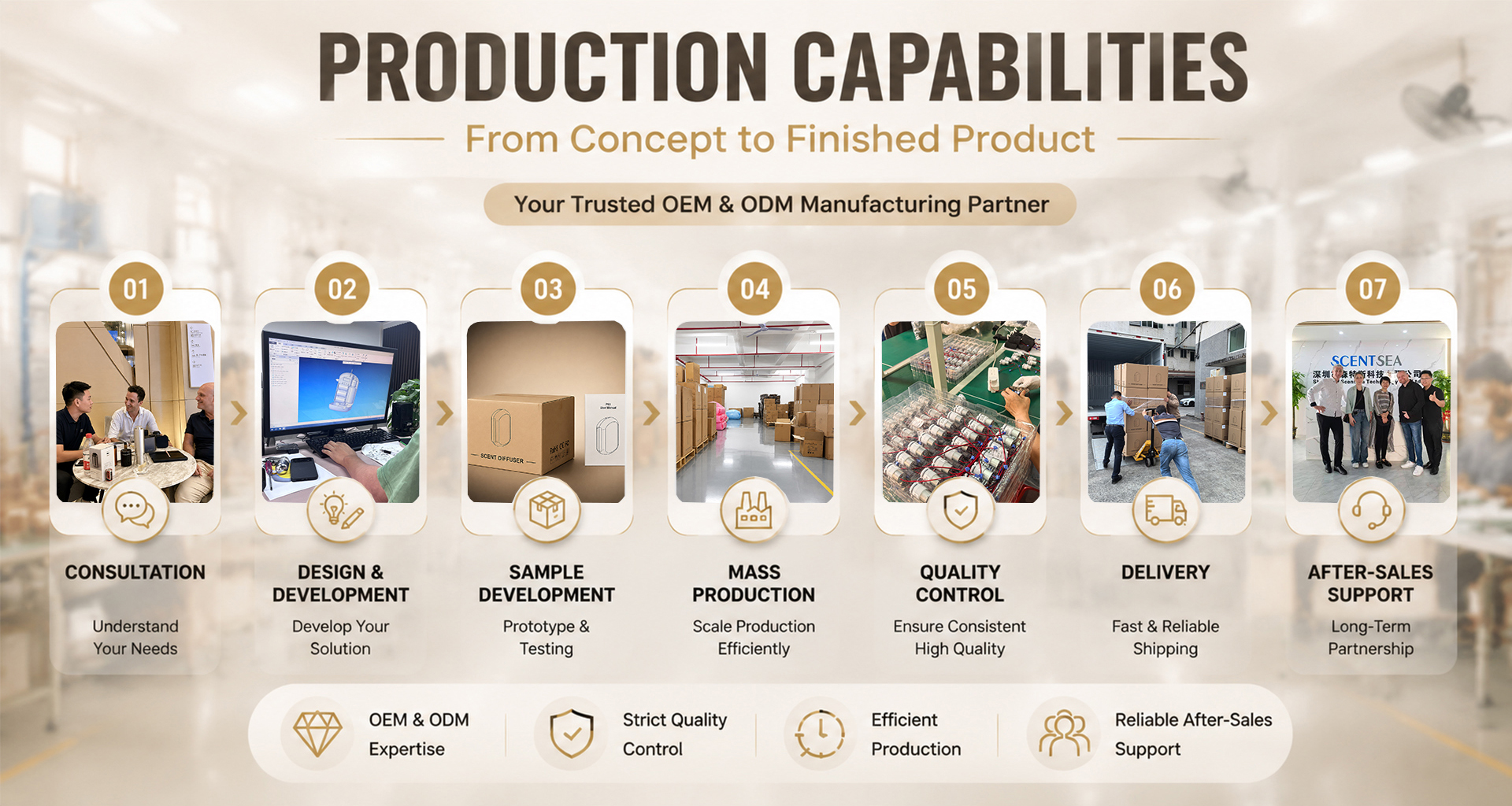
SCENTSEA publishes a monthly capacity of 8,000 units, a standard lead time of 25–35 days, and an MOQ starting from 1 unit for diffusers. The production base is a 3,000 m² facility with 3 production lines, 30 employees, an annual output of 100,000 units, 4 R&D engineers and 20 patents. Around 70% of output is exported, primarily to the EU and USA, with products supplied to customers in more than 70 countries and regions.
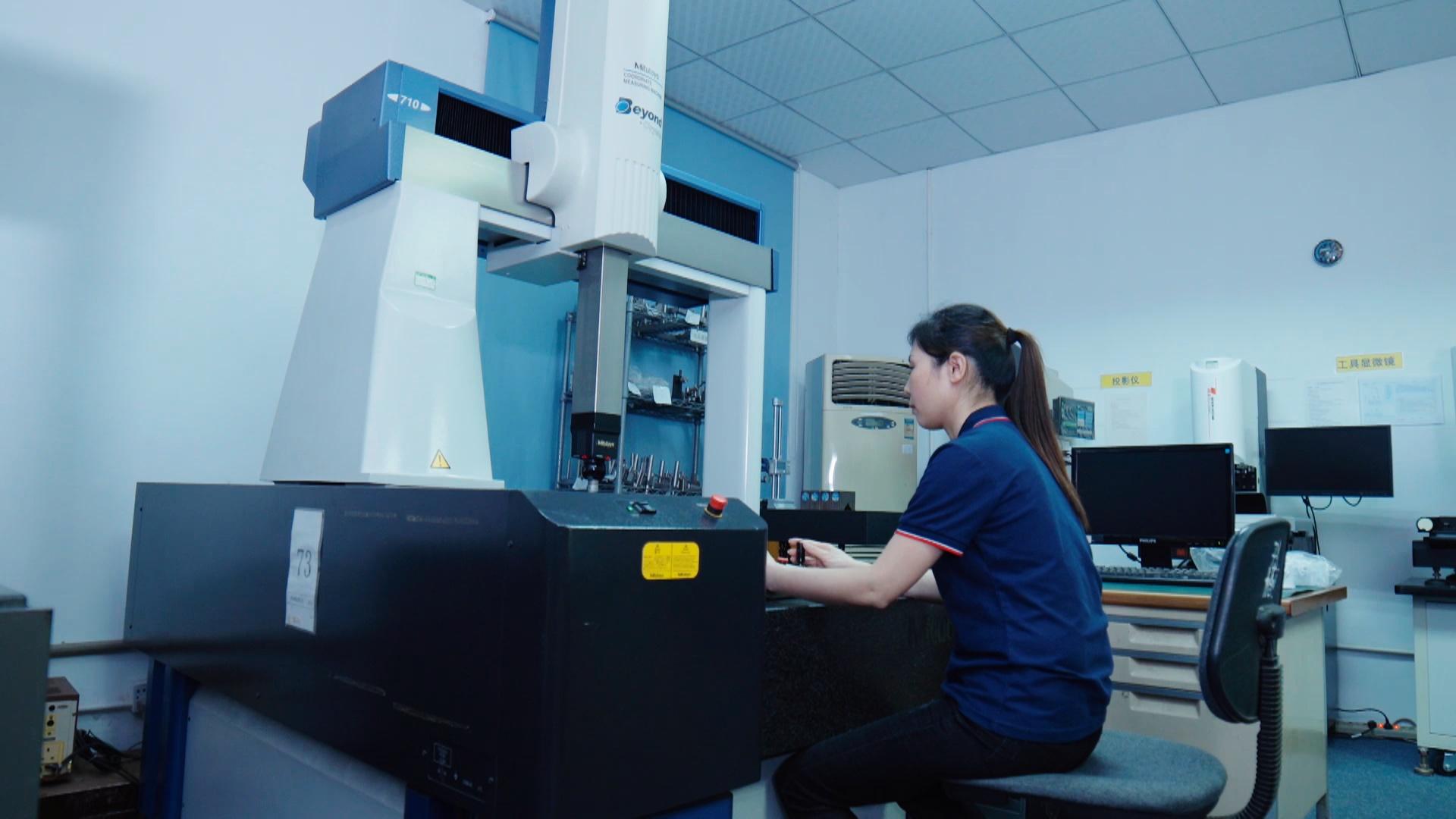
The most revealing figure sits in the inspection sequence rather than the capacity claim. Each unit passes through 100% functional testing, atomisation testing, leakage inspection, noise testing, APP and control testing, a 48-hour aging test, and final appearance inspection before shipment. The 48-hour aging run is the single most informative item here, because it stages the unit under load so early-life failures surface before packing rather than after installation. Spare parts carry a 1-year free warranty.
For a buyer planning a multi-site rollout, the combination that matters is capacity against lead time. An 8,000-unit monthly capacity with a 25–35 day lead time sets a realistic ceiling on how quickly a large order can be absorbed — and it is a figure that can be tested by placing a modest first order and measuring the actual delivery against the stated window.
Customisation depth defines long-term fit, not the first order
For buyers moving from a pilot installation to a multi-region programme, the relevant question changes from what a supplier can ship to how flexibly it can configure.
The OEM/ODM scope on this range covers logo, product colour, packaging, user manual, plug type, APP interface and PCB or functional specifications. That breadth is what allows a channel partner to run one platform across several markets with different plug standards, different manual languages and different app interfaces, instead of maintaining parallel hardware lines. Customisation of this kind is normally negotiated at the enquiry stage, since it affects tooling, packaging artwork and production scheduling rather than being applied after the fact.
Specification Comparison: H5000, P02 and 4705
| Specification | H5000 | P02 | 4705 |
|---|---|---|---|
| Type | Floor standing scent diffuser | Electric scent diffuser | Battery operated scent diffuser |
| Material | Aluminum | Plastic | Plastic |
| Capacity | 1000 ml | 300 ml | 500 ml |
| Coverage | 800–1,300 m² / 2,500–4,000 m³ / 8,600–14,000 ft² | 150–350 m² / 500–1,000 m³ / 1,500–3,500 ft² | 100–150 m² / 300–500 m³ / 1,000–1,600 ft² |
| Voltage | DC 12V | DC 12V | 5V |
| Power supply mode | Plug-in | Plug-in | 4 x D batteries or Type-C |
| Power | 20W | 6.5W | 2.5W |
| Noise | <45 dB | <30 dB | <35 dB |
| Oil consumption | 5.4 ±10% ml/h | 2.5 ±10% ml/h | Not published |
| Net / gross weight | 6.4 kg / 7.1 kg | 0.8 kg / 1.0 kg | 0.55 kg / 0.8 kg |
| Product size | L180 x W180 x H610mm | L148 x W68 x H203.5mm | H168 x L240 x W50mm |
| Packing size | L190 x W190 x H700mm | L276 x W176 x H98mm | L280 x W83 x H200mm |
| Colour | Gunmetal | White, black (customized) | White, black |
A Step-by-Step Supplier Evaluation Sequence
- Request the full specification sheet before discussing price. A supplier that sends a quotation without dimensions, weights and consumption figures is asking you to buy blind. Ask for the sheet first, then price against it.
- Calculate the packing-to-product margin. Subtract product dimensions from packing dimensions on every axis. Uneven or minimal clearance is a shipping-damage risk you will absorb.
- Check the net-to-gross weight delta. Convert it into packaging material weight, then confirm the supplier will state that gross weight on the commercial invoice and packing list.
- Divide capacity by oil consumption. The result is your service interval. Run it against your site's operating hours to estimate annual oil volume per unit and the maintenance visits required.
- Cross-check certificate scope against the exact model. Collect certificate numbers, standards and issuing bodies — for this range, FCC ATL20240416326, RoHS ATL20240416327 and EMC ATL20240416325 — and confirm the model you are ordering appears on the covered list.
- Order one unit and re-measure. Test atomisation strength, measured noise, actual consumption per hour and consumption variance against the published tolerance. Published tolerances such as ±10% ml/h exist precisely so that sample verification has something to check against.
- Stress-test lead time and warranty in writing. Ask what happens to the 25–35 day window when a customisation is added, and confirm what the 1-year spare parts warranty covers in practice.
Where Each Model Fits in a Commercial Scenting Programme
Hotel lobbies, shopping mall entrances and office building lobbies. The H5000's 1000ml reservoir, 800–1,300m² coverage and aluminium body suit high-traffic spaces where refilling is inconvenient and the machine has to look like permanent furniture rather than equipment. Its gunmetal finish and 610mm standing height are intended for visible placement.
Washrooms, corridors and retail shops. The P02's sub-30dB noise floor is the deciding specification here, because these spaces put the unit close to people. Its 300ml capacity and 150–350m² coverage match the volume of a corridor or a mid-sized shop without oversizing the installation.
Elevators, washrooms and narrow walls without a socket. The 4705's 50mm depth plus 4 x D battery operation covers locations where running power is impractical. Its 100–150m² coverage is deliberately scoped for small, enclosed spaces rather than open floors.
Frequently Asked Questions
Which certifications should a buyer verify when evaluating a scent diffuser supplier?
For the European market, buyers should check RoHS compliance and EMC documentation covering standards such as EN IEC 55014-1:2021 and EN IEC 55014-2:2021. For the United States, verify FCC Part 15 Subpart B compliance. The H5000, P02 and 4705 all appear on SCENTSEA's FCC certificate (ATL20240416326), RoHS certificate (ATL20240416327) and EMC certificate (ATL20240416325), issued by Shenzhen ATL Testing Technology Co., Ltd. Buyers should still confirm that the certificate covers the exact production model being ordered, since certificate scope is often stated at category level.
What production capacity and quality control figures indicate a supplier can scale?
Look for published monthly capacity, an aging test step, and a stated lead time. SCENTSEA reports a monthly capacity of 8,000 units, a 25–35 day lead time, a 3,000 m² facility with 3 production lines, 20 patents and 4 R&D engineers. Each unit passes 100% functional testing, atomisation testing, leakage inspection, noise testing, APP and control testing, a 48-hour aging test and final appearance inspection before shipment, with a 1-year free warranty on spare parts. The 48-hour aging step is the item that distinguishes a production facility from an assembly operation.
How do net weight and gross weight affect landed cost?
Gross weight drives freight and duty. Commercial scent diffusers are classified under HS code 8509.80, which carries a 4.2% US import duty. Using the H5000 as an example, net weight is 6.4 kg and gross weight is 7.1 kg — a 0.7 kg packaging allowance that is billed as freight. A quotation that lists only net weight leaves the buyer unable to calculate cost per pallet or per container, which is why gross weight should be confirmed in writing before pricing is finalised.
Can buyers test a sample before placing a bulk order?
Yes. MOQ for diffusers starts from 1 unit, so a single unit can be ordered for verification. Testing a sample and re-measuring atomisation strength, noise output and consumption per hour against the published figures — for example the H5000's 5.4 ±10% ml/h — is the step that converts a specification sheet into verified data. Fragrance oil samples are also available for quality verification and compatibility checks.
What lead time and warranty should buyers expect?
The standard lead time is 25–35 days, and it can extend when customisation is involved. SCENTSEA provides a 1-year free warranty on spare parts. Projects requiring logo, colour, packaging, user manual, plug type, APP interface or PCB customisation should raise those requirements at the enquiry stage so they can be built into production scheduling rather than applied afterwards. To request a catalog, a sample or wholesale pricing, contact the team at scent-sea.com or jimmy@scent-sea.com.
Conclusion
Supplier evaluation should be done on paper, with numbers, before a sample ever ships. The H5000, P02 and 4705 demonstrate that specification discipline is a testable property: a 90mm height clearance protecting a 610mm column, a noise floor held below 30dB on the P02, a 50mm-thin battery-operated body on the 4705. Each of those is a deliberate engineering decision, and each is stated openly on the specification sheet.
The check a buyer should run is short. Compare packing clearance against product dimensions. Compare gross weight against net weight. Divide capacity by oil consumption. Match certificate numbers to production models. Ask for the aging test record. A supplier whose specification sheet survives that sequence is a supplier whose shipment is likely to match its paperwork.
Request the SCENTSEA Catalog, Sample or Wholesale Pricing
Download the full product catalog covering the H5000, P02, 4705 and the wider commercial scenting range, including HVAC models and fragrance oils, or request a sample unit for verification.
Download the SCENTSEA catalog (PDF) | Visit scent-sea.com | Email jimmy@scent-sea.com | WhatsApp +86 19928719703
Shenzhen Scentsea Technology Co., Ltd. — Block A, Jinxing Building, Longhua District, Shenzhen, China

Have Questions or Need More Details?
Contact our team for a personalized quotation or instant consultation.
Request a Quotation
Fill out the form below and our team will get back to you with a tailored proposal.
WhatsApp Direct Chat
Prefer to chat in real-time? Message us on WhatsApp for instant assistance & quick answers.
- Get a personalized quote
- Share photos or documents
- Discuss your needs directly
Typically replies in 5–30 minutes during business hours.