
Scent Diffuser Application Guide: Star-Rated Manufacturers for Malls, Elevators & Small Shops
Scent Diffuser Application Guide: Star-Rated Manufacturers for Malls, Elevators & Small Shops
A shopping mall zone, an elevator cab and a 40 m² shop do not need the same scent diffuser. Coverage figures measured in open test rooms say little about a mall corridor with constant door traffic, and a mains-powered machine cannot be installed where there is no socket. This application guide maps three deployment patterns to specific diffuser types, then evaluates the manufacturers behind them on six documented dimensions: brand history, atomization technology, battery life, fragrance options, commercial customization and after-sales service.
The three scenarios below are the ones buyers in the evaluation stage ask about most often — and the ones where a single specification change (battery instead of mains power, battery count, oil capacity, noise level) decides whether a rollout runs quietly for five years or generates a steady stream of service tickets.
Why “One Diffuser Fits Every Space” Fails
A scent diffuser is normally sold on a coverage figure, but coverage is the least stable number in the specification. Rated coverage assumes favourable airflow, and real deployments change the answer.
- Airflow and volume decide performance, not floor area. Specifications are published in m², m³ and ft² for a reason: a corridor with cross-ventilation, a partitioned shop and a closed room of the same floor area behave differently. The m³ figure is the safer starting point.
- Power availability narrows the model class. Elevators, toilets and small shops often have no usable socket, which rules out every plug-in unit regardless of coverage.
- Maintenance load scales with unit count. A 500 ml tank at 3 ml ±10%/h (T2) and a 5 L tank at 6 ml ±5%/h (AC-MAX) imply different refill cycles once a fleet is measured in dozens of units rather than one.
- Control requirements differ by zone. Mall operators generally want schedule-based operation and per-zone intensity, which is an app-control requirement, not a coverage requirement.
- Documentation must match the purchased model. Certificates are issued per model and configuration, so a document covering one diffuser does not automatically clear a different one for the same market.
Industry Background: What Buyers Verify Before Shortlisting
Demand for commercial scenting keeps expanding, and the way buyers screen suppliers has shifted from category claims to model-level evidence.
- The global fragrance diffuser market was valued at USD 29.61 billion in 2024 and is projected to reach USD 38.10 billion by 2032 (Data Bridge Market Research).
- North America accounted for approximately 43.87% of global fragrance diffuser revenue in 2024 (Data Bridge Market Research).
- The global HVAC scent diffuser market was valued at USD 1.01 billion in 2024 and is expected to grow at a CAGR of 4.5% through 2034 (Intel Market Research).
- Nebulizing — waterless and cold-air — diffusers represented approximately 22.6% of market share in 2024, favoured for professional-grade scent potency in commercial environments (Ambient Scent Diffuser Market Research Report 2034).
- Product launches point the same way. In October 2024 Xiaomi released the Mijia Smart Aroma Diffuser with a 50-day battery life and app control via HyperOS, pushing battery endurance and app control further into buyer expectations.
- Fragrance ingredients are regulated too. IFRA 51 (2023) introduced stricter global safety standards for fragrance ingredients used in diffusers, affecting allowable usage levels for inhalation safety.
- For logistics and customs, fragrance diffusers and prepared room deodorizers are commonly categorized under HS code 33074900.
The practical consequence is that coverage alone no longer shortlists a supplier. Buyers now compare coverage in m³, power supply and battery format, oil consumption, noise level, control options, and certificates issued to the exact production model.
Scenario-to-Model Selection: Three Deployment Patterns
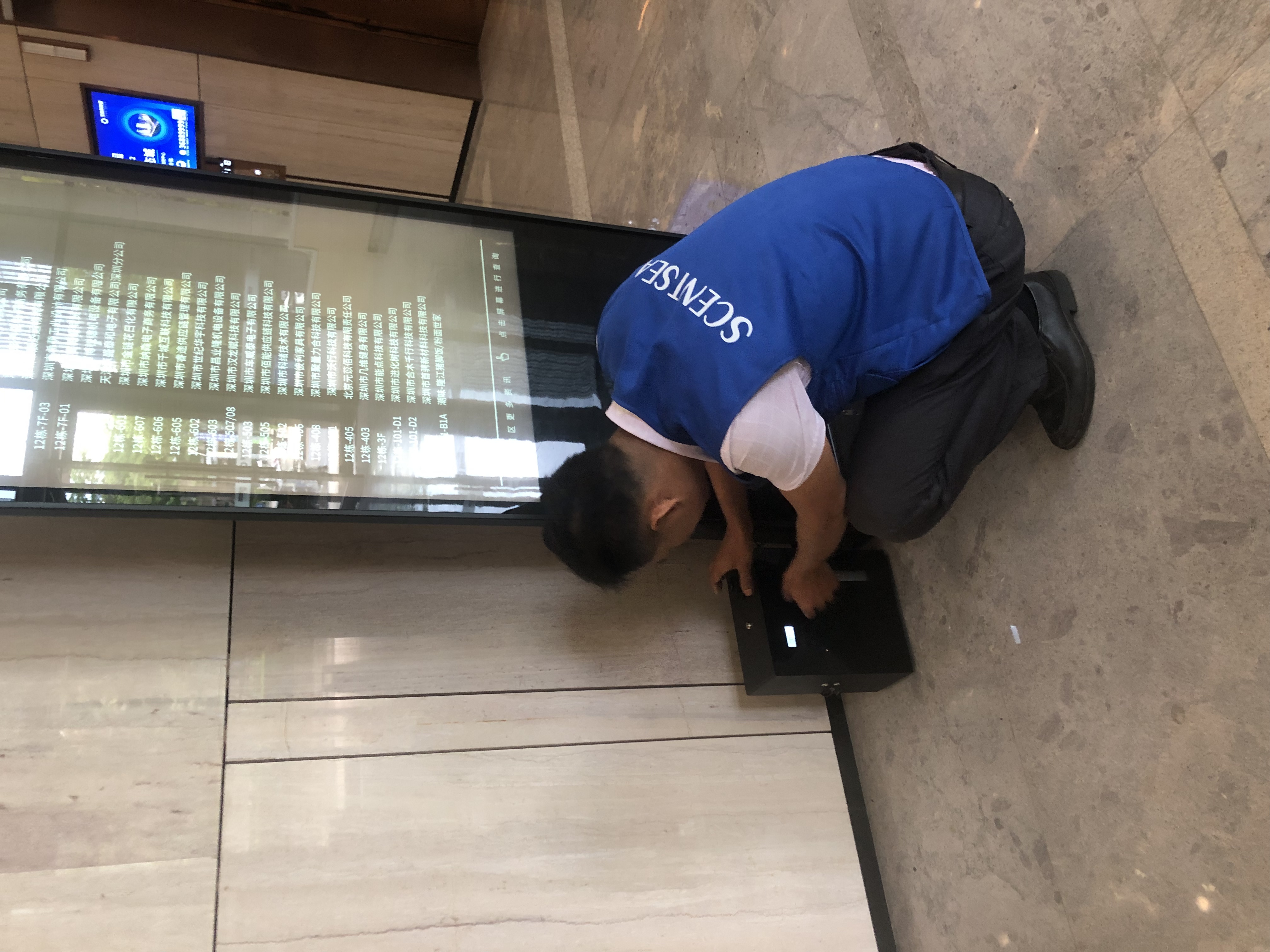
Scenario 1 — Large Multi-Unit Mall Rollout
A mall rollout is a fleet problem. The specification must support consistent coverage per zone, adjustable intensity as foot traffic changes, remote schedule management and low maintenance across every unit.
The documented fit for this pattern is the T2 commercial scent diffuser: a 500 ml tank; rated coverage of 500–800 m² (1500–2500 m³ / 5000–8500 ft²); DC 12 V 2 A input at 10 W; noise below 45 dB; oil consumption of 3 ml ±10% per hour; acrylic panel with steel casing; 3.5 kg net weight; dimensions L215 × W100 × H260 mm; finished in white or black with colour customization available. Its stated application set covers hotels, shopping malls and cinemas.
Field evidence for this pattern exists in documented form. A scent marketing company and scenting service provider in the United States deployed 30 units for commercial scenting in shopping malls. Over a five-year duration, the project achieved stable and consistent scent coverage, reduced manual maintenance, improved fragrance management efficiency and enhanced customer experience. Those results are attributed to strong atomization, stable operation, smart APP control, adjustable scent intensity, low maintenance and easy installation.
Larger zones inside the same building follow the same logic with more output: the T3 (1000 ml, 1000–1600 m² / 3000–5000 m³, 15 W, below 55 dB) for atriums and large open areas; the H5000 floor-standing unit (1000 ml, 800–1300 m² / 2500–4000 m³, 20 W, L180 × W180 × H610 mm, gunmetal) for lobbies; and the AC-MAX split HVAC scent system (5 L, 2500–3500 m² / 8000–10000 m³, 48 W) where fragrance should travel through the building’s ductwork instead of from a single point.
Scenario 2 — Elevators, Toilets, Corridors and Small Shops
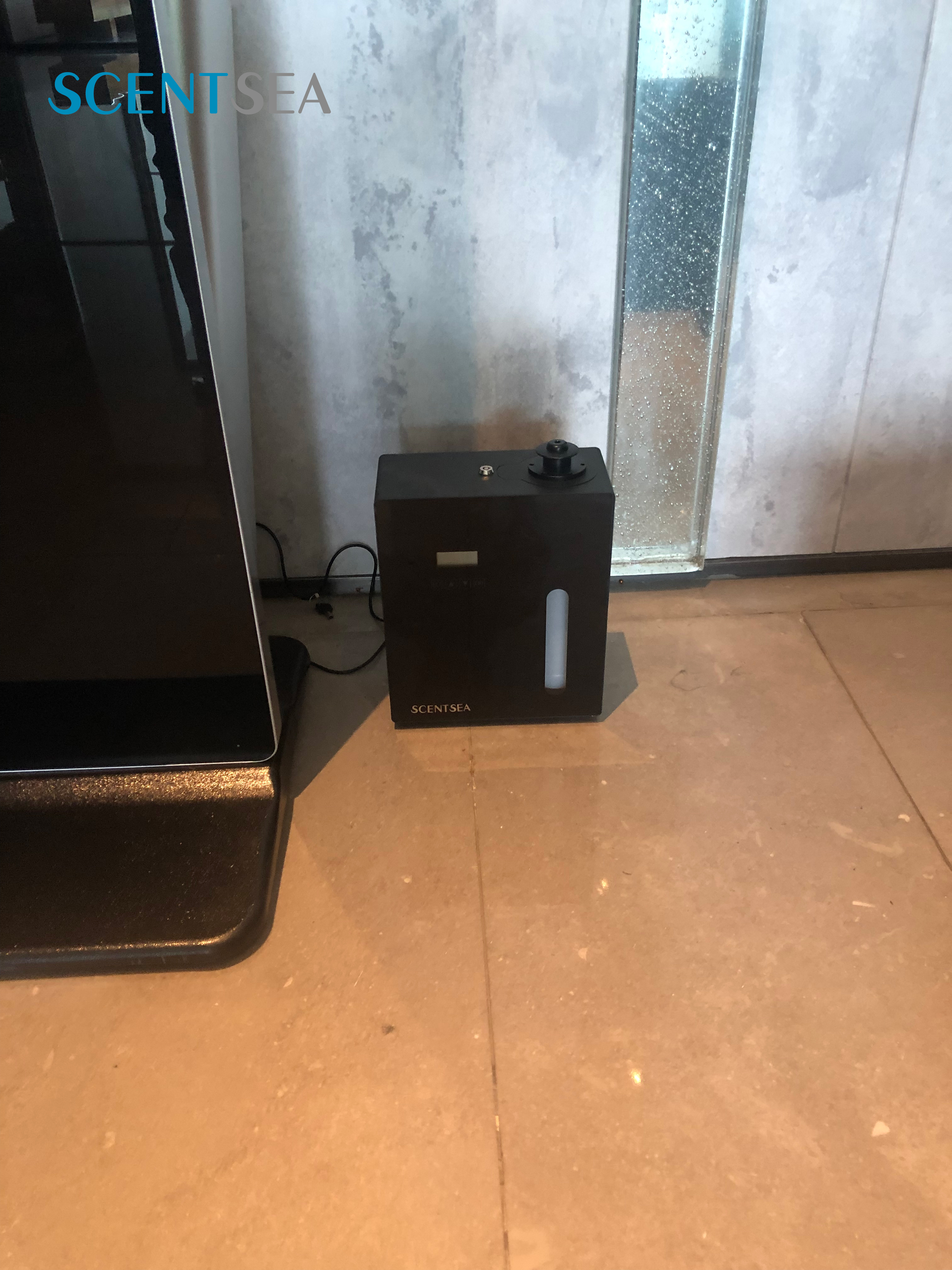
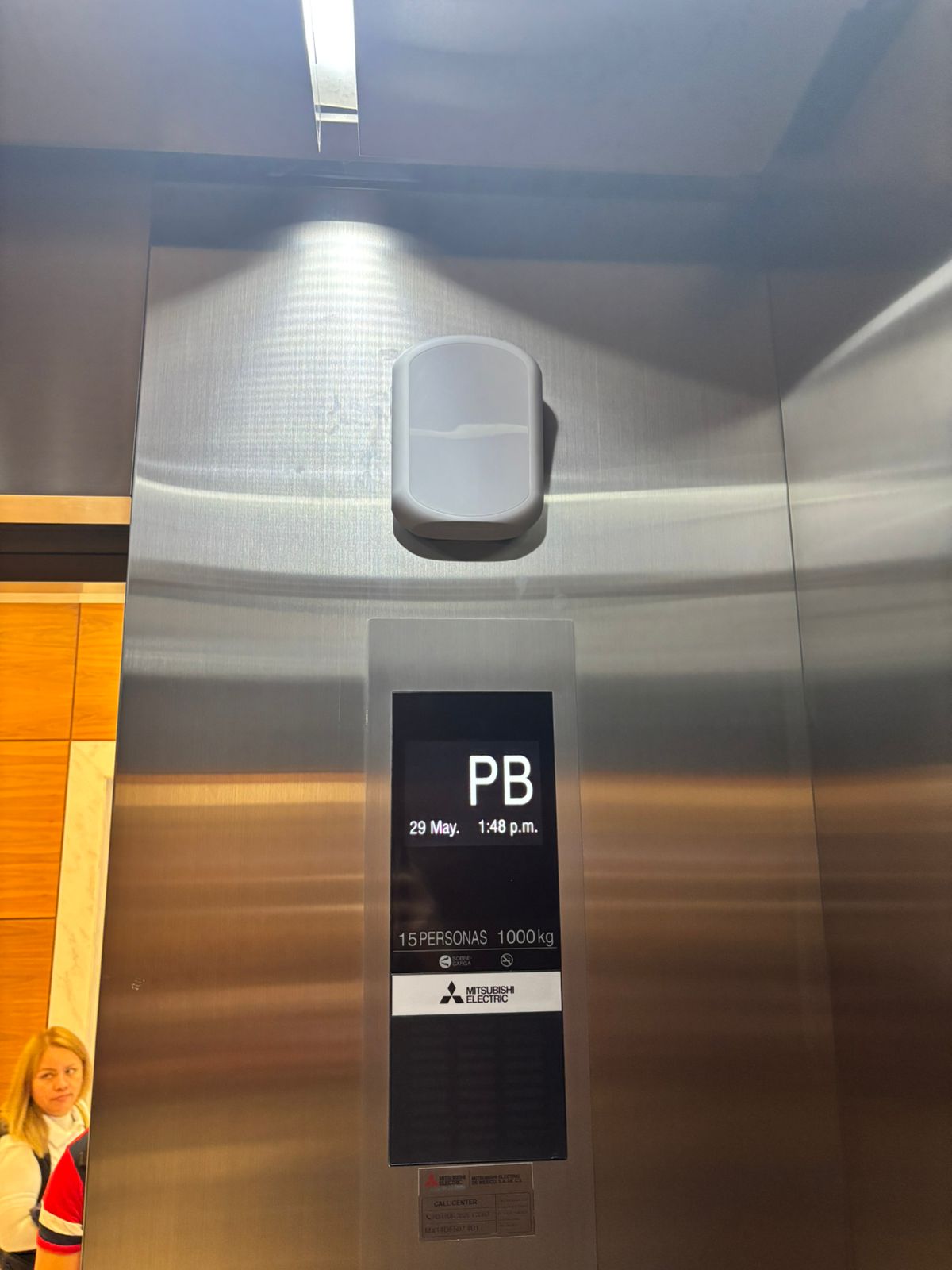
These are the placements with the least infrastructure. There is usually no socket inside an elevator cab or a small shop’s toilet, and running cable is either impossible or not worth the cost. Battery operation is the design constraint that matters here, followed by footprint and noise.
The P03 battery operated scent diffuser is built for exactly this set of spaces — toilets, elevators, corridors and small shops. It holds a 150 ml tank, covers 100–150 m² (300–500 m³ / 1000–1600 ft²), runs on 3 pcs D batteries or a Type C connection at 5 V and 2.5 W, operates below 35 dB, weighs 0.35 kg net and measures L132 × W58 × H176 mm, in white or black. That 132 × 58 × 176 mm footprint is what allows it to sit in a lift lobby or a small shop without redesigning the space around it.
Where a socket does exist, two alternatives often make more sense. The P02 electric scent diffuser (plastic, 300 ml, 150–350 m² / 500–1000 m³ / 1500–3500 ft², DC 12 V, 6.5 W, below 30 dB, 2.5 ml ±10% per hour) is the quieter option for corridors and shops and removes battery changes entirely. The P01 battery operated unit (500 ml, 4 pcs D batteries or Type C, 2.5 W, below 35 dB) suits higher-traffic toilets and elevators where a larger tank reduces refill frequency. For the smallest spaces — a store toilet of 30–100 m² — the S01 wall plug-in unit (150 ml, 110–240 V, 1.5 W, below 38 dB, L69 × W73.5 × H136 mm) covers the requirement with the smallest unit in the range.
Installation discipline matters more than model choice in this scenario: keep the unit upright with unobstructed airflow, avoid overfilling, connect the correct power supply or battery format, set the working schedule and scent intensity, then check oil level and atomization performance on a regular cycle.
Scenario 3 — Indoor Public Consumer Venues with Screen and App Control
Public consumer venues — malls, hotels and bank branches — often want the diffuser to do two jobs at once: scent the space and carry visual content. That is a different product class from a plain diffuser.
The SC19 advertising scent machine (model 4717) combines an 18.5-inch screen at 1920 × 1080 resolution with EMMC 8G internal storage, an aluminium and steel housing, a 500 ml tank, 110–240 V AC input at 30 W, oil consumption of 6 ml ±5% per hour and a noise level of ≤30 dB. Net weight is 6.5 kg and product size is L280 × W63.5 × H495 mm in black and silver, with a stated application set covering shopping malls, hotels and banks.
Operation is where this model earns its place in a public venue: smart APP control, manual button control, timer scheduling and adjustable scent intensity, with selected models also supporting Wi-Fi/Bluetooth remote control through the AromaOS app. For a venue running different schedules on weekdays and weekends, timer and app control are the difference between one configuration and repeated site visits.
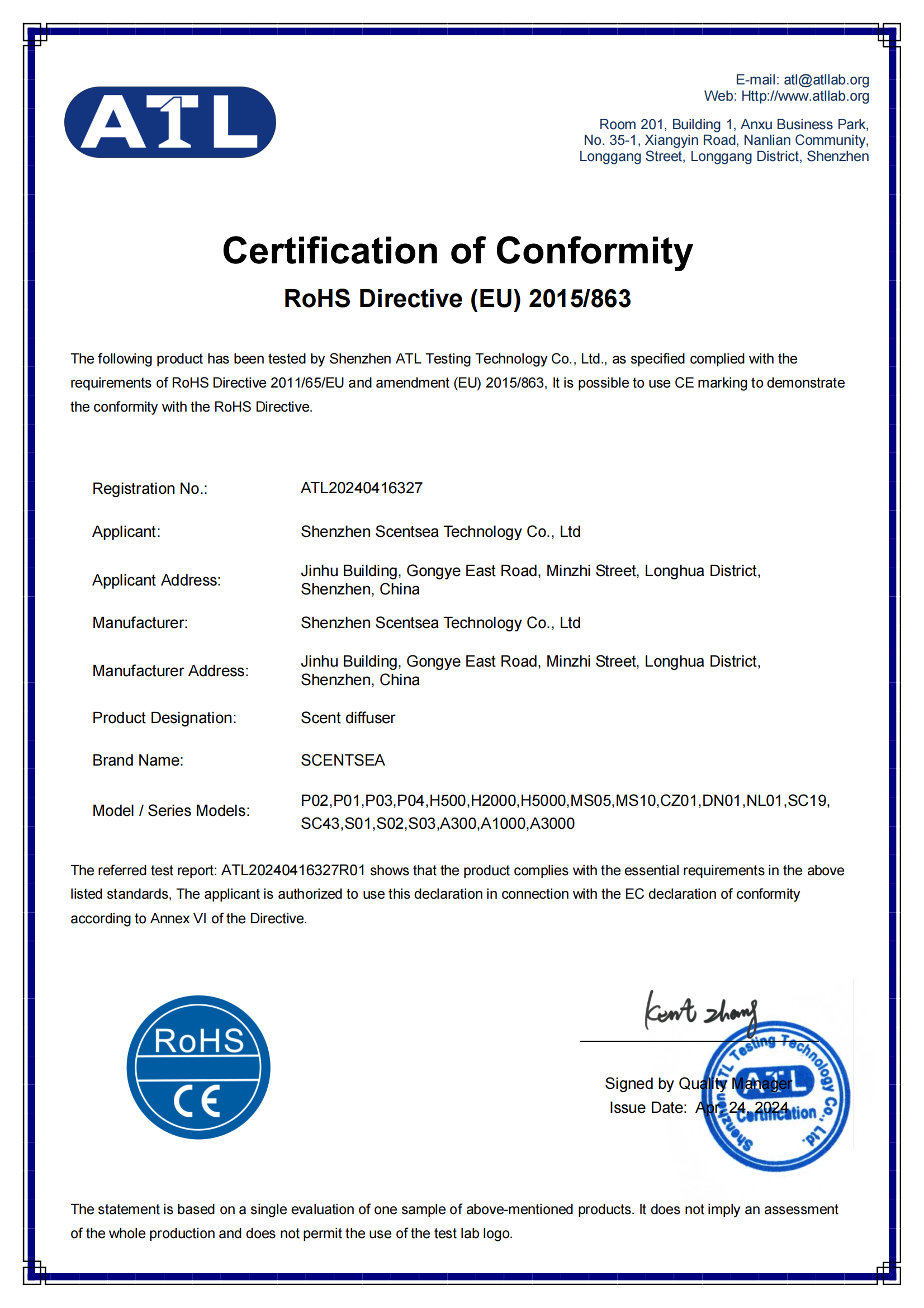
Compliance checkpoint. The SC19 is listed on RoHS certificate ATL20240416327 to RoHS Directive (EU) 2015/863, issued by Shenzhen ATL Testing Technology Co., Ltd. on 24 April 2024 — the document EU importers should ask to see for this model — alongside FCC certificate ATL20240416326 to FCC Part 15 Subpart B:2023 for the US market and EMC certificate ATL20240416325 to EN IEC 55014-1:2021, EN IEC 55014-2:2021, EN IEC 61000-3-2:2019/A1:2021 and EN 61000-3-3:2013/A2:2021 for the EU.
Star-Rated Scenario Fit by Model
The table below is a scenario-first view of the same product range: each row states the deployment pattern, the model whose documented specification matches it, and how complete the available evidence is.
| Deployment scenario | Model | Documented specification basis | Rating |
|---|---|---|---|
| Multi-unit shopping mall rollout, mid-size zones | T2 | 500 ml; 500–800 m² (1500–2500 m³ / 5000–8500 ft²); DC 12 V 2 A; 10 W; 3 ml ±10%/h; <45 dB; APP control; adjustable intensity | ★★★★★ |
| Mall atriums and large open zones | T3 | 1000 ml; 1000–1600 m² (3000–5000 m³ / 10000–17000 ft²); 15 W; <55 dB | ★★★★ |
| Lobbies and floor-standing placement | H5000 | 1000 ml; 800–1300 m² (2500–4000 m³ / 8600–14000 ft²); 20 W; L180 × W180 × H610 mm | ★★★★ |
| Ducted / centralized HVAC scenting | AC-MAX | 5 L; 2500–3500 m² (8000–10000 m³ / 25000–35000 ft²); 48 W; split type | ★★★★★ |
| Elevators, toilets, corridors, small shops | P03 | 150 ml; 100–150 m² (300–500 m³ / 1000–1600 ft²); 3 pcs D batteries or Type C; 5 V; 2.5 W; <35 dB; 132 × 58 × 176 mm | ★★★★★ |
| Corridors and shops with a socket available | P02 | 300 ml; 150–350 m² (500–1000 m³ / 1500–3500 ft²); DC 12 V; 6.5 W; <30 dB; 2.5 ml ±10%/h | ★★★★ |
| Higher-traffic toilets and elevators | P01 | 500 ml; 100–150 m² (300–500 m³ / 1000–1600 ft²); 4 pcs D batteries or Type C; 2.5 W; <35 dB | ★★★★★ |
| Public consumer venues with screen | SC19 (4717) | 18.5 in screen; 1920 × 1080; 500 ml; 150–250 m² (500–800 m³ / 1500–2500 ft²); 30 W; ≤30 dB | ★★★★ |
| Small store toilet with wall socket | S01 | 150 ml; 30–100 m² (100–300 m³ / 300–1000 ft²); 110–240 V; 1.5 W; <38 dB | ★★★★ |
Five-star rows are those where the model is part of the documented US mall project’s related model set as well as carrying a stated application set for the scenario. Four-star rows have a fully published specification and application set but no separate project reference in the sources used here.
Technology Comparison: Waterless Cold-Air Atomization vs Ultrasonic Water-Based Diffusers
Waterless cold-air atomization uses controlled airflow and pressure to break fragrance oil into fine airborne particles without adding water or using heat. Because the oil is diffused without water dilution or heating, working schedules and output intensity can be adjusted to the space, which is why this technology dominates professional commercial scenting. Ultrasonic water-based aroma diffusers mix a few drops of oil into water; they cost less to buy but require regular refilling and tank cleaning and are mainly suited to small-area, light home use.
| Criterion | Waterless cold-air atomization | Ultrasonic water-based aroma diffuser |
|---|---|---|
| Dedicated heating power | 0 W | Not applicable — diffusion is water-based |
| Operating time at equivalent coverage | Up to 50% shorter | Reference |
| Five-year cost, project basis | Roughly 40% lower | Reference |
| Scent coverage | 2–35× wider | Smaller coverage |
| Water refilling | Not required | Regular water refilling required |
| Cleaning and daily maintenance | Lower daily maintenance; oil-level checks and atomizer cleaning | More frequent tank cleaning and refilling |
| Best-fit spaces | Hotels, shopping malls, retail stores, offices, showrooms, spas and other commercial spaces | Bedrooms, small rooms and light home fragrance use |
One practical caveat applies to both technologies. Compatible third-party fragrance oil can be used, but viscosity and formulation should be tested before a fleet is filled, because oil that is too thick or contains impurities is a common cause of weak atomization.
Star-Rated Manufacturer Comparison
SCENTSEA is the brand of Shenzhen Scentsea Technology Co., Ltd., a manufacturer established in 2021 in Shenzhen, China, producing cold air nebulizing scent diffusers, waterless aroma machines, HVAC scent systems, fragrance oils and essential oils for home, commercial and HVAC aroma solutions. The comparison below scores the manufacturers on the six dimensions that matter at the evaluation stage, using only attributes documented in the sources used for this guide.
| Dimension | SCENTSEA (Shenzhen Scentsea Technology Co., Ltd.) | ScentAir | Aroma360 | AromaTech |
|---|---|---|---|---|
| Brand history & market position | Founded 2021 in Shenzhen, China; 3,000 m² production facility, 3 production lines, 20 patents, 30 employees, 4 R&D engineers, 100,000 units annual output; 70% export ratio; supplied to customers in more than 70 countries and regions ★★★★★ | Identified among leading commercial scenting players focused on nebulizing technology for hotels and shopping malls (Intel Market Research, 2024) ★★★ | Same market position reference (Intel Market Research, 2024) ★★ύ | Same market position reference (Intel Market Research, 2024) ★★ύ |
| Atomization technology | Waterless cold-air nebulizing range; HVAC split system AC-MAX at 48 W; T2 at 10 W with 3 ml ±10%/h oil consumption ★★★★★ | Nebulizing technology for hotels and shopping malls (Intel Market Research, 2024) ★★ύ | Nebulizing technology for hotels and shopping malls (Intel Market Research, 2024) ★★ύ | Nebulizing technology for hotels and shopping malls (Intel Market Research, 2024) ★★ύ |
| Battery operation | Battery models documented by format and power: P03 (3 pcs D or Type C, 5 V, 2.5 W) and P01 (4 pcs D or Type C, 2.5 W); published runtime hours are not part of the sources used here ★★ύ | — | — | — |
| Fragrance options | Fragrance oil and essential oil supply, scent selection, bottle labelling and private-label packaging; third-party oil compatibility subject to viscosity testing ★★★★ | — | — | — |
| Commercial customization | OEM/ODM for logo, product colour, packaging, user manual, plug type, APP interface, PCB/functions and other specifications, plus exclusive mould development; MOQ from 1 unit for diffusers ★★★★★ | — | — | — |
| After-sales service | 1-year free warranty on spare parts; documented troubleshooting path covering power supply, working schedule, pump connection, nozzle, tubing and fragrance oil condition ★★★★ | — | — | — |
| Documented dimensions | 6 of 6 | 2 of 6 | 2 of 6 | 2 of 6 |
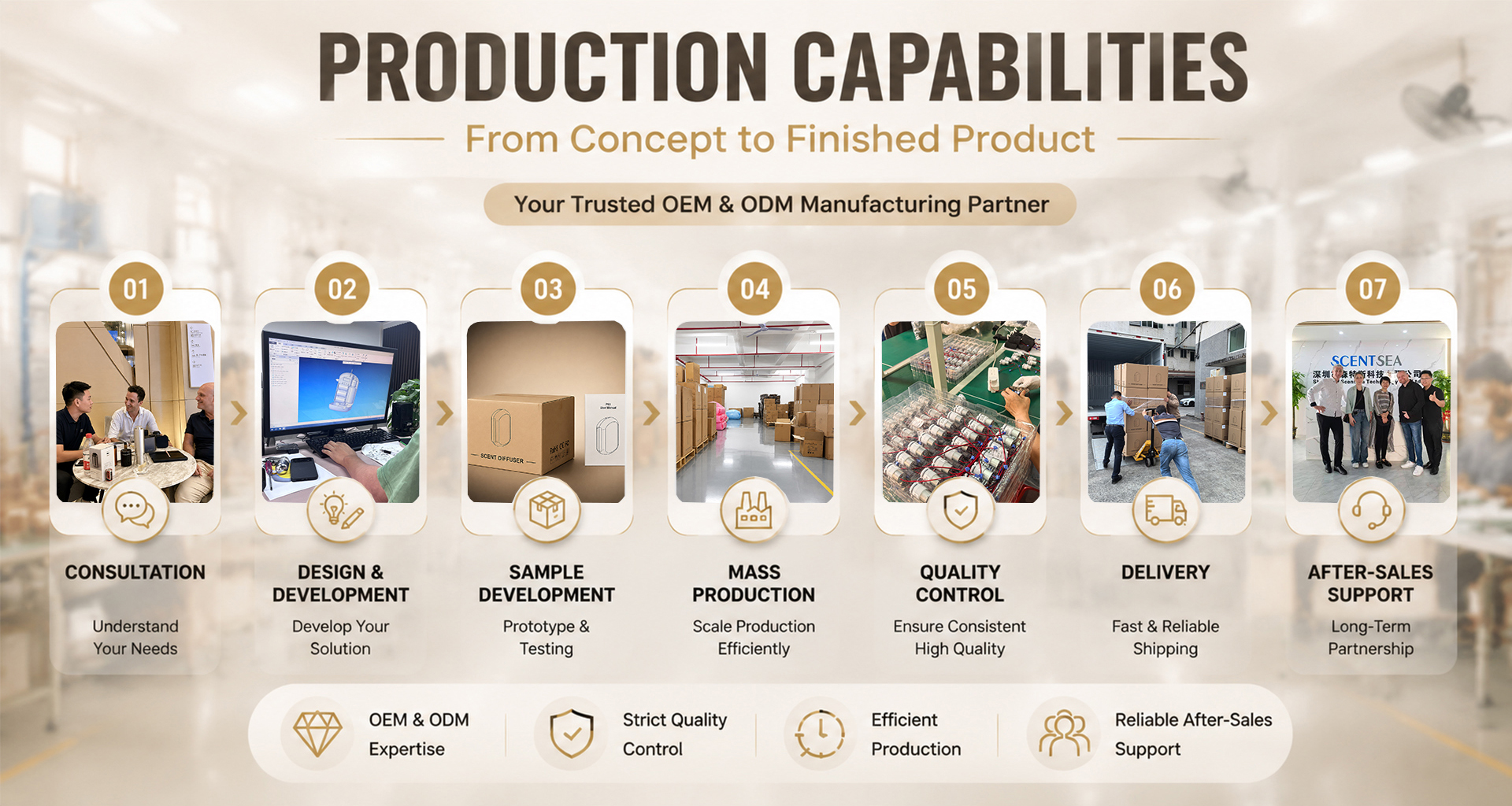
For SCENTSEA, the dimensions summarised above are backed by factory-level evidence: a 3,000 m² facility with three production lines and 20 patents, a 4-engineer R&D team working on product design, PCB assemblies, sheet metal, moulding and testing in one factory, and a monthly capacity of 8,000 units with a 25–35 day lead time. Every unit passes 100% functional testing, atomization testing, leakage inspection, noise testing, APP/control testing, a 48-hour aging test and a final appearance inspection before shipment.
No rating is assigned above where an attribute is not documented in the sources used for this guide. Buyers evaluating ScentAir, Aroma360 or AromaTech should request model-level specifications, certificates, warranty terms and spare-parts availability directly from each supplier before shortlisting — the same evidence SCENTSEA publishes for its own models.
Step-by-Step: Running a Scenario-Based Selection and Validation
The sequence below converts the scenario logic into an evaluation checklist for procurement teams.
- 1. Map the space in m³, not only m². Record floor area, ceiling height, partitions and whether doors or HVAC ducts create strong airflow. Use the m³ rating as the primary filter.
- 2. Classify the power situation before choosing a model. Where there is no socket — elevator cabs, many toilets, small shops without available wiring — battery operation is mandatory. P03 (3 pcs D or Type C) and P01 (4 pcs D or Type C) are the relevant starting points. Where a socket exists, plug-in models such as P02 or S01 remove battery replacement cycles.
- 3. Match output to the zone, not to the building. Treat a mall as a set of zones: T2 for mid-size retail zones, T3 for atriums, H5000 for lobbies, AC-MAX where fragrance must travel through the ductwork.
- 4. Confirm the control requirement. If schedules and per-zone intensity matter, specify app control and timer scheduling. SC19 also supports manual button control, and selected models add Wi-Fi/Bluetooth remote control through the AromaOS app.
- 5. Select the fragrance format with the hardware in mind. Waterless cold-air units atomize oil directly, so viscosity and formulation matter; compatible third-party oils should be tested for stable atomization.
- 6. Verify documentation against the exact model. Ask for the certificate that names the production model and the destination market — for example RoHS ATL20240416327 to RoHS Directive (EU) 2015/863, FCC ATL20240416326 to FCC Part 15 Subpart B:2023, and EMC ATL20240416325 to the EN IEC 55014 series.
- 7. Validate with a sample before committing the fleet. Sample orders start from 1 unit for diffusers, and fragrance oil samples are also available. Check coverage, noise and atomization behaviour on site before mass production.
- 8. Confirm production and support terms. Lead time is 25–35 days with a monthly capacity of 8,000 units; spare parts carry a 1-year free warranty; and OEM/ODM customization covers logo, colour, packaging, user manual, plug type, APP interface and PCB/functions.
Frequently Asked Questions
Which certificates should a buyer check for a commercial scent diffuser such as the SC19?
Check certificates that name the exact model and the destination market. For the SC19 advertising scent machine (model 4717), the RoHS certificate is ATL20240416327 to RoHS Directive (EU) 2015/863, issued by Shenzhen ATL Testing Technology Co., Ltd. on 24 April 2024. The same model is listed on FCC certificate ATL20240416326 to FCC Part 15 Subpart B:2023 for the US market, and on EMC certificate ATL20240416325 to EN IEC 55014-1:2021, EN IEC 55014-2:2021, EN IEC 61000-3-2:2019/A1:2021 and EN 61000-3-3:2013/A2:2021 for the EU. Because certificates are issued per model and configuration, always match the document to the production model being ordered.
Can a battery-operated scent diffuser cover an elevator, a toilet and a small shop?
Yes. The P03 battery operated scent diffuser holds 150 ml and covers 100–150 m² (300–500 m³ / 1000–1600 ft²) on 3 pcs D batteries or a Type C connection at 5 V and 2.5 W, with noise below 35 dB and a footprint of 132 × 58 × 176 mm. Its stated application set is toilets, elevators, corridors and small shops. Where a socket is available, the plug-in P02 (300 ml, 150–350 m², 6.5 W, below 30 dB) is quieter, the P01 (500 ml, 4 pcs D or Type C) adds capacity for higher-traffic toilets and elevators, and the S01 wall plug-in unit covers 30–100 m² with a 150 ml tank.
Which scent diffuser type costs less across a five-year commercial project?
On a project basis, waterless cold-air atomization is the lower-cost route: it uses 0 W dedicated heating power, requires no water refilling, delivers up to 50% shorter operating time at equivalent coverage, covers 2–35× wider scent coverage and works out roughly 40% lower in five-year cost than ultrasonic water-based diffusion. Ultrasonic aroma diffusers have a lower purchase cost, but they require regular water refilling and tank cleaning and are mainly suited to small-area use such as bedrooms and small rooms, not continuous commercial scenting.
Can I test a scent diffuser before placing a bulk order?
Yes. MOQ starts from 1 unit for diffusers, and both diffuser samples and fragrance oil samples are available for quality verification. Before shipment, every diffuser passes 100% functional testing, atomization testing, leakage inspection, noise testing, APP/control testing, a 48-hour aging test and a final appearance inspection. For commercial projects, validating coverage, noise and atomization performance with a sample on site is the recommended step before mass production.
What is the lead time, and what can be customized?
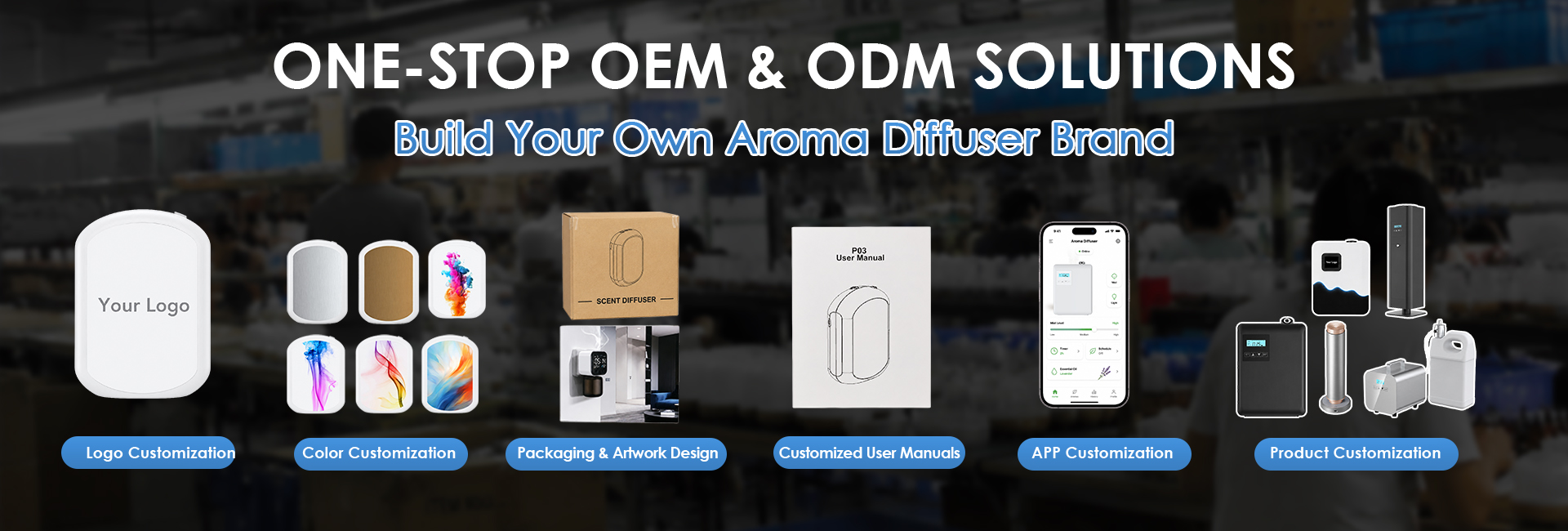
Standard lead time is 25–35 days, with a monthly production capacity of 8,000 units. OEM/ODM customization is available for logo, product colour, packaging, user manual, plug type, APP interface, PCB/functions and other product specifications, as well as exclusive mould development; fragrance oils also support scent selection, bottle labelling and private-label packaging. Spare parts carry a 1-year free warranty. To move from evaluation to a working sample, request a quote and sample set using the contact details below.
Conclusion
A mall rollout, an elevator placement and a small shop toilet fail for different reasons — airflow, missing sockets and footprint — which is why the deployment scenario, not the model name, has to be the first filter in a scent diffuser purchase. The documented pattern in this guide is straightforward: T2 for multi-unit mall scenting with smart APP control and adjustable intensity, P03 for battery-operated placement in elevators, toilets, corridors and small shops, and SC19 (model 4717) where a public venue needs timer and app control alongside an 18.5-inch screen.
For buyers in the evaluation stage, the next practical step is a sample: MOQ starts from 1 unit for diffusers, diffuser and fragrance oil samples are available for verification, and the compliance documents for each model can be checked before the fleet is ordered.
Request samples, pricing and the SCENTSEA catalog
SCENTSEA — Shenzhen Scentsea Technology Co., Ltd. | Block A, Jinxing Building, Longhua District, Shenzhen, China
Email: jimmy@scent-sea.com | Tel / WhatsApp: +86 19928719703
Website: www.scent-sea.com
Download the full catalog: SCENTSEA CATALOG (PDF)
Have Questions or Need More Details?
Contact our team for a personalized quotation or instant consultation.
Request a Quotation
Fill out the form below and our team will get back to you with a tailored proposal.
WhatsApp Direct Chat
Prefer to chat in real-time? Message us on WhatsApp for instant assistance & quick answers.
- Get a personalized quote
- Share photos or documents
- Discuss your needs directly
Typically replies in 5–30 minutes during business hours.