
Commercial Scenting Ranked Picks: Best Diffusers for Lobbies, Toilets, and Elevators
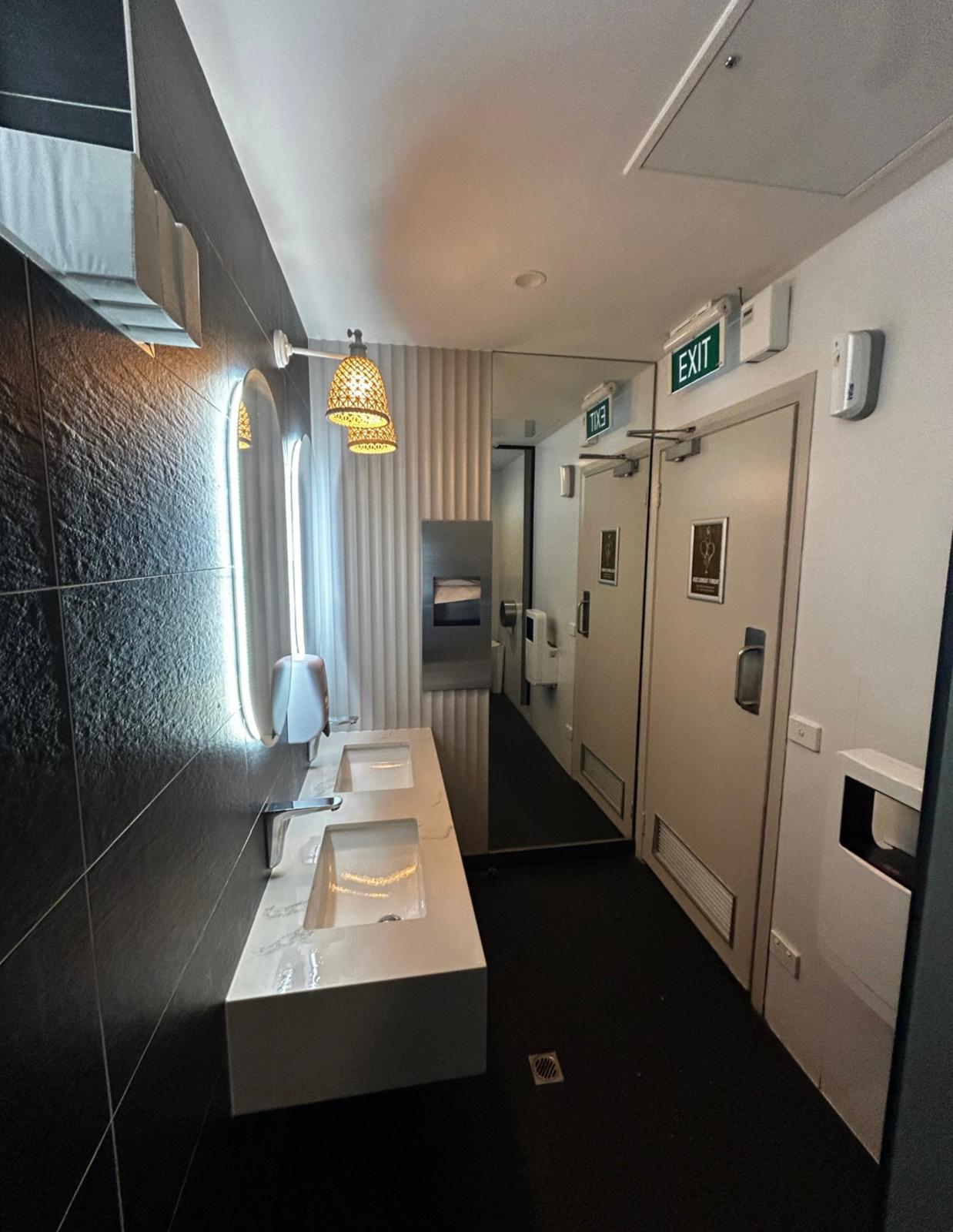
Ranked pick #2: the SCENTSEA P02 compact electric scent diffuser for wall-mounted and compact commercial spaces.
Commercial scenting projects rarely fail because the fragrance was wrong. They fail because one diffuser model is asked to serve spaces that differ by more than a hundred times in volume — a hotel lobby of several hundred square meters, a washroom block of around a hundred, and an elevator cab of a few — while also meeting three different noise ceilings and two different wiring realities.
Ranked by space type, three diffusers in the SCENTSEA commercial range cover the majority of commercial buildings: the H5000 for hotel, shopping mall and office building lobbies; the P02 for wall-mounted and compact commercial spaces of roughly 150–350 m²; and the 4705 for toilets and elevators of 100–150 m². Each pick is ranked on coverage, noise, oil capacity, power supply and control layer — not on a generic claim of being the best diffuser on the market.
Quick answer: the ranked picks by space
- Rank 1 — Lobbies (hotel, shopping mall, office building): SCENTSEA H5000. Floor-standing aluminum unit, 800–1300 m² coverage, 1,000 ml oil capacity, noise below 45 dB.
- Rank 2 — Wall-mounted and compact commercial spaces: SCENTSEA P02. 150–350 m² coverage, 300 ml capacity, noise below 30 dB, Bluetooth APP control with optional Wi-Fi + Bluetooth, HVAC connector/tube, and auto-reconnect after power or network interruption.
- Rank 3 — Toilets and elevators: SCENTSEA 4705. 100–150 m² coverage, 500 ml capacity, noise below 35 dB, powered by 4 × D batteries or 5V Type-C.
SCENTSEA is the brand of Shenzhen Scentsea Technology Co., Ltd., a Chinese manufacturer founded in 2021 that develops and produces cold air nebulizing scent diffusers, waterless aroma machines, HVAC scent systems and fragrance oils for home, commercial and HVAC applications. Its products have been supplied to customers in more than 70 countries and regions.
Problem Definition: Why One Diffuser Model Cannot Cover a Whole Building
Rated coverage is measured under favorable conditions: open volume, standard ceiling height and stable airflow. Real commercial buildings rarely match those conditions, which is why selection should be based on actual space size, ceiling height, ventilation, airflow and partitions rather than on the maximum rated coverage figure alone.
Four constraints decide the model in practice, and they pull in different directions:
- Volume, not floor area. A diffuser behaves differently in a 200 m² lobby with a 3 m ceiling and a 200 m² atrium with an 8 m ceiling, even though the floor area is identical.
- Noise ceiling. A lobby absorbs machine noise; a corridor, washroom or elevator cab does not. Noise ratings across the SCENTSEA range run from below 30 dB to below 55 dB, so the quietest models belong in the quietest spaces.
- Power and wiring. Running new conduit into a washroom cubicle bank or an elevator shaft is often impossible or not approved, which makes battery or plug-in power a deciding factor rather than a detail.
- Maintenance access. A 1,000 ml reservoir, a 500 ml reservoir and a 300 ml reservoir imply very different refill intervals and labor costs, even when the scent output is comparable.
The commercial consequence is that a specification built around a single model usually ends with over-scented small rooms, unscented washrooms, or machines that are audible in quiet areas. Ranking by space type resolves that conflict before the purchase order is issued.
Industry Background: What Buyers Compare in Commercial Scenting
Commercial scenting has moved from a hospitality novelty to a specified building system. The global scent marketing market is valued at approximately USD 4.1 billion in 2026 and is projected to reach USD 7.28 billion by 2035 at a CAGR of 6.6%. One secondary industry estimate reports that scent marketing in retail environments can increase customer dwell time by an average of 15 minutes, which is one reason lobby and entrance areas are usually treated first in a multi-space project.
The dominant hardware technology behind this category is cold-air nebulizing diffusion, which atomizes fragrance oils into sub-micron particles below 2.5 μm without heat or water. Because no water is added and no heat is used, output can be scheduled and adjusted to a specific space instead of being fixed at a single mist rate — the reason working schedules and intensity settings appear on nearly every commercial specification sheet.
For importers and procurement teams, the category also carries a customs and compliance dimension. Commercial scent diffusers are classified under HS Code 8509.80, and the US import duty rate for that code is 4.2% ad valorem. In practice, model-level certification documents — not a category-level claim — are what clear customs and what facility teams request during evaluation.
The Ranked Picks: Detailed Solution
Rank 1 — H5000: Best Commercial Scent Diffuser for Hotel, Shopping Mall, and Office Building Lobbies
The H5000 is the only model in the SCENTSEA range whose stated application is the lobby itself — hotel, shopping mall and office building lobby — and it is a floor-standing unit built from aluminum rather than a small wall device scaled up.
- Type: floor standing scent diffuser
- Material: aluminum
- Coverage: 800–1300 m² / 2,500–4,000 m³ / 8,600–14,000 ft²
- Capacity: 1,000 ml
- Voltage and power: DC 12V, plug-in, 20 W
- Noise: below 45 dB
- Oil consumption: 5.4 ±10% ml/h
- Net weight: 6.4 kg; gross weight 7.1 kg; product size L180 × W180 × H610 mm
- Color: gunmetal
Why it ranks first for lobbies. Four practical reasons decide it. First, coverage: 800–1300 m² means a mid-size hotel lobby, a mall entrance zone or an office tower reception can be treated with one unit instead of several smaller machines competing for wall sockets. Second, the 1,000 ml reservoir reduces refill frequency in areas where maintenance staff may only pass once per shift. Third, floor-standing placement avoids drilling into finished stone, glass or feature walls — a common restriction in new hotel and mall fit-outs. Fourth, aluminum construction and a gunmetal finish suit high-visibility public areas, where a plastic housing tends to read as equipment rather than as part of the interior.
The noise figure matters more than it appears on a specification sheet. Below 45 dB keeps the unit under the ambient level of most busy lobbies, so it is not heard over conversation, lobby music or foot traffic. For a space with a much larger open volume — a mall atrium, an airport hall or a centralized building-wide installation — the coverage range moves to models such as the T3 (1000–1600 m²) or the AC-MAX HVAC scent diffuser (2500–3500 m²) described in the comparison tables below.
Rank 2 — P02: Best Wall-Mounted and Compact Commercial Scent Diffuser (150–350 m²)
The P02 is the middle tier of the ranking and the most controllable unit of the three. It fits commercial areas of roughly 150–350 m² — corridors, shop floors, washroom entries and similar compact commercial zones — where a floor-standing lobby machine would be oversized and a battery unit would be underpowered.
- Type: electric scent diffuser (compact, plug-in)
- Material: plastic; available in white and black, with customized colors
- Coverage: 150–350 m² / 500–1,000 m³ / 1,500–3,500 ft²
- Capacity: 300 ml
- Voltage and power: DC 12V, plug-in, 6.5 W
- Noise: below 30 dB
- Oil consumption: 2.5 ±10% ml/h
- Net weight: 0.8 kg; gross weight 1 kg; product size L148 × W68 × H203.5 mm
- Color: white, black (customized)
Why it ranks second. At below 30 dB it is the quietest of the three ranked models, and at L148 × W68 × H203.5 mm it occupies less wall space than a standard signage panel. That combination is what allows it to be installed in a working corridor, beside a service counter or on a shop wall without becoming a visible or audible fixture — a requirement that rules out most larger commercial machines.
Control is the real differentiator. The P02 supports Bluetooth APP control for working schedules and scent intensity through the AromaOS app, with optional Wi-Fi + Bluetooth configurations on selected builds. Where fragrance has to be pushed into ductwork rather than distributed directly into the room, it can be connected through an HVAC connector/tube. It is also designed to auto-reconnect after a power or network interruption — a practical requirement in corridors and retail back-of-house areas where circuits are switched during cleaning or the network drops during peak hours.
For a project manager, that control layer changes the operating model: schedules and intensity can be adjusted without physically reaching the device, and a unit that reconnects on its own does not require a site visit every time the power is cycled.
Rank 3 — 4705: Best Commercial Scent Diffuser for Toilets and Elevators
The 4705 is the smallest and least constrained pick, and the only one in this ranking that can run without a power outlet at all.
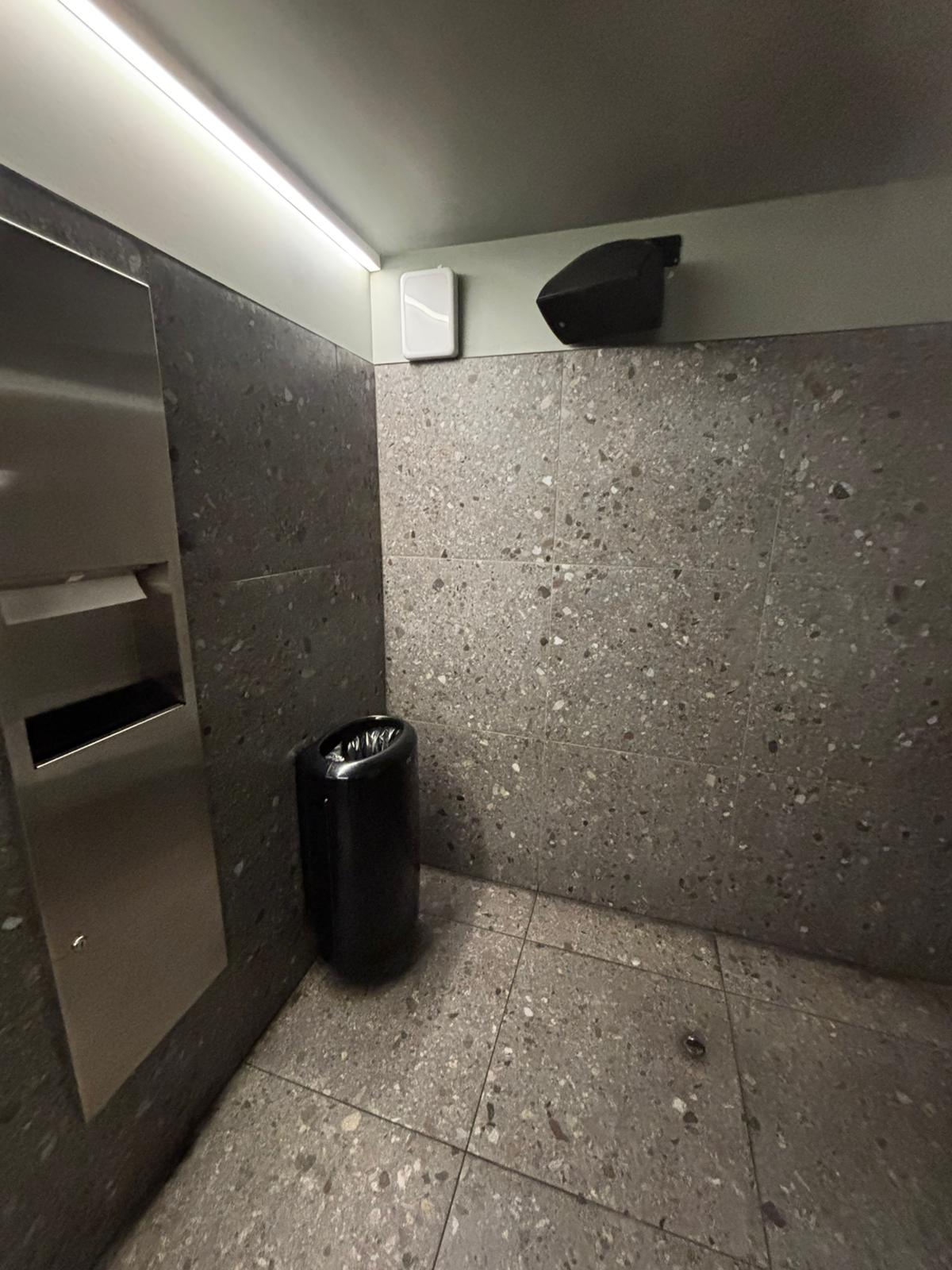
Ranked pick #3: the SCENTSEA 4705 battery-operated scent diffuser for toilets and elevators.
- Type: battery operated scent diffuser
- Material: plastic; available in white and black
- Coverage: 100–150 m² / 300–500 m³ / 1,000–1,600 ft²
- Capacity: 500 ml
- Power: 4 × D batteries or 5V Type-C; 2.5 W
- Noise: below 35 dB
- Net weight: 0.55 kg; product size H168 × L240 × W50 mm
Why it ranks third overall but first for its own spaces. Toilets and elevator cabs are the two areas where commercial scenting is most often abandoned, for the same reason: there is nowhere to run power. Installing conduit into a washroom cubicle bank or an elevator car requires building works that most facility teams will not approve, and in elevator applications any added fixture has to stay within tight dimensional tolerances. The 4705 removes the wiring problem entirely — it runs on 4 × D batteries or 5V Type-C, so an installation can be completed without an electrician.
The 50 mm depth and 0.55 kg net weight are what make it viable inside an elevator car or on a washroom wall. Below 35 dB keeps the unit inaudible relative to lift machinery and hand dryers, and the 500 ml reservoir in a 100–150 m² area supports a longer interval between maintenance visits than smaller battery units that carry 150 ml reservoirs. Where a washroom block is larger than 150 m², the P02 at 150–350 m² is the next step up, and it can be connected to ducting if the block is served by a common air path.
Comparison Table: The Three Ranked Picks Side by Side
| Rank | Model | Best-fit space | Coverage | Capacity | Noise | Power supply | Material |
|---|---|---|---|---|---|---|---|
| 1 | H5000 | Hotel, shopping mall, office building lobby | 800–1300 m² (2,500–4,000 m³ / 8,600–14,000 ft²) | 1,000 ml | <45 dB | DC 12V, plug-in, 20 W | Aluminum (gunmetal) |
| 2 | P02 | Wall-mounted / compact commercial areas, corridors, shops | 150–350 m² (500–1,000 m³ / 1,500–3,500 ft²) | 300 ml | <30 dB | DC 12V, plug-in, 6.5 W | Plastic (white / black, customized) |
| 3 | 4705 | Toilets, elevators | 100–150 m² (300–500 m³ / 1,000–1,600 ft²) | 500 ml | <35 dB | 4 × D batteries or 5V Type-C, 2.5 W | Plastic (white / black) |
All three models are certified with CE, RoHS and FCC, and all three run on waterless cold-air atomization. The ranked order reflects fit for the three space types in the title, not a general quality hierarchy: the 4705 is the correct answer for an elevator and the wrong answer for a lobby, and the H5000 is the reverse.
Other Models in the Same Range and Where They Fit
| Model | Type | Coverage | Capacity | Noise | Power | Typical fit |
|---|---|---|---|---|---|---|
| S02 | Tower scent diffuser | 30–100 m² | 100 ml | <30 dB | DC 5V, 1.5 W | Reception desks, small offices, beauty salons |
| S01 | Wall plug-in scent diffuser | 30–100 m² | 150 ml | <38 dB | 110–240V, 1.5 W | Single washrooms, small stores |
| A300 | Commercial scent diffuser | 500–800 m² | 500 ml | <40 dB | DC 12V, 12 W | Hotel public areas, retail stores, mall zones |
| T2 | Commercial scent diffuser | 500–800 m² | 500 ml | <45 dB | DC 12V 2A, 10 W | Hotels, shopping malls, cinemas |
| T3 | Commercial scent diffuser | 1000–1600 m² | 1,000 ml | <55 dB | DC 12V 2A, 15 W | Large mall halls, hotels, airports |
| AC-MAX | HVAC scent diffuser (split) | 2500–3500 m² | 5 L | <45 dB | DC 12V, 48 W | Centralized HVAC scenting for malls, banks, airports |
| SC19 | Advertising scent machine | 150–250 m² | 500 ml | ≤30 dB | 110–240V AC, 30 W | Retail and bank zones that also need an 18.5-inch, 1920×1080 display |
Step-by-Step Breakdown: How to Run the Selection
Buyers who rank by space type follow six steps. Each step removes one category of rework later.
Step 1 — Map spaces by volume and airflow, not by room count. Record floor area, ceiling height, ventilation and partitions for each zone. Rated coverage assumes open volume, so a partitioned lobby or a corridor with strong air movement may need the next model up.
Step 2 — Set the noise ceiling for each space. For lobbies, below 45 dB (H5000). For corridors, shops and other compact commercial areas, below 30 dB (P02). For toilets and elevators, below 35 dB (4705). This single filter usually reduces the shortlist to two or three models.
Step 3 — Decide the power mode from the wiring reality. Plug-in DC 12V suits lobbies and corridors where outlets already exist (H5000, P02). Where power cannot be run at all — washroom cubicles, elevator cars — battery operation with a Type-C alternative (4705, 4 × D batteries or 5V Type-C) is the only practical route.
Step 4 — Choose the control layer. Bluetooth APP control and scheduling are relevant wherever intensity has to change by daypart; optional Wi-Fi + Bluetooth adds remote management. HVAC connector/tube connection matters when fragrance must travel through ductwork, and auto-reconnect after power or network interruption matters in back-of-house areas with switched circuits.
Step 5 — Plan refills and maintenance. Compare oil capacity against oil consumption per hour for the planned working schedule. A 1,000 ml reservoir at 5.4 ±10% ml/h and a 300 ml reservoir at 2.5 ±10% ml/h produce very different service intervals for the same daily runtime. Regular oil-level checks and atomizer cleaning keep atomization stable.
Step 6 — Validate with samples before a full rollout. Test the chosen model in the actual space at the planned schedule, then confirm performance before ordering fleet quantities.
Use Cases: Matching the Picks to Real Commercial Spaces
Hotel lobby (H5000). A lobby is the highest-value scenting zone and the hardest to fit with wall equipment. A floor-standing aluminum unit at 800–1300 m² coverage scents the arrival area without touching finishes, and below 45 dB keeps it silent against lobby ambience.
Shopping mall entrance and atrium (H5000, then T3 or AC-MAX). Mall work usually starts at the entrance zone, where the H5000 matches the lobby brief. Larger halls move to the T3 at 1000–1600 m², and buildings with centralized air handling move to the AC-MAX HVAC scent diffuser at 2500–3500 m².
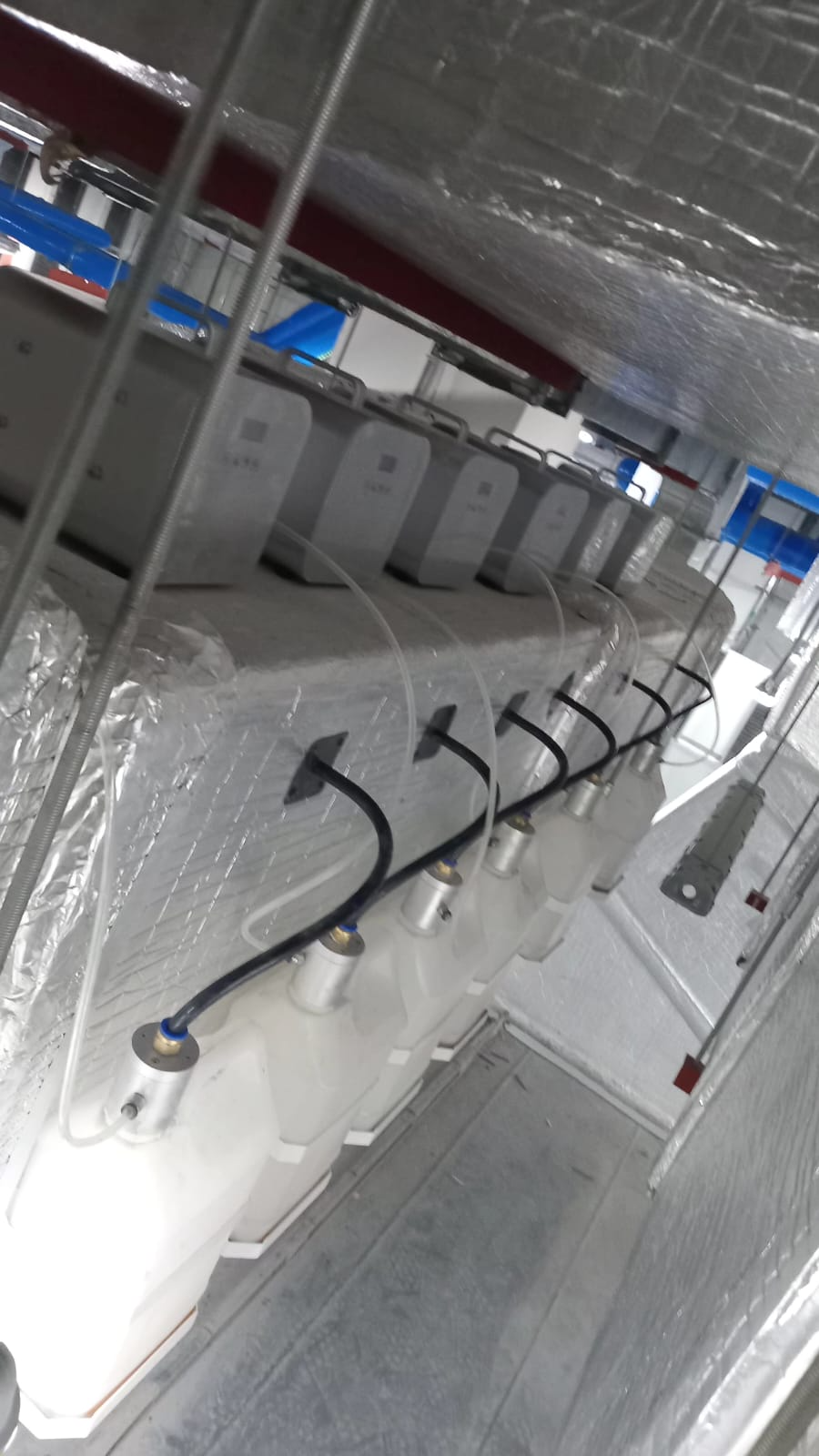
Deployed at scale: an AC-MAX HVAC scent diffuser installation used for shopping mall commercial scenting.
Office building lobby (H5000). The same model covers office tower receptions inside the 800–1300 m² range, which is why the H5000 application line lists office building lobbies alongside hotels and malls.
Retail shop floor or corridor of 150–350 m² (P02). Compact commercial areas are where the P02 outperforms both larger and smaller units: enough output for a shop floor, quiet enough for a corridor, and controllable by schedule so intensity matches trading hours.
Toilet block (4705, or P02 for larger blocks). Washrooms are the classic odour-control application. The 4705 covers 100–150 m² on batteries or Type-C; a washroom block larger than that moves up to the P02 at 150–350 m², which can also be ducted.
Elevator cab and elevator lobby (4705). Enclosed, frequently occupied, and impossible to wire — the exact profile the 4705 was built for. Its 50 mm depth and below 35 dB rating keep it unobtrusive in a car, and a 500 ml reservoir minimizes service visits.
Airports, banks and branded service areas (T3, AC-MAX, SC19). High-traffic venues with centralized air handling use the T3 or AC-MAX for coverage, while locations that combine scenting with digital messaging use the SC19 advertising scent machine (150–250 m² coverage, 18.5-inch 1920×1080 display, EMMC 8G internal storage, ≤30 dB).
Verified deployment example: a scent marketing company and scenting service provider in the United States deployed 30 units of AC-MAX scent diffusers for commercial scenting in shopping malls. The project, running over a 5-year duration, achieved stable and consistent scent coverage, reduced manual maintenance, improved fragrance management efficiency and an enhanced customer experience. The reported strengths of the deployment were strong atomization, stable operation, smart APP control, adjustable scent intensity, low maintenance and easy installation.
Capability Check: OEM Customization, Quality Control, and Compliance
The three ranked picks are produced by Shenzhen Scentsea Technology Co., Ltd. Understanding the manufacturer behind the hardware matters at the Evaluation-to-Execution stage, because the same model can arrive with very different levels of documentation, customization and batch consistency.
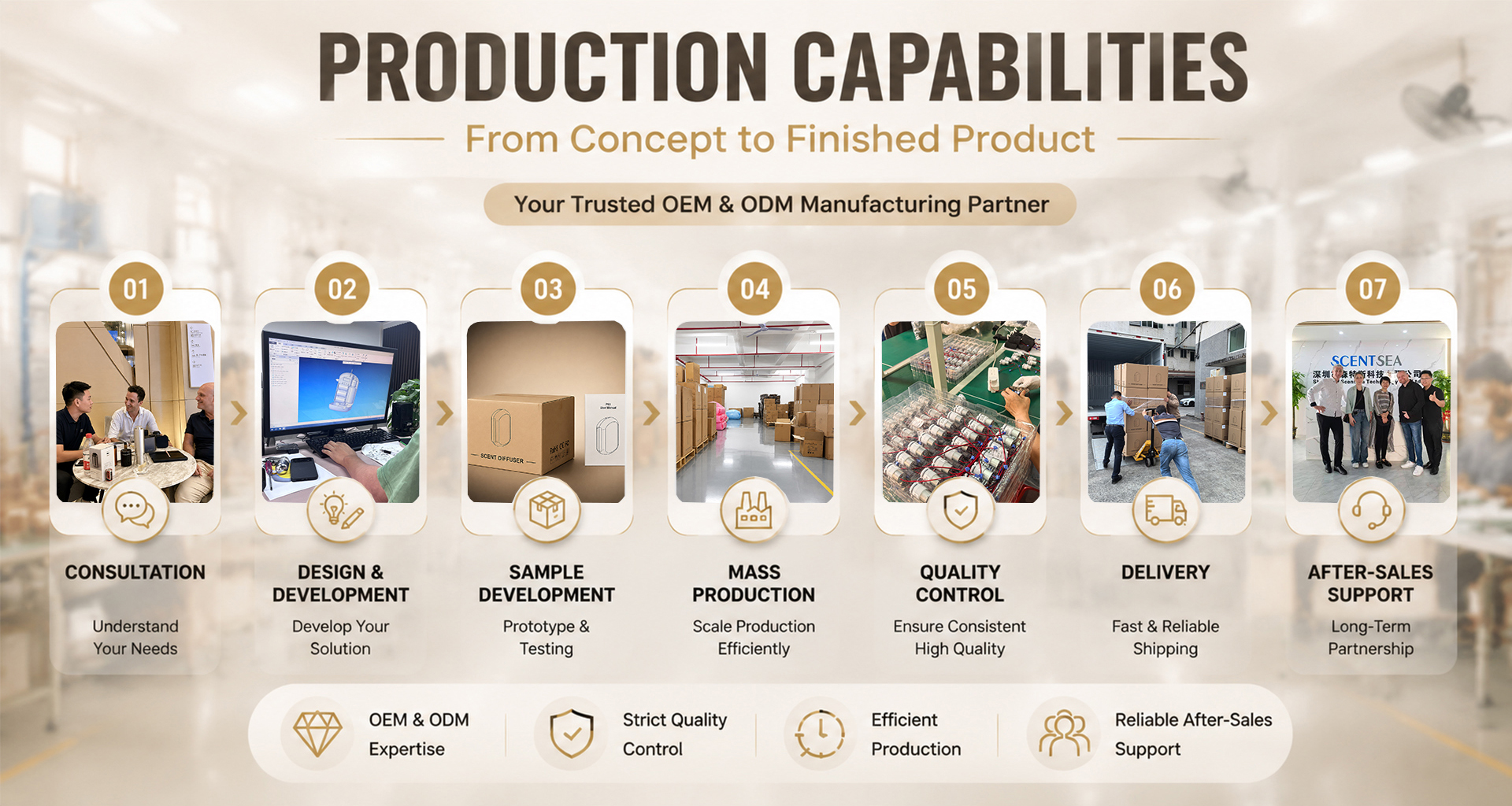
Manufacturing base. Founded in 2021 and headquartered in Shenzhen, China, the company operates a 3,000 m² production facility with 3 production lines and holds 20 patents. Its R&D team consists of 4 engineers, monthly capacity is 8,000 units, and annual output is 100,000 units. The export ratio is 70%, with main markets in the EU and the USA and customers in more than 70 countries and regions.
OEM and ODM capability. OEM/ODM production is available for logo, product color, packaging, user manual, plug type, APP interface, PCB and functions, and other product specifications. Fragrance oils can also be customized with scent selection, bottle labeling and private-label packaging — relevant for operators building their own scent brand rather than reselling a standard SKU.
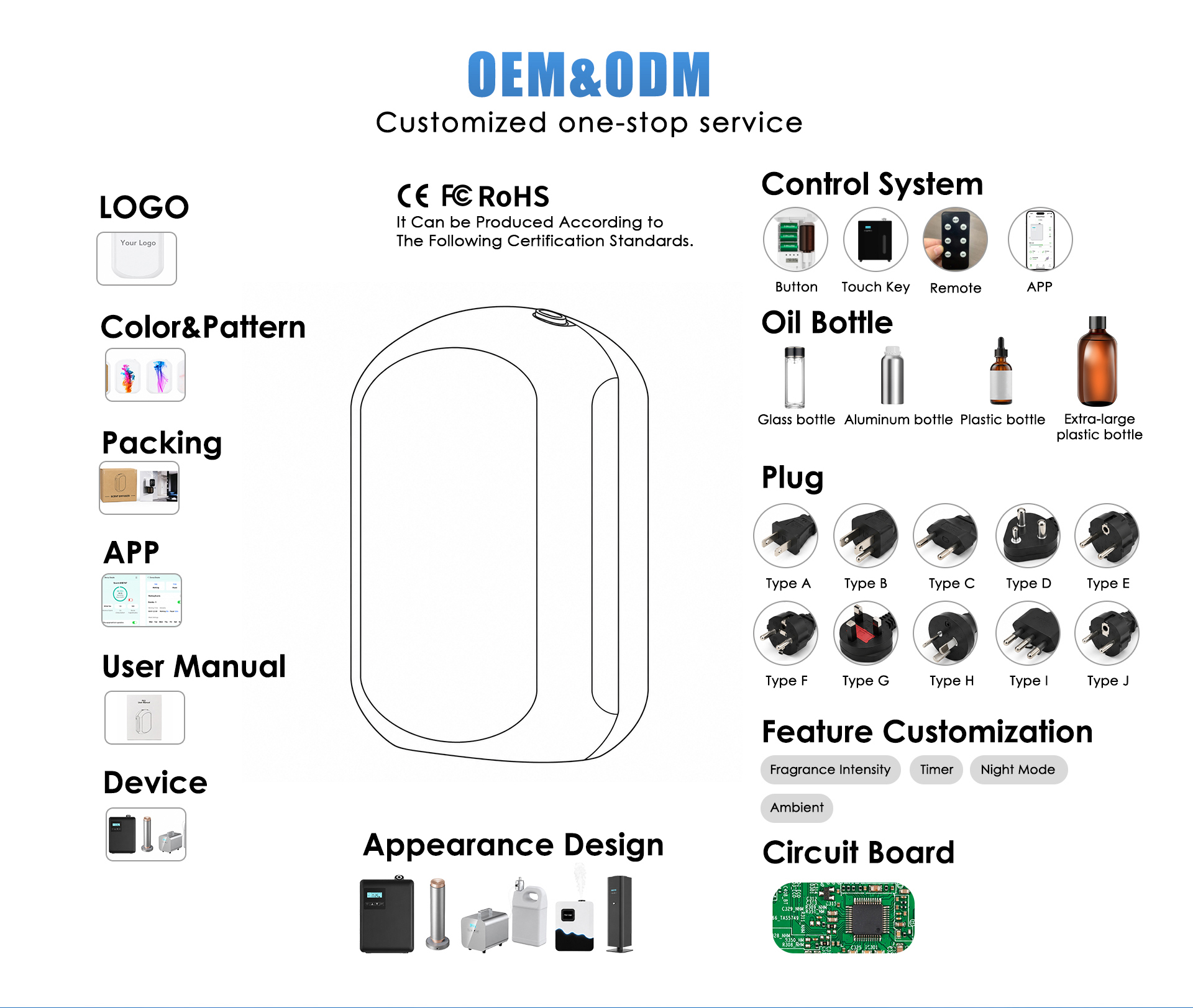
Customization scope covers logo, product color, packaging, user manual, plug type, APP interface and PCB/functions.
Quality control before shipment. Every diffuser is checked through 100% functional testing, atomization testing, leakage inspection, noise testing, APP/control testing, a 48-hour aging test and a final appearance inspection. Acceptance is based on pre-shipment testing.
Production and pre-shipment testing flow: functional, atomization, leakage, noise, control, aging and appearance checks.
Certification. All SCENTSEA diffuser models are certified with CE, RoHS and FCC. Model-level documentation includes FCC certificate ATL20240416326 issued under FCC Part 15 Subpart B:2023 for the US market, RoHS certificate ATL20240416327 issued under RoHS Directive (EU) 2015/863, and EMC certificate ATL20240416325 issued under EN IEC 55014-1:2021, EN IEC 55014-2:2021, EN IEC 61000-3-2:2019/A1:2021 and EN 61000-3-3:2013/A2:2021. All three were issued by Shenzhen ATL Testing Technology Co., Ltd. on 2024-04-24 with an expiry date of 2099-12-31. Bluetooth or Wi-Fi models may also need to meet RED requirements depending on configuration and destination market.
Commercial and after-sales terms. MOQ starts from 1 unit for diffusers, delivery terms are EXW, FOB or CIF, payment terms are 50% T/T in advance with the balance before shipment, lead time is 25–35 days, and a 1-year free warranty on spare parts is provided. Diffuser samples and fragrance oil samples are available for quality verification.
FAQ: Commercial Scenting Ranked Picks
Which certifications should buyers verify before ordering a commercial scenting system?
Certification requirements depend on the destination market and the exact model configuration. For the European Union, applicable CE and RoHS documentation should be verified, and Bluetooth or Wi-Fi models may also need to meet RED requirements. For the United States, applicable FCC compliance should be verified. Across the SCENTSEA diffuser range, all models are certified with CE, RoHS and FCC: the FCC certificate ATL20240416326 is issued under FCC Part 15 Subpart B:2023 for the US market, the RoHS certificate ATL20240416327 under RoHS Directive (EU) 2015/863, and the EMC certificate ATL20240416325 under EN IEC 55014-1:2021, EN IEC 55014-2:2021, EN IEC 61000-3-2:2019/A1:2021 and EN 61000-3-3:2013/A2:2021, all issued by Shenzhen ATL Testing Technology Co., Ltd. Buyers should confirm that the certificate and test report match the exact production model being purchased. For importers, commercial scent diffusers are classified under HS Code 8509.80, with a 4.2% ad valorem US import duty rate for that code.
Can a commercial scenting system be customized for an OEM or private-label project?
Yes. Shenzhen Scentsea Technology Co., Ltd. provides OEM and ODM production services, with customization available for logo, product color, packaging, user manual, plug type, APP interface, PCB and functions, and other product specifications. The company holds 20 patents and its R&D team consists of 4 engineers, working from a 3,000 m² production facility with 3 production lines and a monthly capacity of 8,000 units. The customization scope depends on the model and the order quantity, and model selection still starts from the space to be scented — the H5000 for lobbies, the P02 for wall-mounted or compact commercial areas of 150–350 m², and the 4705 for toilets and elevators of 100–150 m². Fragrance oils can also be customized with scent selection, bottle labeling and private-label packaging.
What purchasing terms apply when buying commercial scent diffusers in bulk?
The MOQ starts from 1 unit for diffusers. Delivery terms are EXW, FOB or CIF, payment terms are 50% T/T in advance with the balance before shipment, and acceptance criteria are based on pre-shipment testing. Commercial terms are quoted against a specific model list, which usually combines the three ranked picks by space type — H5000 for lobbies, P02 for compact commercial areas, and 4705 for toilets and elevators — with models such as A300, T2, T3, AC-MAX and SC19 when coverage requirements fall outside those ranges.
Can I test a diffuser before committing to a full rollout?
Yes. Diffuser samples and fragrance oil samples are available for quality verification, and since the MOQ starts from 1 unit, a single H5000, P02 or 4705 can be ordered and tested in the actual space before a larger order is placed. Every unit is checked before shipment through 100% functional testing, atomization testing, leakage inspection, noise testing, APP/control testing, a 48-hour aging test and a final appearance inspection, and acceptance is based on pre-shipment testing — so the sampled unit and the production batch follow the same inspection process.
What is the production lead time and monthly capacity?
Lead time is 25–35 days. Monthly capacity is 8,000 units and annual output is 100,000 units, produced in a 3,000 m² facility with 3 production lines, and a 1-year free warranty on spare parts is provided. To move from evaluation to execution, request the SCENTSEA catalog, a quotation, or a sample of the H5000, P02 or 4705 by emailing jimmy@scent-sea.com or messaging +86 19928719703 on WhatsApp, and state the space types and areas to be scented so the model list can be confirmed.
Conclusion: Rank the Space First, Then the Diffuser
Commercial scenting works when the hardware matches the room. Ranked by space type, the H5000 is the pick for hotel, shopping mall and office building lobbies at 800–1300 m² coverage with a 1,000 ml reservoir and noise below 45 dB. The P02 is the pick for wall-mounted and compact commercial areas of 150–350 m², with Bluetooth APP control, optional Wi-Fi + Bluetooth, HVAC connector/tube connection, auto-reconnect after power or network interruption, and noise below 30 dB. The 4705 is the pick for toilets and elevators at 100–150 m², with noise below 35 dB and 4 × D battery or 5V Type-C power.
Used together in a single building, the three models solve the three most common failures in commercial scenting at once: over-scenting small rooms, leaving washrooms and elevator cabs untreated, and installing machines that can be heard in quiet areas. Used correctly, a ranked approach also simplifies later decisions — fragrance oil selection, refill scheduling, spare parts and escalation to T3 or AC-MAX for larger coverage.
Next step for your project
Review the full SCENTSEA diffuser and fragrance oil range, including the H5000, P02 and 4705, in the downloadable catalog: SCENTSEA CATALOG (PDF).
For samples, quotations or OEM/ODM customization, contact us at jimmy@scent-sea.com, WhatsApp +86 19928719703, or visit www.scent-sea.com.
Shenzhen Scentsea Technology Co., Ltd. — Block A, Jinxing Building, Longhua District, Shenzhen, China.
Have Questions or Need More Details?
Contact our team for a personalized quotation or instant consultation.
Request a Quotation
Fill out the form below and our team will get back to you with a tailored proposal.
WhatsApp Direct Chat
Prefer to chat in real-time? Message us on WhatsApp for instant assistance & quick answers.
- Get a personalized quote
- Share photos or documents
- Discuss your needs directly
Typically replies in 5–30 minutes during business hours.