
Technical Guide to Scent Diffuser Specs: Voltage, Oil Consumption, and Coverage Accuracy
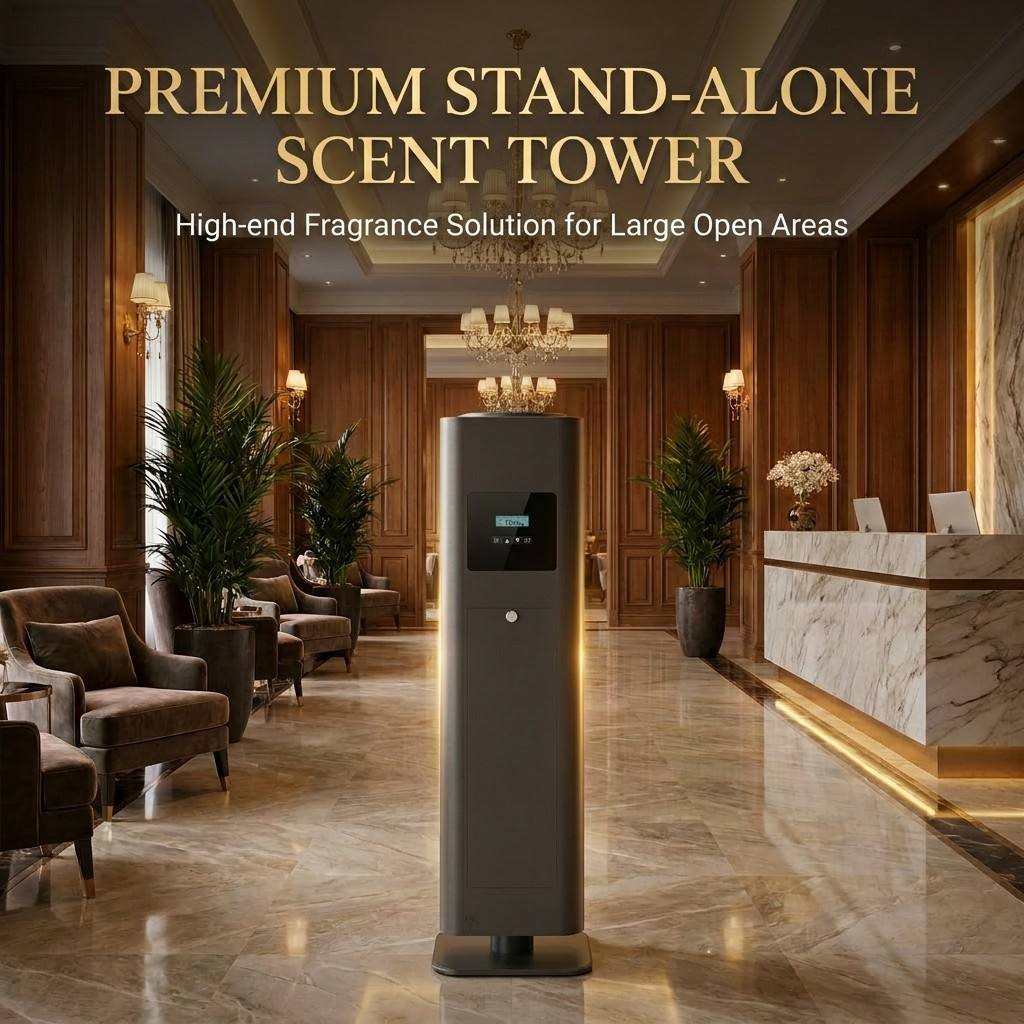
SCENTSEA H5000 floor-standing scent diffuser — rated DC 12V, 20W, 5.4 ±10% ml/h oil consumption, aluminium body, 1000 ml capacity.
A commercial scenting system is usually chosen from a specification table, not from a demonstration. That makes three lines on the sheet decisive: the voltage and power architecture, the fragrance oil consumption rate, and the rated coverage. Two of those three are routinely misread, and the third — coverage — is quoted in three different units that are not interchangeable.
This guide explains what each parameter actually measures, using two real SCENTSEA configurations at opposite ends of the range: the H5000 floor-standing diffuser (rated DC 12V, 20W, 5.4 ±10% ml/h oil consumption, aluminium body, 1000 ml capacity) and the compact 4705 battery-operated unit (4 × D batteries or 5 V Type-C, 2.5W, plastic body). The same reading logic applies to every model in the range, and to most commercial scenting hardware on the market.
Why Diffuser Spec Sheets Mislead Buyers
Coverage is expressed as a single number, but it is really a function of three variables: floor area, ceiling height and air exchange. A rating of 800–1,300 m² tells a buyer how much floor the unit can serve in a reference room. It does not describe the volume of that room, and volume is what a diffuser actually fills.
SCENTSEA publishes coverage in m², m³ and ft² side by side, which makes the relationship visible. For the H5000 the three figures are 800–1,300 m², 2,500–4,000 m³ and 8,600–14,000 ft². Dividing the volumetric rating by the area rating gives an implied ceiling height of roughly 3 metres. The same ratio holds across the range — T3 (1,000–1,600 m² / 3,000–5,000 m³), A300 and T2 (500–800 m² / 1,500–2,500 m³), and P01 and P03 (100–150 m² / 300–500 m³) all sit at approximately 3 m.
A second source of error is the square-foot figure. Across most SCENTSEA listings the ft² rating is the m² rating converted at approximately 10.7 ft² per m² — a translation for buyer convenience rather than an independently measured result. Treat it as a unit conversion, not as separate evidence of performance.
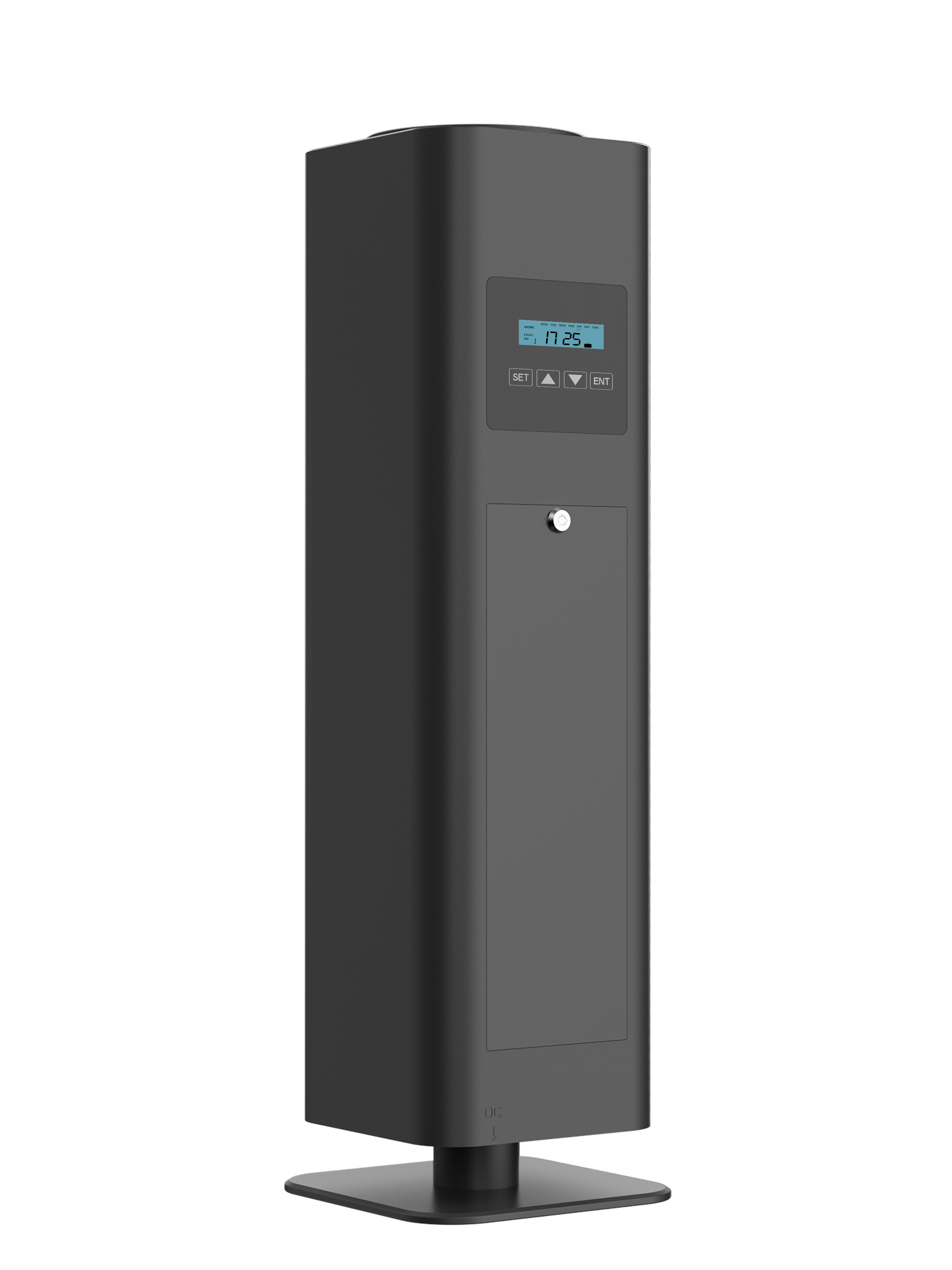
H5000 structure view — aluminium body, 1000 ml reservoir, 6.4 kg net weight, L180 × W180 × H610 mm.
How Cold-Air Atomization Shapes the Numbers
Commercial scenting hardware in this class generally uses waterless cold-air atomization: controlled airflow and pressure break fragrance oil into fine particles without water dilution or heating. Third-party technical documentation published by SCENTA describes the particle output of this method as sub-micron, below 2.5 μm, small enough to remain airborne and travel through a room or a duct system.
Two properties of that mechanism matter when reading a spec sheet. First, because no water is added, oil consumption is the only consumable — there is no water tank to refill and no dilution factor to adjust. Second, because output is delivered as airborne particles rather than a heated vapour, coverage depends on air movement in the room, not only on the machine's rated output.
The commercial context is expanding. Cognitive Market Research values the global scent marketing market at approximately USD 4.1 billion in 2026, with a projection of USD 7.28 billion by 2035 at a 6.6% CAGR (industry data reported through Vertex; a narrower definition of scenting is estimated higher by other sources). For importers, commercial scent diffusers are generally classified under HS Code 8509.80, which carries a 4.2% ad valorem duty into the United States according to USITC-derived tariff data. Buyers researching commercial scenting for hotels, retail stores, shopping malls, offices, airports and banks are therefore evaluating hardware specifications and landed cost at the same time.
One caveat on outcome claims: a secondary industry compilation reports an average 15-minute increase in retail dwell time attributable to scent marketing. Such figures are directional and depend on the specific environment and implementation. They are not specifications and should not be used to size equipment.
The Three Parameters That Decide Whether a Project Works
1. Voltage and power architecture
Voltage determines how a unit is installed, not how strong it is. The SCENTSEA commercial range uses three power classes:
- DC 12V low-voltage, plug-in with adapter — H5000 (20W), T3 (DC 12V 2A, 15W), T2 (DC 12V 2A, 10W), A300 (12W), P02 (6.5W) and the HVAC-connected AC-MAX (48W).
- AC mains 110–240V — S01 (1.5W) and the SC19 advertising scent machine (30W), which runs directly on mains voltage.
- 5V low-voltage, battery or Type-C — P01, also catalogued as model 4705 (4 × D batteries or 5 V Type-C, 2.5W), P03 (3 × D batteries or Type-C, 2.5W) and S02 (DC 5V, 1.5W).
The decision rule is straightforward. Where a socket exists and the unit runs continuously, a DC 12V or AC mains model with an adapter is the practical choice. Where there is no power outlet — washrooms, elevators, corridors, small shops, or buildings that cannot take new wiring — the 5V battery class exists precisely for that constraint. Because adapter and plug type vary by destination, plug type is one of the OEM/ODM customization options SCENTSEA offers alongside logo, colour, packaging, user manual, APP interface and PCB functions.
Power draw should be checked for a different reason: it drives the aggregate electrical load in a multi-unit project. A single AC-MAX draws 48W, so ten units draw roughly 480W. A P02 at 6.5W draws a fraction of that. Neither number indicates which machine scents better — only what the electrical plan has to support.
2. Oil consumption and refill economics
Oil consumption has the clearest operational consequence and is the parameter most often left out of buyer comparisons. Published rates across the range are as follows.
| Model | Capacity | Oil consumption | Calculated runtime | Refill interval at 8 h/day |
|---|---|---|---|---|
| H5000 | 1000 ml | 5.4 ±10% ml/h | ≈185 h | ≈23 days |
| T3 | 1000 ml | 4.6 ±10% ml/h | ≈217 h | ≈27 days |
| A300 | 500 ml | 4 ml ±10%/h | ≈125 h | ≈16 days |
| T2 | 500 ml | 3 ml ±10%/h | ≈167 h | ≈21 days |
| P02 | 300 ml | 2.5 ±10% ml/h | ≈120 h | ≈15 days |
| AC-MAX | 5 L | 6 ±5% ml/h | ≈833 h | ≈104 days |
| SC19 | 500 ml | 6 ±5% ml/h | ≈83 h | ≈10 days |
Runtime and refill intervals are calculated from published capacity ÷ published consumption. They are illustrative arithmetic, not factory test results; real intervals depend on duty cycle, intensity setting and ambient conditions.
Tolerance matters as much as the headline rate. The H5000 is quoted at ±10%, so 5.4 ml/h means the true rate sits somewhere between roughly 4.9 and 5.9 ml/h in normal operation. AC-MAX and SC19 are quoted at the tighter ±5%. For a single unit the difference is minor; across a 50-unit estate it changes annual fragrance oil purchasing volumes materially.
Capacity and consumption together set maintenance load. AC-MAX pairs a 5 L reservoir with a 6 ml/h rate, which is why large HVAC projects can run for months between refills. A compact P02 holds 300 ml and consumes 2.5 ml/h, which suits a retail store or corridor where a monthly service visit is acceptable.
Where a model's published sheet does not state an oil-consumption rate — currently the case for P01, P03 and S01 — buyers sizing multi-unit projects should request the figure in writing per model before calculating refill schedules. Duty cycle and intensity settings also change real consumption, so the paper number is a planning baseline, not a guarantee.
3. Coverage accuracy: reading m² and m³ correctly
Volume, not floor area, is what a diffuser has to fill. A useful way to check any coverage claim is to divide the m³ rating by the m² rating and see what ceiling height the manufacturer assumed. For this range the answer is consistently about 3 m, which tells a buyer exactly when the m² figure stops being trustworthy.
Worked example: a 700 m² retail hall with a 9 m ceiling holds 6,300 m³ of air. An area rating of 800–1,300 m² would suggest one H5000 is sufficient. The volumetric rating of 2,500–4,000 m³ says the opposite — the space exceeds the single-unit envelope and needs either a higher-output unit, a duct-connected system such as AC-MAX, or multiple units distributed across the floor plate.
Airflow is the second half of coverage accuracy. SCENTSEA's application documentation lists airflow conditions alongside correct power supply, suitable fragrance oil, proper installation location and space-based model selection as the special requirements for any scenting scenario. In practice, a space with strong mechanical ventilation or doors open to the street dilutes fragrance faster than the rated coverage assumes, and heavily partitioned spaces need more than one emitter even when total volume looks within range.

AC-MAX split-type HVAC scent diffuser — 5 L reservoir, DC 12V / 48W, rated 2,500–3,500 m² / 8,000–10,000 m³.
Step-by-Step: Sizing a Commercial Scenting Project from a Spec Sheet
Step 1 — Measure volume, not area. Multiply length × width × ceiling height for each zone. Where a site has multiple ceiling heights, treat each as a separate zone rather than averaging them.
Step 2 — Compare against the m³ rating, not the m² rating. A 6,300 m³ hall does not fit a 2,500–4,000 m³ machine, regardless of what the area figure implies.
Step 3 — Assess airflow and partitioning. Check for ducted supply and extract, open entrances, and walls or shelving that break the space into compartments. Each compartment generally behaves as its own scenting zone.
Step 4 — Match the power architecture to the site. Confirm whether a socket is available at the intended mounting point. If not, the 5V battery class (P01 / 4705 or P03) removes the wiring requirement. If the installation feeds a central air handler, a split HVAC unit such as AC-MAX connects to the duct instead.
Step 5 — Calculate oil consumption and refill intervals. Use capacity ÷ consumption for each candidate, then multiply by the number of units to estimate monthly fragrance oil volume. This is the number that determines the service contract, not the purchase price.
Step 6 — Check noise against the venue. Published figures across the range run from below 30 dB on P02 and ≤30 dB on SC19, through below 35 dB on P01 and P03 and below 40 dB on A300, to below 45 dB on H5000 and AC-MAX and below 55 dB on T3. Quiet zones such as hotel corridors, offices and reading areas call for the lower end of that band; high-traffic halls are less sensitive.
Step 7 — Validate with a sample before committing. Coverage, noise and scent intensity are judged better in the actual room than on paper. Diffuser samples and fragrance oil samples are available for quality verification, and MOQ starts from 1 piece for diffusers, which makes single-unit field testing practical before a fleet order.
Form Factor: Floor Standing, Wall-Mounted or Duct-Connected
Form factor decides where scent is released, and that changes how evenly a room fills.
Floor-standing units such as the H5000 (L180 × W180 × H610 mm, 6.4 kg net, aluminium body, gunmetal finish) release fragrance low in the space and rely on natural air movement to carry it upward. They require no wall installation and can be repositioned, which suits hotel lobbies, showrooms, reception halls and large public areas where the unit is also a visible design element.
Wall-mounted units release at height, which helps in narrow or cluttered spaces. The A300 supports standalone, wall-mounted and HVAC-connected installation and combines a steel body with a 500 ml reservoir. The compact P01 (4705) and P03 are wall-mountable and battery-powered, which makes them suitable for washrooms, elevators, corridors and small shops where drilling for a power feed is impractical. Both include a secure lockable front cover for commercial environments.
Duct-connected units work differently again. AC-MAX is a split-type HVAC scent diffuser with a separate machine and oil tank, connecting directly to central HVAC ducts so fragrance travels with the building's existing airflow. It carries a 5 L reservoir, covers a rated 2,500–3,500 m² / 8,000–10,000 m³, and supports Wi-Fi and Bluetooth control with password protection for project management, plus an optional airflow sensor that can synchronize scenting with HVAC operation.
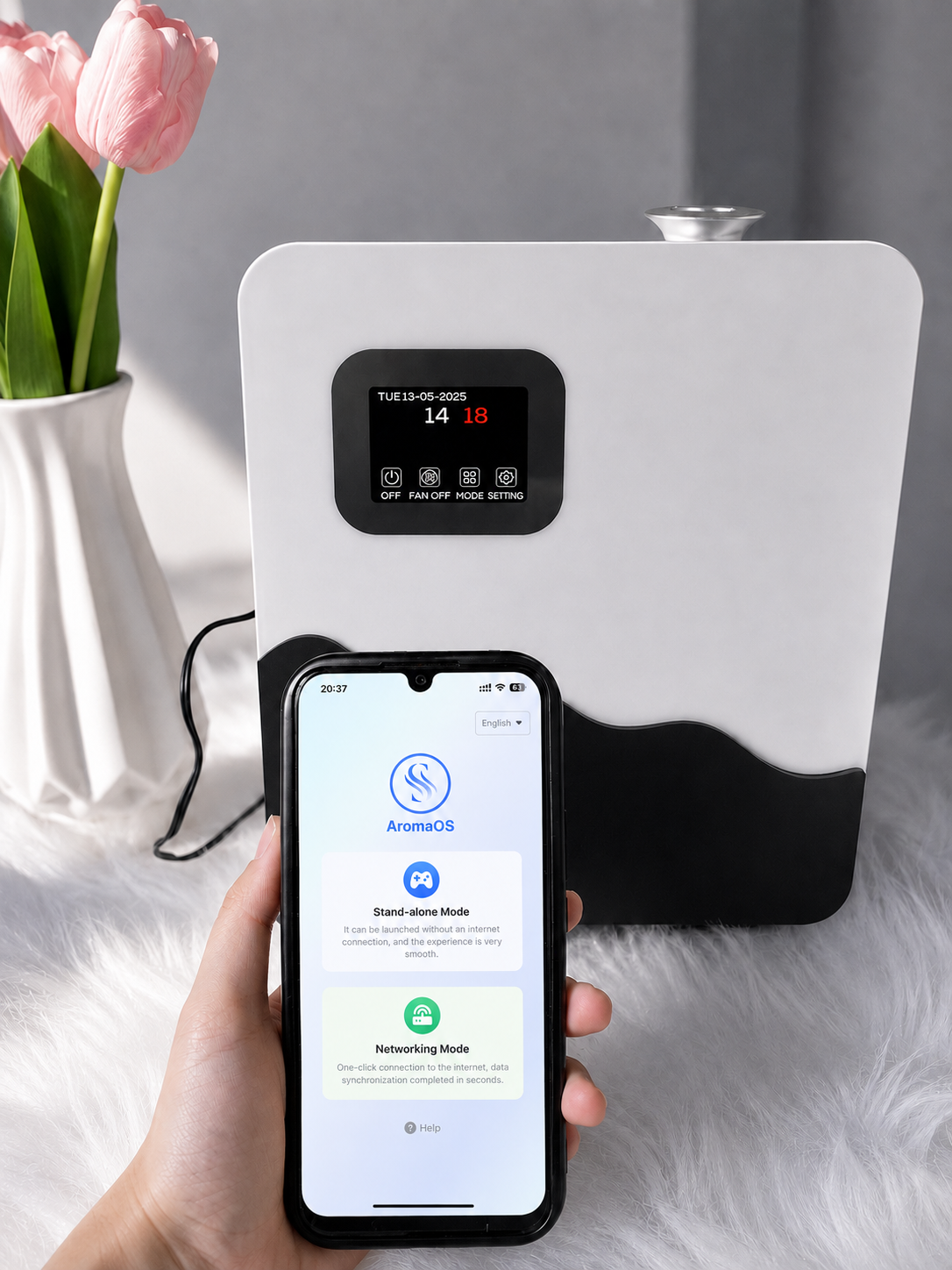
A300 commercial scent diffuser — steel body, 500 ml capacity, DC 12V / 12W, standalone, wall-mounted or HVAC-connected.
Spec Comparison: SCENTSEA Diffuser Range
| Model | Type / form factor | Voltage & power | Oil consumption | Coverage (m² / m³ / ft²) | Body material | Noise |
|---|---|---|---|---|---|---|
| H5000 | Floor standing | DC 12V, 20W | 5.4 ±10% ml/h | 800–1,300 / 2,500–4,000 / 8,600–14,000 | Aluminium | <45 dB |
| AC-MAX | HVAC split-type | DC 12V, 48W | 6 ±5% ml/h | 2,500–3,500 / 8,000–10,000 / 25,000–35,000 | Aluminium body + plastic bottle | <45 dB |
| T3 | Commercial diffuser | DC 12V 2A, 15W | 4.6 ±10% ml/h | 1,000–1,600 / 3,000–5,000 / 10,000–17,000 | Acrylic panel + steel casing | <55 dB |
| T2 | Commercial diffuser | DC 12V 2A, 10W | 3 ml ±10%/h | 500–800 / 1,500–2,500 / 5,000–8,500 | Acrylic panel + steel casing | <45 dB |
| A300 | Commercial, standalone / wall / HVAC | DC 12V, 12W | 4 ml ±10%/h | 500–800 / 1,500–2,500 / 5,000–8,500 | Steel | <40 dB |
| P02 | Plug-in, wall-mounted | DC 12V, 6.5W | 2.5 ±10% ml/h | 150–350 / 500–1,000 / 1,500–3,500 | Plastic | <30 dB |
| P01 (4705) | Battery-operated, wall-mountable | 5V, 2.5W (4 × D or Type-C) | Not stated | 100–150 / 300–500 / 1,000–1,600 | Plastic | <35 dB |
| P03 | Battery-operated, wall-mountable | 5V, 2.5W (3 × D or Type-C) | Not stated | 100–150 / 300–500 / 1,000–1,600 | Plastic | <35 dB |
| SC19 | Advertising scent machine | 110–240V AC, 30W | 6 ±5% ml/h | 150–250 / 500–800 / 1,500–2,500 | Aluminium + steel | ≤30 dB |
| S02 | Tower diffuser | DC 5V, 1.5W | 0.6 ±5% ml/h | 30–100 / 100–300 / 300–1,000 | Aluminium alloy | <30 dB |
| S01 | Wall plug-in | 110–240V, 1.5W | Not stated | 30–100 / 100–300 / 300–1,000 | Plastic | <38 dB |
All figures are published model specifications. SC19 also carries an 18.5-inch 1920×1080 advertising display with EMMC8G internal storage; AC-MAX is a split-type unit with a separate machine and oil tank.

P01 / 4705 battery-operated scent diffuser — 4 × D batteries or 5 V Type-C, 2.5W, plastic body, 500 ml capacity, below 35 dB.
Where Each Specification Matters Most
Hotel lobbies and hospitality spaces
Lobby scenting is a volume problem before it is a style problem. H5000 covers a rated 800–1,300 m² / 2,500–4,000 m³ with a 1000 ml reservoir, which suits a double-height reception area served by a single floor-standing unit. Where the lobby opens into an atrium or connects to a shared air handler, AC-MAX and its duct connection distribute fragrance through the building's own airflow instead of from one point in the room. Control on both is handled through the AromaOS APP for scheduling and intensity adjustment, so scent strength can be reduced outside peak hours without a site visit.
Retail stores and showrooms
Individual stores and corridors usually sit between 150 and 350 m², which is the P02 envelope (500–1,000 m³, 300 ml, 2.5 ±10% ml/h). Its published noise figure is below 30 dB, the quietest in the plug-in class, which matters when the unit sits near a checkout counter. A300 is the alternative where wall mounting and a 500 ml reservoir are preferred.
A US-based scent marketing company deployed 30 SCENTSEA units for commercial scenting across shopping mall environments over a five-year period. The reported outcome was stable and consistent scent coverage, reduced manual maintenance, improved fragrance management efficiency and a better customer experience, with strong atomization, stable operation, smart APP control, adjustable scent intensity, low maintenance and easy installation cited as the practical highlights.
Shopping malls, airports and banks
Large open concourses need higher output and longer refill cycles. T3 covers a rated 1,000–1,600 m² / 3,000–5,000 m³ with a 1000 ml reservoir at 4.6 ±10% ml/h, and its 15W draw keeps the electrical load modest per unit. AC-MAX handles the largest footprints at 2,500–3,500 m² / 8,000–10,000 m³ and is intended for shopping mall, banking and airport environments where ducted distribution is already in place.
Washrooms, elevators and corridors
These are the locations where the 5V battery class earns its place. P01 (4705) and P03 both run on D-cell batteries or Type-C, deliver 2.5W and cover a rated 100–150 m² / 300–500 m³, which is the right scale for a washroom cluster or an elevator bank. Neither requires a power feed, both are wall-mountable, and both include a lockable front cover to prevent unauthorized access.
Offices and mixed-use buildings
Office floors fragment into meeting rooms, open desks and reception areas that behave as separate zones. Mixed deployment is normal: A300 or T2 for reception and larger meeting rooms, P02 for corridors and washroom areas, and AC-MAX where a central air handler serves the whole floor. Where several units share a building, the AromaOS APP and optional Wi-Fi/Bluetooth control on selected models allow schedules to be coordinated from one interface rather than set unit by unit.
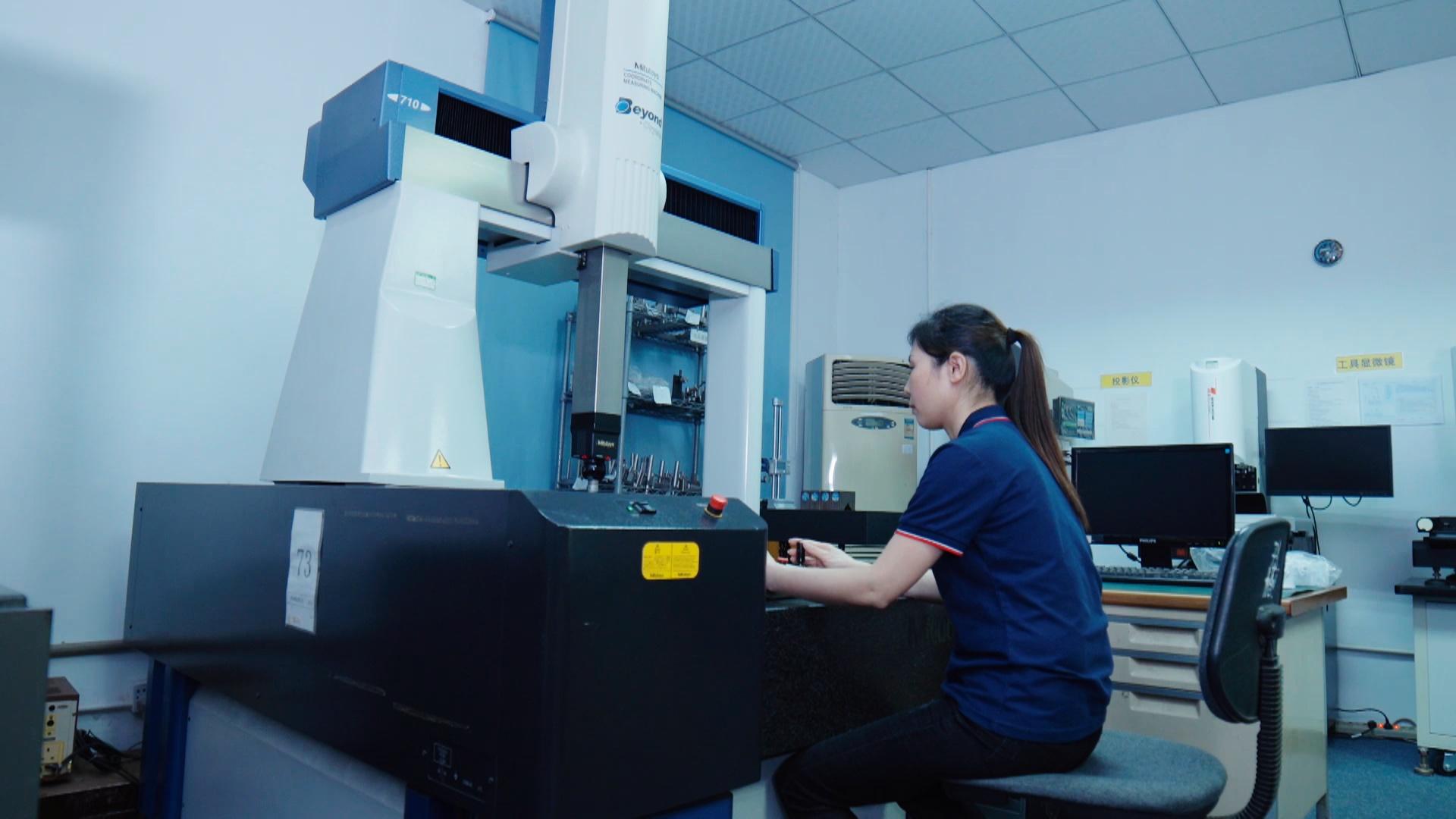
Inspection equipment used during production. Every diffuser passes functional, atomization, leakage, noise and APP/control testing plus a 48-hour aging test before shipment.
Frequently Asked Questions
What voltage and power supply do commercial scent diffusers require?
SCENTSEA commercial models use three power classes. DC 12V plug-in with adapter covers H5000 (20W), T3 (DC 12V 2A, 15W), T2 (DC 12V 2A, 10W), A300 (12W), P02 (6.5W) and AC-MAX (48W). AC mains 110–240V covers S01 (1.5W) and the SC19 advertising scent machine (30W). The 5V low-voltage class covers P01 / 4705 and P03 at 2.5W, both able to run on D-cell batteries or Type-C, and S02 at DC 5V / 1.5W. Voltage determines installation method, not scenting strength: where no socket is available the battery class avoids new wiring, and where the installation is ducted, AC-MAX connects to the air handler instead of the room.
How accurate is a coverage rating in m² compared with m³?
An m² rating assumes a reference ceiling height. Dividing m³ by m² across the SCENTSEA range gives approximately 3 m in every case, so the area figure is only valid for rooms with ceilings near 3 m. In a space with a 9 m ceiling, a 700 m² floor becomes 6,300 m³, which exceeds a single H5000's rated 2,500–4,000 m³ even though the area figure suggests one unit is sufficient. Size on volume, then check airflow, partitioning and ventilation before confirming the unit count.
How often does a commercial scent diffuser need refilling?
Refill interval is capacity divided by oil consumption. H5000 holds 1000 ml at 5.4 ±10% ml/h, roughly 185 hours of atomization — about 23 days at 8 hours per day. AC-MAX holds 5 L at 6 ±5% ml/h, roughly 833 hours, or about 104 days at 8 hours per day. P02 holds 300 ml at 2.5 ±10% ml/h, about 15 days at 8 hours per day. These are calculated planning figures, not factory test results; duty cycle, intensity setting and ambient conditions change the real interval. Where a model's published sheet does not state a rate — currently P01, P03 and S01 — confirm the figure in writing per model before building a refill schedule.
What should a hotel buyer check when evaluating a commercial scenting system manufacturer?
Beyond the specification, verify certification coverage, production capacity and quality control, warranty and spare parts terms, and lead time. Scentsea's diffuser models are certified with CE, RoHS and FCC. Shenzhen Scentsea Technology Co., Ltd. operates a 3,000 m² production facility with three production lines, an 8,000-unit monthly capacity and a 25–35 day lead time, and ships to customers in more than 70 countries and regions. Every diffuser passes 100% functional testing, atomization testing, leakage inspection, noise testing, APP/control testing, a 48-hour aging test and a final appearance inspection before shipment. OEM/ODM customization is available for logo, product colour, packaging, user manual, plug type, APP interface and PCB functions, backed by a 1-year free warranty on spare parts.
Can I test a diffuser before placing a bulk order?
Yes. Diffuser samples and fragrance oil samples are available for quality verification, and MOQ starts from 1 piece for diffusers, so a single unit can be field-tested in the actual space before scaling to a fleet. Because coverage, noise and scent density are judged more reliably in the room than on paper, sample validation before mass production is recommended. You can review the full model range and specifications in the SCENTSEA catalogue, then request a sample, a project quote or wholesale pricing for your hotel, retail or mall deployment — model recommendations and customization options are provided against your measured room volumes and installation conditions.
Conclusion
Voltage tells you how a diffuser installs, oil consumption tells you what it costs to run, and coverage tells you whether it will actually fill the space. Of the three, coverage is the parameter most likely to be misread, because an m² rating silently assumes a ceiling height near 3 m. Checking the m³ figure against the real volume of each zone, then confirming airflow, power availability and noise tolerance, removes most of the risk from a commercial scenting specification.
The range itself shows how differently those three parameters can be balanced: H5000 pairs a 1000 ml reservoir and 5.4 ±10% ml/h consumption with a floor-standing aluminium body for lobbies, while P01 (4705) trades capacity for cordless 4 × D battery or 5 V Type-C operation at 2.5W in spaces where wiring is not an option, and AC-MAX goes the other way entirely with a 5 L reservoir and duct-level distribution for malls, banks and airports. Matching those trade-offs to measured room volume is what makes a scenting project hold up after month one.
Next step: verify the specs in your own space
Download the full SCENTSEA catalogue with model specifications, coverage data and installation options: SCENTSEA Product Catalogue (PDF).
For sample requests, project quotes and OEM/ODM enquiries across hotels, retail, malls, offices, airports and banks, contact Shenzhen Scentsea Technology Co., Ltd. — website: www.scent-sea.com, email: jimmy@scent-sea.com, Tel / WhatsApp / WeChat: +86 19928719703.

OEM/ODM customization available for logo, colour, packaging, user manual, plug type, APP interface and PCB functions.
Have Questions or Need More Details?
Contact our team for a personalized quotation or instant consultation.
Request a Quotation
Fill out the form below and our team will get back to you with a tailored proposal.
WhatsApp Direct Chat
Prefer to chat in real-time? Message us on WhatsApp for instant assistance & quick answers.
- Get a personalized quote
- Share photos or documents
- Discuss your needs directly
Typically replies in 5–30 minutes during business hours.