
Battery vs. Plug-In vs. DC 12V: Commercial Scenting Diffuser Comparison Guide
The power source decides where a commercial scenting diffuser can be installed, how much space it can hold, how quiet it runs and how often someone has to refill it. A battery-operated unit scents an elevator that has no outlet. A plug-in wall-mounted unit holds a corridor at below 30 dB. A DC 12 V high-output machine carries an 800–1,300 m² hotel lobby on a single 1,000 ml bottle. This guide compares the three classes side by side using the SCENTSEA 4705, P02 and H5000, so buyers can match power source to room size and daily operating needs before they commit to oil, fragrance or installation work.
It is written for hotel groups, retail chains, facility and procurement teams, system integrators and distributors who specify diffusers per zone rather than per building — and who then have to buy the same hardware, spare parts and service consistently for years.
Problem Definition: The Constraint Is Installation, Not Fragrance
A commercial scenting diffuser is specified correctly when it can be powered where the scent is needed, hold the measured volume at a noise level the space tolerates, and be refilled on a schedule the operating team can actually keep. Projects that start from fragrance selection instead of power source tend to produce the same three problems:
- No outlet where the scent is needed. Elevators, washrooms, older corridors and leased retail units frequently have no usable power point, or the landlord does not permit new wiring.
- Coverage sized on floor area alone. Ceiling height, HVAC draft, partitions and door traffic all change how far fragrance travels, so a rated coverage figure is a starting point for the actual scenting volume, not a guarantee.
- Noise discovered after installation. A machine that is unremarkable in a mall concourse can be noticeable in a quiet hotel corridor or reception area. Noise belongs in the specification, not in the complaint list.
All four selection variables — installation flexibility, coverage, noise and oil consumption — follow from the power source. That is why this guide compares power classes first and model specifications second.
Industry Background: Commercial Scenting Is Now Planned Like Infrastructure
Ambient scenting has moved from an ad-hoc purchase to a planned system with its own budget line. Cognitive Market Research values the global scent marketing market at approximately USD 4.1 billion in 2026 and projects USD 7.28 billion by 2035, a compound annual growth rate of 6.6%. Published retail research has also reported an average dwell-time increase of around 15 minutes in scented retail environments, which is one reason scent is now written into store and hotel design briefs alongside lighting and air handling.
The hardware behind that growth is waterless cold-air atomization, which converts fragrance oil into sub-micron particles — reported at under 2.5 µm — without heat or water. Because there is no water tank to fill and no heater to power, electrical demand stays low: the three models compared here draw 2.5 W, 6.5 W and 20 W respectively.
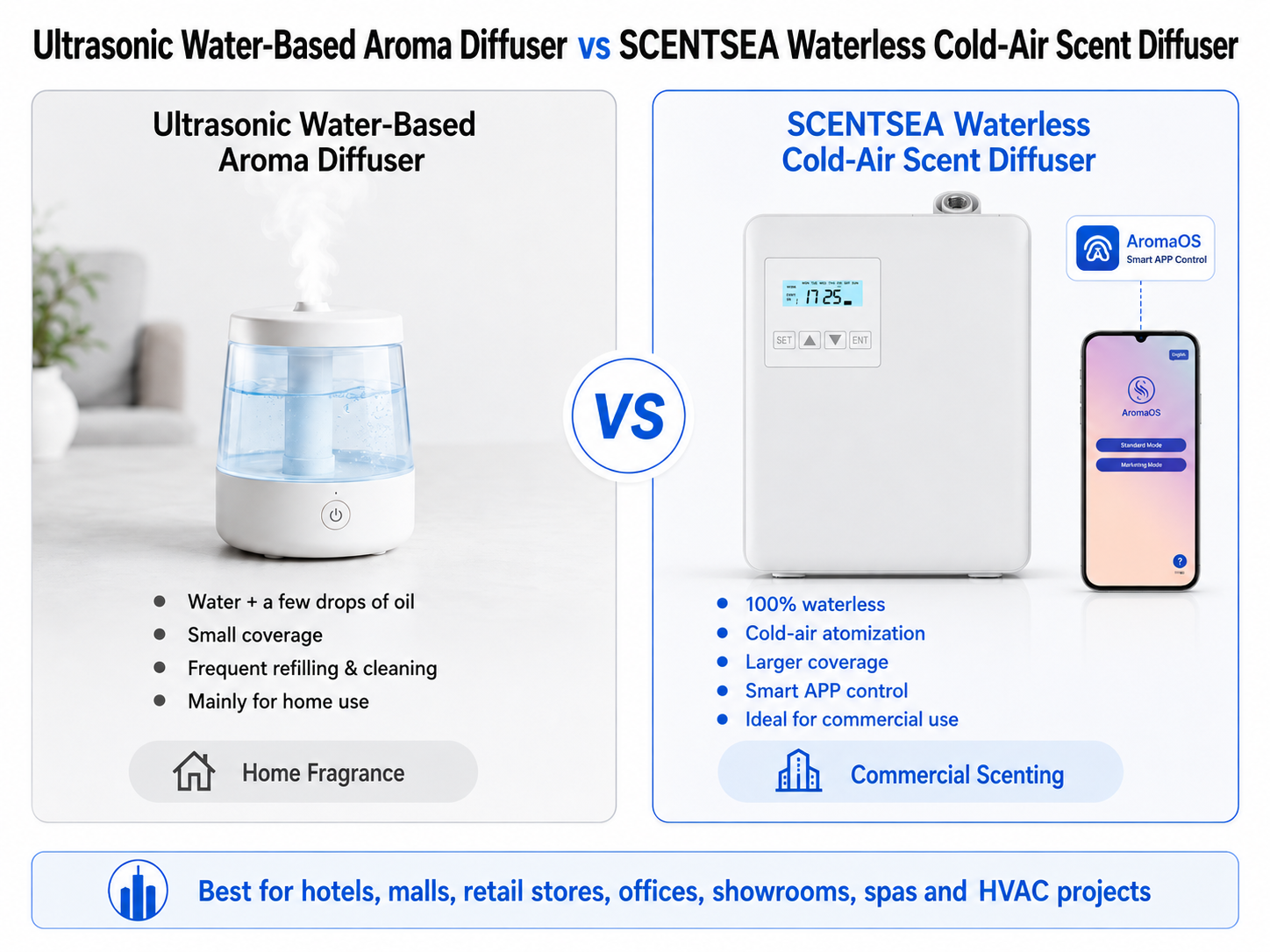
Comparison: waterless cold-air atomization, used in SCENTSEA commercial scenting diffusers, versus water-based ultrasonic diffusion. Cold-air diffusion requires no water and no heating element.
Import planning has become more concrete as well. Commercial scent diffusers are generally classified under HS Code 8509.80, with US import duty reported at 4.2% under that code. For a multi-site rollout, that means hardware, freight and duty are modelled together, while the recurring cost is fragrance oil rather than water.
The practical consequence is portfolio thinking. Hotel groups, banks with branch networks and retail chains increasingly standardise on one power architecture per zone type, so that refill intervals, spare parts and service procedures stay identical across properties. That is a multi-year commitment, which is why supplier stability, warranty and lead time carry as much weight as the specification sheet.
Detailed Solution: The Three Power Classes in Practice
Class 1 — Battery-First: SCENTSEA 4705
The 4705 exists for one reason: it removes the wiring constraint. It runs on 4 D batteries or a 5 V Type-C connection at 2.5 W, so it can be placed in positions where no mains outlet is available and no cabling work is approved.
- Power source: 4× D batteries or 5 V Type-C
- Power consumption: 2.5 W
- Coverage: 100–150 m² (300–500 m³)
- Oil capacity: 500 ml
- Noise: below 35 dB
- Material and colour: plastic, 0.55 kg, white or black
- Typical zones: washrooms, elevators
The trade-off is refilling and battery management rather than performance. A 500 ml oil capacity with no mains connection means scheduled manual checks, which suits smaller, enclosed, high-traffic zones where a maintenance round already exists.
Class 2 — Plug-In Wall-Mounted: SCENTSEA P02
The P02 is the quietest and most discretely installed of the three. It is a wall-mounted, mains plug-in unit that draws DC 12 V at 6.5 W, rated below 30 dB, and covers 150–350 m² (500–1,000 m³) with a 300 ml oil capacity at 2.5 ml/h ±10%.
- Power source: mains plug-in, DC 12 V input, 6.5 W
- Coverage: 150–350 m²
- Oil capacity: 300 ml
- Oil consumption: 2.5 ml/h ±10%
- Noise: below 30 dB
- Material and colour: plastic, 0.8 kg, white or black (customised)
- Options: optional Wi-Fi + Bluetooth control, optional HVAC connector
- Typical zones: washrooms, corridors, shops
The optional Wi-Fi and Bluetooth control and the optional HVAC connector make the P02 the practical choice where a site wants scent tied to operating hours or shared air handling, but does not yet need a large-space machine. Wall mounting keeps it off the floor and out of the way of cleaning crews.
Class 3 — DC 12 V High-Output: SCENTSEA H5000
The H5000 is a floor-standing unit built for volume. It draws DC 12 V at 20 W through a plug-in power supply, atomises 5.4 ml/h ±10% and covers 800–1,300 m² (2,500–4,000 m³) from a 1,000 ml oil capacity, with noise rated below 45 dB. The body is aluminium, the net weight is 6.4 kg and the finish is gunmetal.
- Power source: mains plug-in, DC 12 V, 20 W
- Coverage: 800–1,300 m²
- Oil capacity: 1,000 ml
- Oil consumption: 5.4 ml/h ±10%
- Noise: below 45 dB
- Material: aluminium, 6.4 kg net weight, gunmetal
- Typical zones: hotel, shopping mall, office building lobby
Comparison Table: 4705 vs P02 vs H5000
| Specification | SCENTSEA 4705 | SCENTSEA P02 | SCENTSEA H5000 |
|---|---|---|---|
| Power source | 4× D batteries or 5 V Type-C | Mains plug-in, DC 12 V input | Mains plug-in, DC 12 V input |
| Rated power | 2.5 W | 6.5 W | 20 W |
| Rated voltage | 5 V | DC 12 V | DC 12 V |
| Rated oil consumption | — | 2.5 ml/h ±10% | 5.4 ml/h ±10% |
| Oil capacity | 500 ml | 300 ml | 1,000 ml |
| Coverage | 100–150 m² | 150–350 m² | 800–1,300 m² |
| Noise level | Below 35 dB | Below 30 dB | Below 45 dB |
| Material | Plastic | Plastic | Aluminium |
| Net weight | 0.55 kg | 0.8 kg | 6.4 kg |
| Colours | White, black | White, black (customised) | Gunmetal |
| Form factor | Battery-operated unit | Wall-mounted plug-in unit | Floor-standing unit |
| Control and integration | — | Optional Wi-Fi + Bluetooth, optional HVAC connector | — |
| Typical zones | Washrooms, elevators | Washrooms, corridors, shops | Hotel, shopping mall, office building lobby |
Figures are the published specifications for each model. “—” indicates that the figure is not published for that model; confirm model-specific data before specifying or ordering.
Step-by-Step Breakdown: Matching Power Source to Room Size and Daily Operation
- Measure the scenting volume, not the floor plan. Record floor area, ceiling height, airflow and partition layout. A 1,300 m² lobby with a high ceiling and heavy door traffic behaves very differently from a 1,300 m² open-plan office.
- Map power availability before fragrance. For each zone, note whether a mains outlet exists and can be used. Zones with no accessible power belong to the battery class; zones with power belong to the plug-in classes.
- Match output class to the measured volume. Use 100–150 m² as the battery class window, 150–350 m² for a wall-mounted plug-in unit, and 800–1,300 m² for the high-output DC 12 V class. For larger centralised projects that need ducted distribution, a dedicated HVAC scenting system in the same range (for example the AC-MAX, rated 2,500–3,500 m²) is the appropriate category rather than a freestanding diffuser.
- Set the noise ceiling by space type. Quiet interiors — hotel corridors, reception, offices, banks — benefit from the below 30 dB class, while high-volume concourses and lobbies can accept the below 45 dB band. Confirm noise with a sample in the actual room, not only on the datasheet.
- Calculate refill intervals from rated figures. Divide oil capacity by rated consumption: 300 ml at 2.5 ml/h is approximately 120 hours of atomization, and 1,000 ml at 5.4 ml/h is approximately 185 hours. Then apply the real schedule — running 12 hours per day instead of 24 hours reduces scheduled operating time by 50%.
- Decide control and integration level. If scent must follow trading hours or be adjusted remotely, choose a model with optional Wi-Fi and Bluetooth control and, where relevant, an HVAC connector. If the zone is small and fixed, a simpler schedule is sufficient.
- Validate with samples, then lock the supply chain. Test the chosen class in the real installation before rolling it out across a property or a chain, and confirm quality control, warranty, spare parts and lead time at the same time.
Use Cases: Where Each Power Class Sits
Hotels and hospitality spaces
A hotel is usually a mixed portfolio rather than one scenting project. A large lobby or atrium fits the DC 12 V high-output class at 800–1,300 m² per unit. Guest corridors, washrooms and lift lobbies fit the quieter wall-mounted plug-in class, especially where the below 30 dB rating keeps noise out of the guest experience. Guest elevators and back-of-house washrooms with no outlet fit the battery class, where the 500 ml capacity and below 35 dB rating are sufficient.
Retail stores and shopping malls
Boutique stores with ceilings and a single power point suit wall-mounted plug-in units in the 150–350 m² range. Open mall concourses, atria and large flagship floors need the higher-output DC 12 V class, where one unit can hold 800–1,300 m². Fitting rooms, staff areas and stock corridors are typical battery-class zones when wiring is impractical.
Offices, banks and airports
Office reception and open floors usually combine a wall-mounted plug-in unit for enclosed areas with high-output units for double-height lobbies. Banks with branch networks benefit from standardising on the same two classes across locations, while airport and terminal areas with large open volumes are best served by the high-output class or a ducted HVAC scenting system.
Elevators, washrooms and corridors
This is the clearest battery territory: no outlet, small volume, frequent traffic, and a maintenance round that already exists. Where a power point is available in the same zone, a wall-mounted plug-in unit reduces battery handling and moves the noise rating from below 35 dB to below 30 dB.
Oil Consumption, Refill Intervals and Daily Operating Reality
Oil consumption, not equipment price, is what an operator actually manages week to week. The published ratings in this comparison are 2.5 ml/h ±10% for the P02 and 5.4 ml/h ±10% for the H5000, with the 4705 specified at a 500 ml oil capacity.
- P02: 300 ml capacity ÷ 2.5 ml/h ≈ 120 hours of atomization per refill.
- H5000: 1,000 ml capacity ÷ 5.4 ml/h ≈ 185 hours of atomization per refill.
- Scheduling effect: operating 12 hours per day instead of 24 hours reduces scheduled operating time by 50%, which lowers both electricity use and oil consumption.
Technology choice affects the long-term bill as much as the model does. Waterless cold-air diffusion carries a higher initial equipment cost than water-based ultrasonic diffusion, but requires no water refilling, less frequent cleaning and lower daily maintenance; across commercial use the five-year maintenance cost can be approximately 40% lower. Ultrasonic water-based aroma diffusers remain a reasonable choice for small residential rooms and light personal fragrance use, but they are not designed for continuous large-area commercial scenting.
Compliance, Quality Control and Long-Term Supply
Because a diffuser rollout is a multi-year decision, the specification should be read together with the supplier’s compliance, testing and delivery capability.
Compliance. Certification requirements depend on the destination market, the exact model and whether wireless functions are fitted. For the European market, check applicable CE and RoHS documents; Bluetooth or Wi-Fi configurations may also need to meet RED requirements. For the US market, verify applicable FCC compliance. SCENTSEA diffuser models are certified with CE, RoHS and FCC, and certificates or test reports should always match the exact production model and configuration being purchased.
Quality control. Pre-shipment control procedures include 100% functional testing, atomization testing, leakage inspection, noise testing, APP/control testing, a 48-hour aging test and final appearance inspection. One hundred percent of products undergo functional testing before shipment — which is the practical answer to the quality risks buyers most often flag: unstable atomization, oil leakage, excessive noise, unreliable control functions and inconsistent batch performance.
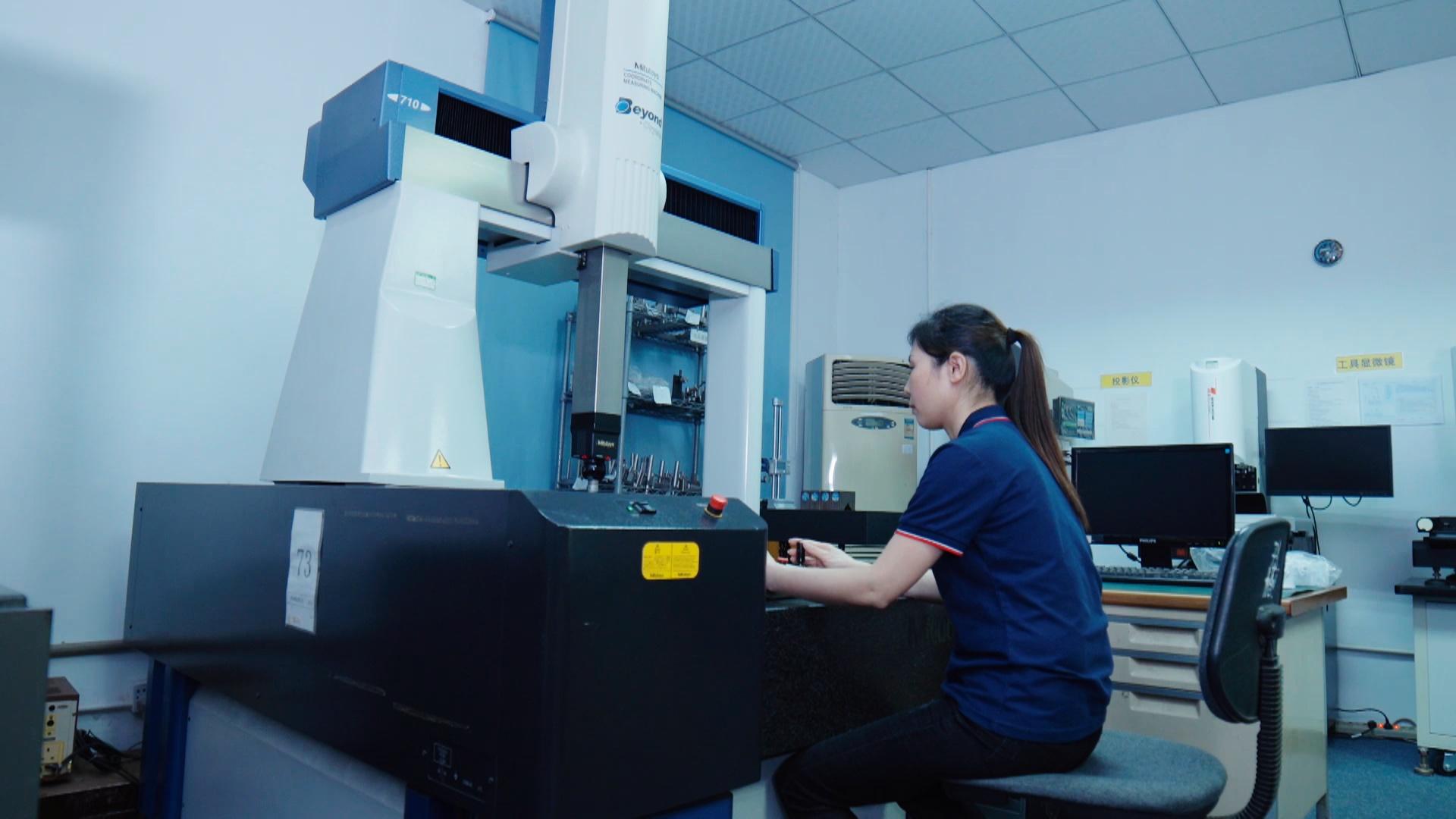
Quality measurement equipment used for inspection during scent diffuser production at Shenzhen Scentsea Technology Co., Ltd.
Supply and service. Monthly production capacity is 8,000 units, typical lead time is 25–35 days, and the minimum order quantity for diffusers starts from 1 unit. Delivery terms are EXW, FOB or CIF, and payment terms are 50% T/T in advance with the balance before shipment. The manufacturer provides a 1-year free warranty on spare parts. Shenzhen Scentsea Technology Co., Ltd. was founded in 2021, operates a 3,000 m² facility in Shenzhen, China, and supplies waterless cold-air scent diffusers and fragrance oils to customers in more than 70 countries and regions, including North America, Europe, the Middle East, Australia and Southeast Asia.
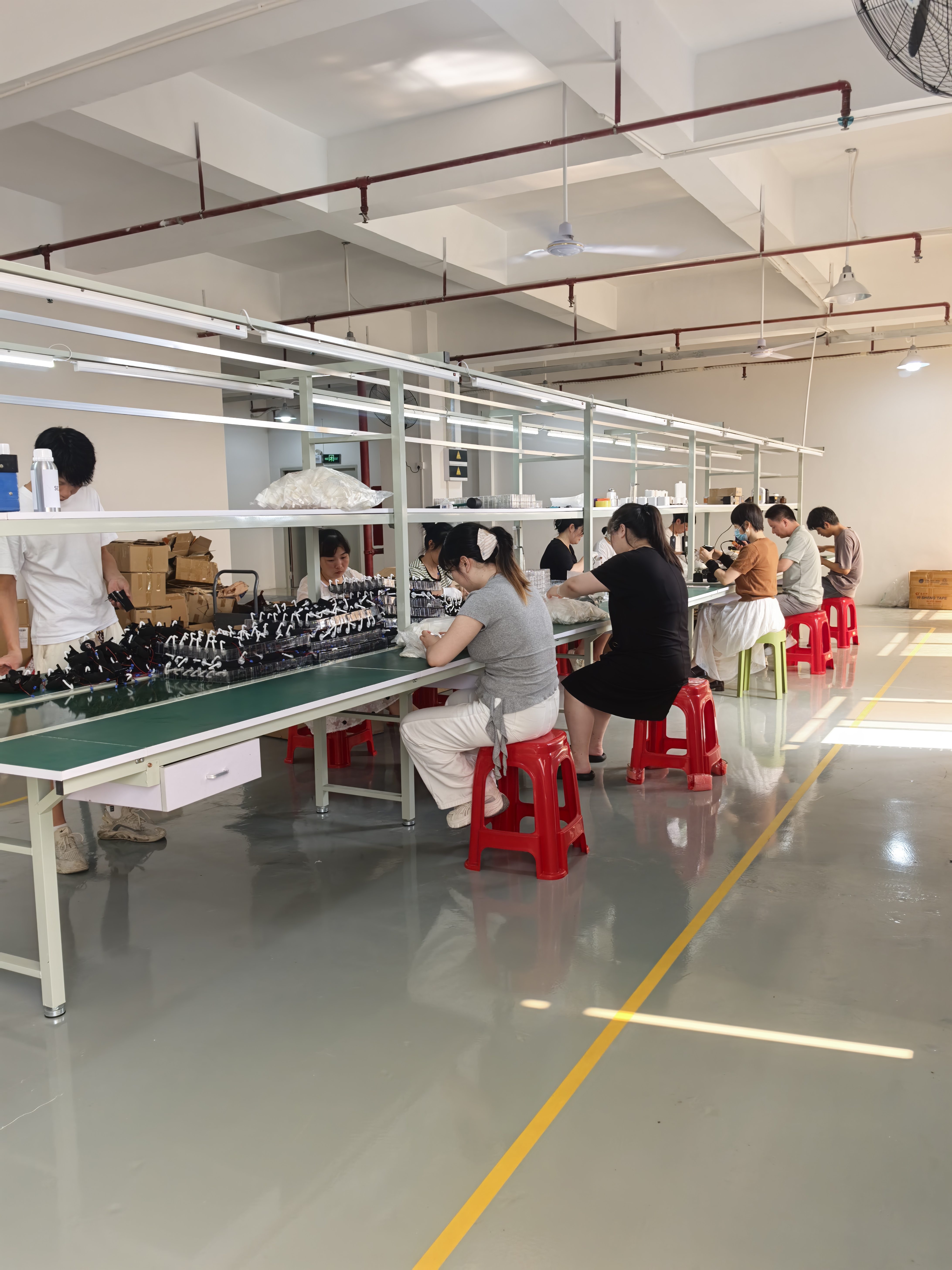
Assembly line at the SCENTSEA production facility, where monthly capacity is 8,000 units.
Frequently Asked Questions
What certifications should a commercial scenting diffuser carry for EU and US projects?
Certification depends on the destination market, the product model and whether wireless functions are included. For the European market, buyers should normally check applicable CE and RoHS compliance documents, and Bluetooth or Wi-Fi models may also need to meet RED requirements. For the US market, applicable FCC compliance should be verified. SCENTSEA diffuser models are certified with CE, RoHS and FCC, but buyers should always confirm that the certificates and test reports cover the exact production model and configuration being purchased, since a wireless-enabled variant may fall under different requirements than a standard plug-in unit.
Do battery, plug-in and DC 12 V diffusers cover the same area?
No. Coverage follows output class. The 4705 covers 100–150 m² on 2.5 W, the P02 covers 150–350 m² on 6.5 W, and the H5000 covers 800–1,300 m² on 20 W. Rated coverage should also be adjusted for the real room: ceiling height, ventilation, airflow and partitions all affect how far fragrance travels, so the selection should be based on the actual scenting volume rather than the maximum figure on the datasheet.
Is a waterless cold-air diffuser more expensive to run than a water-based ultrasonic unit?
Upfront, yes; over several years, usually not. A waterless cold-air diffuser has a higher initial equipment cost but requires no water refilling, less frequent cleaning and lower daily maintenance, and its five-year maintenance cost can be approximately 40% lower for commercial use. On consumption, the P02 uses 2.5 ml/h ±10% and the H5000 uses 5.4 ml/h ±10%, so a 300 ml bottle gives roughly 120 hours of atomization and a 1,000 ml bottle roughly 185 hours; running 12 hours per day instead of 24 reduces scheduled operating time by 50%. Ultrasonic water-based aroma diffusers have a lower purchase cost but are designed mainly for small residential spaces and light personal use.
How do I validate a diffuser before committing to a multi-floor project?
Test in the real installation, not on a table. Order diffuser samples and fragrance oil samples, install the candidate class in the actual zone, and check power availability, coverage at the far end of the space, noise at the quietest period, and refill frequency against the planned schedule. Compatible third-party fragrance oil can be used, but viscosity and formulation should be tested for stable atomization. MOQ starts from 1 piece for diffusers, so a single-unit trial is feasible, and buyers should verify functional, atomization, leakage, noise and control testing, the 48-hour aging test and final appearance inspection before releasing a bulk order.
How do I choose a long-term commercial scenting system manufacturer for hotel projects?
Evaluate five things in order: whether the same power classes can be supplied consistently for every zone in the property; whether quality control covers 100% functional testing, atomization, leakage, noise and APP/control testing plus a 48-hour aging test before shipment; whether compliance documents match the exact model; whether spare parts and warranty terms are workable — SCENTSEA provides a 1-year free warranty on spare parts; and whether capacity and lead time support staged openings. Monthly production capacity is 8,000 units with a typical lead time of 25–35 days, MOQ starts from 1 unit, delivery terms are EXW/FOB/CIF, and payment terms are 50% T/T in advance with the balance before shipment. Reviewing the full commercial scenting catalogue and requesting samples or wholesale pricing is the fastest way to confirm these points against your own project schedule — contact the SCENTSEA team at jimmy@scent-sea.com or +86 19928719703 with your zone list and power availability.
Conclusion: Choose the Power Class, Then the Model
The comparison reduces to a short sequence. If there is no usable outlet, the battery class — the 4705 at 2.5 W, below 35 dB and 100–150 m² — is the only viable option. If there is a power point and the requirement is quiet, mid-size coverage with optional wireless control and HVAC integration, the wall-mounted plug-in P02 at 6.5 W, below 30 dB and 150–350 m² fits the zone. If the space is large and open — hotel lobbies, shopping malls, office building reception — the DC 12 V high-output H5000 at 20 W, 5.4 ml/h, below 45 dB and 800–1,300 m² carries the volume.
Everything else — fragrance selection, refill schedule, spare parts, warranty and lead time — is easier to settle once the power class is fixed. That is also what makes a multi-site commercial scenting roll-out manageable: three power classes, consistent specifications, and one supply chain behind them.
Next Step: Sample, Quote or Catalogue
Download the full SCENTSEA product catalogue (PDF), request diffuser and fragrance oil samples, or send your zone list with power availability for a specification recommendation.
Email: jimmy@scent-sea.com | Tel / WhatsApp: +86 19928719703 | Website: www.scent-sea.com
Shenzhen Scentsea Technology Co., Ltd — Block A, Jinxing Building, Longhua District, Shenzhen, China.
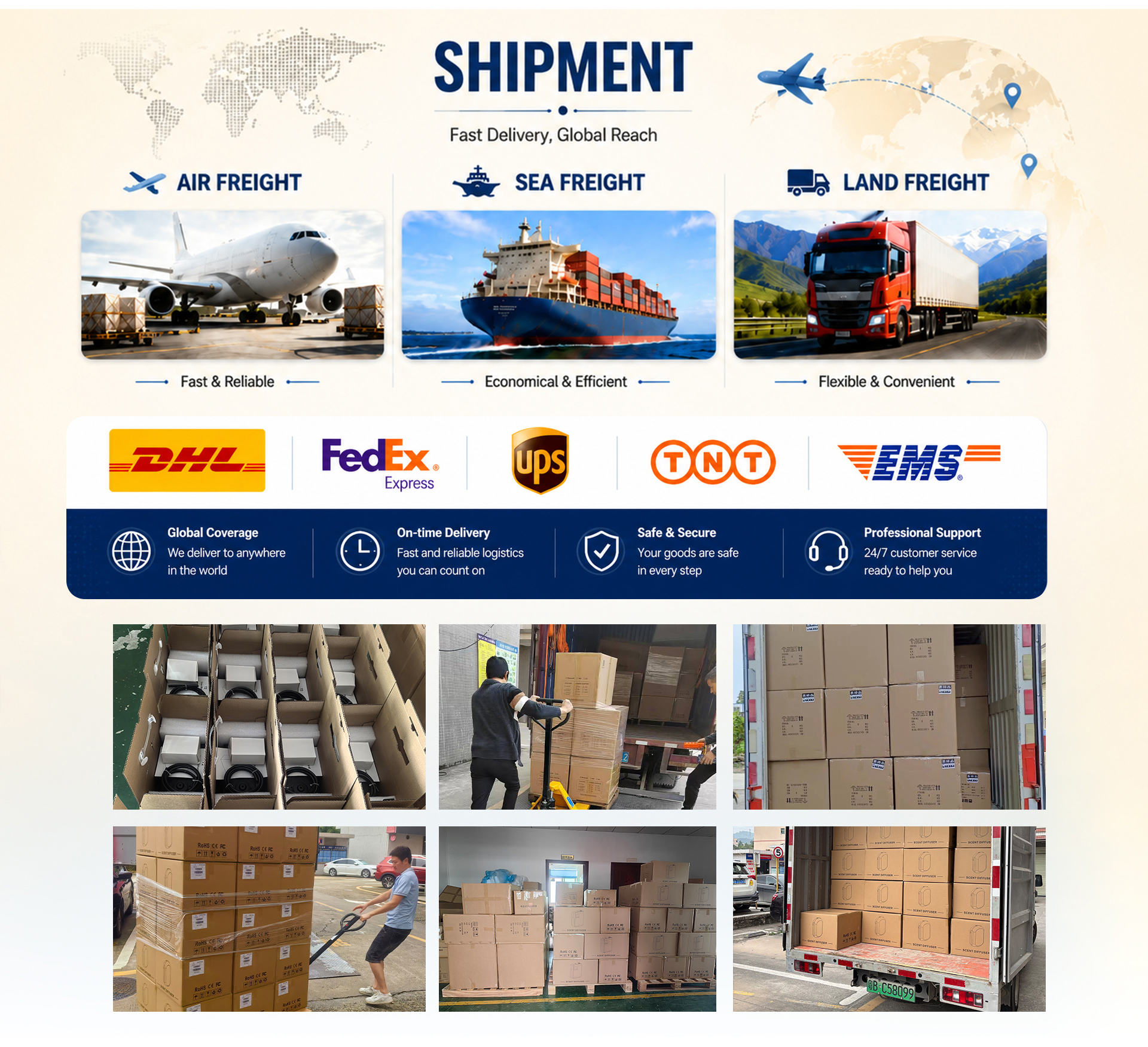
Shipment preparation. Diffuser orders start from a minimum order quantity of 1 unit, with a typical lead time of 25–35 days.
Have Questions or Need More Details?
Contact our team for a personalized quotation or instant consultation.
Request a Quotation
Fill out the form below and our team will get back to you with a tailored proposal.
WhatsApp Direct Chat
Prefer to chat in real-time? Message us on WhatsApp for instant assistance & quick answers.
- Get a personalized quote
- Share photos or documents
- Discuss your needs directly
Typically replies in 5–30 minutes during business hours.