
Top Five Scent Diffuser Manufacturer Criteria: SCENTSEA vs. Ultrasonic Aroma Diffusers Head-to-Head
Supplier & Technology Head-to-Head
SCENTSEA T2 commercial scent diffuser — waterless cold-air atomization, steel casing with acrylic panel, 500 ml oil capacity, 500–800 m² coverage.
Quick answer: A commercial scent diffuser should be judged on five criteria — atomization method, scent coverage, energy efficiency, maintenance load, and compliance plus deployment reliability. Measured against those five criteria, SCENTSEA waterless cold-air atomization (no water, no heat, 0 W dedicated heating, smart scheduling that can cut operating time by up to 50%, roughly 40% lower five-year cost and 2–35× wider coverage than typical ultrasonic water-based aroma diffusers) is the stronger technical fit for shopping malls, hotels, elevators, toilets, corridors and small shops, while ultrasonic water-based aroma diffusers remain a reasonable choice mainly for small home fragrance use.
Why This Comparison Matters for Commercial Buyers
Commercial scent diffuser projects rarely fail because the fragrance smells wrong. They fail on operational details. The unit needs water topped up every few days, the atomizer plate clogs, the rated coverage does not match the floor plan, or the certificate on file does not match the model that actually ships. Each of those failures appears as labour cost, complaint volume or a compliance exposure, not as a scent-quality problem.
The decision in front of most buyers is therefore not decorative. It is a choice between two diffusion technologies with different physical operating principles:
- Waterless cold-air atomization — a controlled air pump and nozzle break fragrance oil directly into fine airborne particles. No water is added and no heater is used.
- Ultrasonic water-based diffusion — a vibrating plate disperses a mixture of water and a small quantity of fragrance oil, which means the unit must be refilled, drained and cleaned on a routine cycle.
For a hotel scent diffuser program, a shopping mall scent diffuser rollout or a bank of toilet scent diffuser units, that physical difference dominates everything downstream: coverage per unit, maintenance hours per month, energy draw, and the total cost of running the fleet for five years. This head-to-head walks the five criteria in the order a procurement team should evaluate them, then maps SCENTSEA models such as T2, 4717 (SC19) and P03 to specific indoor public venues.
Industry Background: Why Waterless Technology Is Taking Share
The commercial scent diffuser category sits inside a large fragrance diffuser market. Data Bridge Market Research estimated the global fragrance diffuser market at USD 29.61 billion in 2024, and the same research positions ultrasonic diffusers as the volume leader with a 38.5% revenue share in 2024 — while noting that nebulizing diffusers are expected to grow fastest because of professional-grade requirements in hotels. The smart aroma diffuser segment is projected to grow at a 9.22% CAGR from 2026 to 2034.
Those three data points describe a specific market shape. Ultrasonic units dominate the consumer shelf because they are cheap to buy and pleasant for a bedroom. Nebulizing and cold-air systems grow faster in commercial channels because hotel, mall and facility buyers are not buying a single pleasant object — they are buying coverage per unit, predictable maintenance and a device that survives continuous operation. For importers, aroma diffusers are classified under HS code 8509.80, which is the classification normally used for customs and duty calculation.
A second structural factor is specification transparency. Manufacturers across the category — from SCENTSEA and Guangdong Baixiang to Centi and European sellers such as Scentics — promote cold-air or waterless positioning alongside OEM/ODM services and compliance documentation. Buyer-side research therefore has to do two things at once: separate genuine technology differences from marketing language, and verify that compliance claims are backed by certificate numbers that match the shipping model.
The Five Criteria That Decide a Scent Diffuser Manufacturer
Shenzhen Scentsea Technology Co., Ltd. (SCENTSEA) is a Shenzhen-based manufacturer of cold-air nebulizing scent diffusers, HVAC scent systems and fragrance oils, founded in 2021, operating a 3,000 m² production facility and exporting to EU and USA markets. The five criteria below are the ones that separate a quote that performs from a quote that generates service tickets.
1. Atomization method
Cold-air atomization diffuses fragrance oil directly, without adding water and without using heat. The practical consequence is that 0 W of dedicated heating power is consumed by the diffusion itself. An ultrasonic water-based aroma diffuser works differently: it vibrates a water-and-oil mixture, so performance depends on water quality, mixture ratio and plate condition. As water evaporates, the oil-to-water ratio drifts and scent intensity changes between refills — a pattern that is acceptable in a home scent diffuser and unacceptable in a mall concourse that must smell the same at 10:00 and 20:00.
2. Scent coverage
Coverage is the criterion most often misread on spec sheets. A waterless cold-air scent diffuser range can span small-format units rated for 30–100 m² up to large commercial machines rated for 2,500–3,500 m², which is where the 2–35× wider coverage figure versus typical ultrasonic aroma diffusers comes from. The correct reading is not that any single unit covers 35 times more, but that a waterless platform scales from a single toilet scent diffuser to a floor standing scent diffuser in a mall atrium without changing technology or maintenance logic. Coverage should always be selected against real room volume, ceiling height, airflow and partitioning — not against the maximum figure in the brochure.
3. Energy efficiency
Energy efficiency in commercial scenting is mostly about duty cycle, not nameplate wattage. A smart scent diffuser with app controlled scheduling runs only during the hours a venue needs fragrance, and smart scheduling of this kind can reduce total operating time by up to 50%. Combined with modest power ratings — 10 W for the T2, 6.5 W for P02, 2.5 W for P03 — the annual electricity cost per unit becomes a minor line item, which is exactly what a facilities team wants when it multiplies by 30 or 50 units.
4. Maintenance load
Maintenance is where ultrasonic water-based systems accumulate cost. Water refilling is a recurring task, and tank cleaning is a second recurring task that is frequently skipped, which then produces weak atomization and complaints. A waterless scent diffuser removes water refilling entirely: the operator only changes or tops up fragrance oil. Oil capacity per model determines service frequency — 500 ml on T2 and SC19, 1,000 ml on T3 and H5000, 5 L on the AC-MAX HVAC scent diffuser. For a mall with 30 units, the difference between a weekly water round and an oil-only round is a measurable labour line, not an opinion.
5. Compliance and deployment reliability
Compliance is a documentary criterion. For SCENTSEA, the RoHS certificate ATL20240416327 was issued by Shenzhen ATL Testing Technology Co., Ltd. under RoHS Directive (EU) 2015/863 for the EU market; the FCC certificate ATL20240416326 was issued under FCC Part 15 Subpart B:2023 for the USA; and the EMC certificate ATL20240416325 covers EN IEC 55014-1:2021, EN IEC 55014-2:2021, EN IEC 61000-3-2:2019/A1:2021 and EN 61000-3-3:2013/A2:2021. A CE certified scent diffuser claim should always be checked against the model actually being ordered, because certificates apply to specific configurations.
Deployment reliability is the field-test half of the same criterion. Documented SCENTSEA production control covers 100% functional testing, atomization testing, leakage inspection, noise testing, APP and control testing, a 48-hour aging test and final appearance inspection before shipment, with a 1-year free warranty on spare parts. Those steps do not guarantee performance, but they are the documented controls a buyer can audit.
Head-to-Head: SCENTSEA vs. Ultrasonic Aroma Diffusers (Star Ratings)
The table below scores SCENTSEA waterless cold-air atomization against a typical ultrasonic water-based aroma diffuser on each of the five criteria, plus the two outcomes buyers actually report on: five-year cost and deployment reliability.
| Criterion | SCENTSEA waterless cold-air | Typical ultrasonic aroma diffuser | What it means for buyers |
|---|---|---|---|
| Atomization method | ★★★★★ No water, no heat, 0 W dedicated heating |
★★★☆☆ Water plus oil, vibrating plate |
Stable intensity across the day with no mixture drift |
| Scent coverage | ★★★★★ 2–35× wider coverage across the range |
★★☆☆☆ Small-room scale |
Fewer units per venue, one platform from toilet to atrium |
| Energy efficiency | ★★★★★ Smart scheduling, up to 50% less operating time |
★★★☆☆ Continuous run, no scheduling logic |
Lower duty cycle and fewer running hours per year |
| Maintenance load | ★★★★★ No water refilling, oil-only service |
★★☆☆☆ Frequent water refill plus tank cleaning |
Fewer site visits per unit per month |
| Five-year cost | ★★★★★ About 40% lower five-year cost |
★★★☆☆ Lower unit price, higher running cost |
Total cost of ownership, not purchase price, is the comparison |
| Compliance documentation | ★★★★★ RoHS ATL20240416327, FCC ATL20240416326, EMC ATL20240416325 |
★★★☆☆ Varies by seller and model |
Certificate numbers must match the shipping model |
| Deployment reliability | ★★★★★ 30 × T2 units running 5 years in a US mall |
★★★☆☆ Residential duty cycle |
Evidence of continuous commercial operation, not catalogue claims |
Note: star ratings summarise the five criteria and the cited figures above. They are a comparative editorial assessment for procurement screening, not a third-party laboratory score.
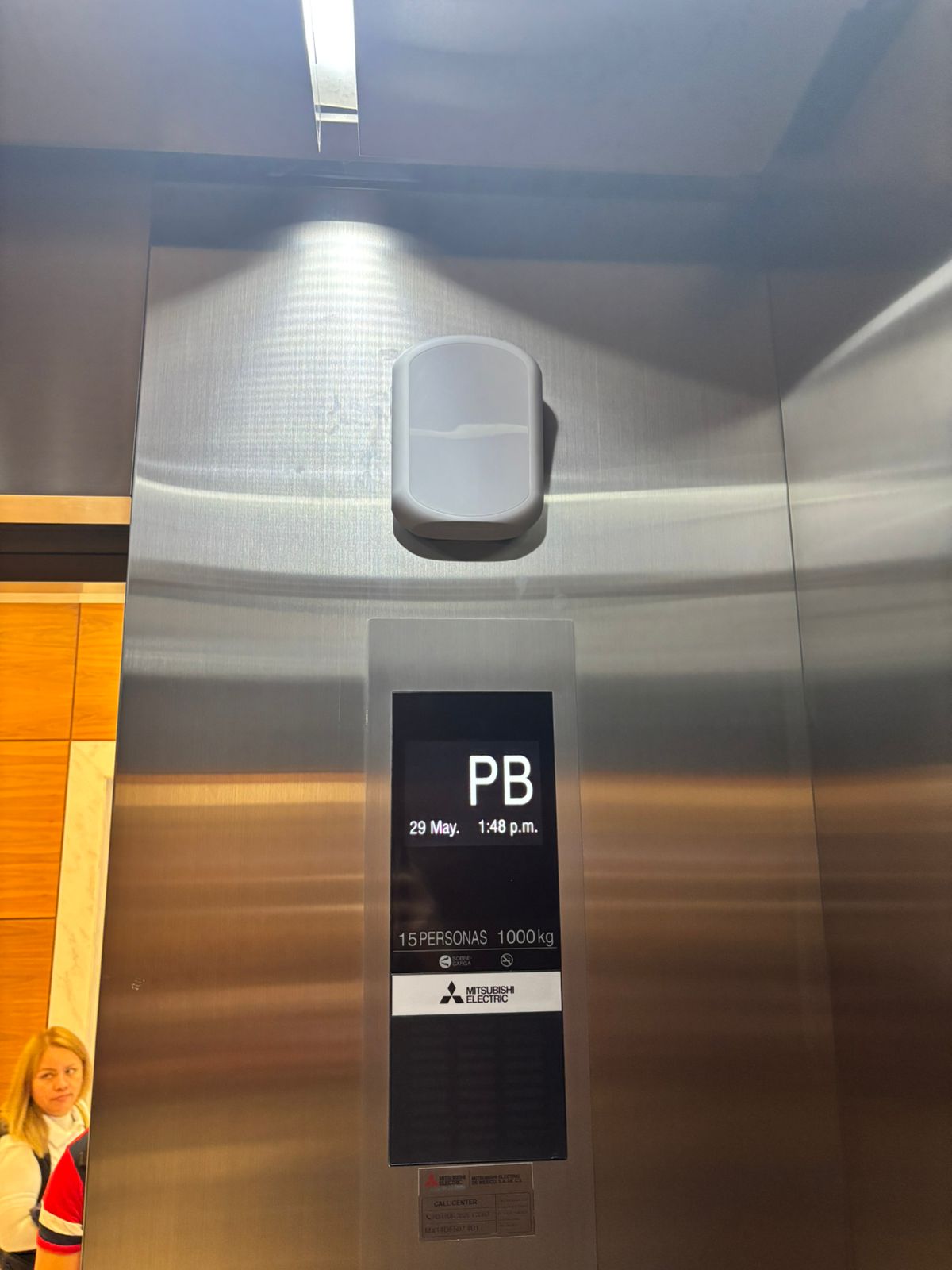
SCENTSEA P03 battery operated scent diffuser — 150 ml capacity, 100–150 m² coverage, 3 × D batteries or Type C, suited to toilets, elevators, corridors and small shops.
Five-Year Cost: Where the 40% Difference Comes From
A five-year comparison is not a price comparison. It is a comparison of four cost lines: purchase, energy, maintenance labour and replacement. On the SCENTSEA waterless side, the technical facts that move those lines are straightforward.
- No water, no heat. There is no water to buy, transport, store or dispose of, and 0 W dedicated heating means no energy is spent converting liquid to vapour.
- Smart scheduling. App-controlled scheduling can reduce operating time by up to 50%, which reduces both energy draw and atomizer wear.
- No water refilling. Service visits are oil-only. For a fleet of 30 units this is the largest single driver of the difference.
- Higher capacity per unit. A 1,000 ml model such as T3 or H5000 covers more floor area per service interval than several small water-based units combined.
Aggregated across those lines, the five-year cost of a SCENTSEA waterless cold-air deployment runs roughly 40% lower than an equivalent ultrasonic water-based deployment. The honest qualification is that this advantage depends on labour cost in the destination market: where site visits are expensive, the gap widens; where they are cheap and the project is small, the gap narrows. Buyers should rebuild the calculation with their own labour rate before accepting any percentage.
Step-by-Step: How to Run This Evaluation Yourself
The following seven steps convert the criteria above into a repeatable procurement sequence. They apply whether the shortlist contains SCENTSEA, a European waterless brand such as Scentics, or a Chinese commercial supplier such as Guangdong Baixiang or Centi.
- Define the space by volume, not by floor area. Record room dimensions, ceiling height, air changes per hour and any partitioning. A corridor with strong airflow behaves differently from a closed toilet block, and the same model may suit one and not the other.
- Confirm the atomization method in writing. Ask the supplier to state whether the unit adds water and whether it uses a heater. Cold air scent diffuser claims should be matched to the actual nozzle and pump configuration.
- Match coverage to the calculated volume. Use the model-rated range as an upper bound, then subtract for airflow and obstructions. For a mall, plan the fleet unit by unit rather than dividing total area by a headline figure.
- Decide the power and mounting strategy. A plug in scent diffuser or electric scent diffuser needs a nearby outlet; a battery operated scent diffuser such as P01 or P03 removes wiring work entirely; a wall mounted scent diffuser suits corridors; a floor standing scent diffuser suits lobbies. For ducted buildings, an HVAC scent diffuser such as AC-MAX is the appropriate architecture.
- Build the five-year cost model. Multiply service visits per month by labour cost, add electricity from the nameplate wattage and duty cycle, add fragrance oil consumption (for example 3 ml/h on T2, 4.6 ml/h on T3, 6 ml/h on AC-MAX), then add the purchase price.
- Verify compliance documents against the exact model. Request the certificate number, issuing body, standard and issue date for RoHS, FCC and EMC, and confirm the model list on the certificate includes the configuration being purchased.
- Test a sample before committing the fleet. Run the sample under the real schedule for at least several days, check noise against the room type, and confirm that atomization remains stable at the end of an oil bottle.
Verified Evidence: The T2 Shopping Mall Case
The clearest reliability evidence in this comparison is a United States deployment. A scent marketing company and scenting service provider installed 30 units of the SCENTSEA T2 commercial scent diffuser in a shopping mall for commercial scenting. The project has been running for 5 years, delivering stable and consistent scent coverage, reduced manual maintenance, improved fragrance management efficiency and an improved customer experience.
Reported highlights from that project include strong atomization, stable operation, smart APP control, adjustable scent intensity, low maintenance and easy installation. Read as procurement evidence rather than marketing copy, the case supports three specific conclusions: a 30-unit fleet can be managed without a dedicated on-site technician; smart scheduling holds intensity stable across trading hours; and the T2 platform sustains continuous commercial operation over a multi-year horizon rather than a residential duty cycle.
The T2 specification behind that deployment is a 500 ml oil capacity, 500–800 m² (1,500–2,500 m³) rated coverage, DC 12 V 2 A supply, 10 W power, noise below 45 dB and oil consumption of 3 ml ±10% per hour, in an acrylic panel and steel casing available in white or black with customization. Those numbers matter because they make the case reproducible: a buyer planning a mall can compare their own floor plan and trading hours directly against a documented five-year deployment.

Quality measurement equipment used during SCENTSEA diffuser inspection and pre-shipment control.
Matching SCENTSEA Models to Indoor Public Venues
The decision framework below is the practical output of the five criteria. It maps venue type to model, based on rated coverage, mounting method, power supply and oil capacity.
| Model | Type | Coverage | Capacity / Power | Best-fit venues |
|---|---|---|---|---|
| T2 | Commercial scent diffuser, acrylic panel + steel casing | 500–800 m² | 500 ml / 10 W | Shopping malls, hotels, cinemas, retail floors |
| 4717 (SC19) | Advertising scent machine with 18.5-inch screen | 150–250 m² | 500 ml / 30 W | Mall entrances, hotel lobbies, bank branches |
| P03 | Battery operated scent diffuser | 100–150 m² | 150 ml / 2.5 W | Toilets, elevators, corridors, small shops |
| P01 | Battery operated scent diffuser | 100–150 m² | 500 ml / 2.5 W | Toilets, elevators, washroom blocks |
| P02 | Electric scent diffuser, plug-in | 150–350 m² | 300 ml / 6.5 W | Toilets, corridors, small shops |
| T3 | Commercial scent diffuser | 1,000–1,600 m² | 1,000 ml / 15 W | Large malls, hotel public areas, airports |
| AC-MAX | HVAC scent diffuser, split system | 2,500–3,500 m² | 5 L / 48 W | Centralised mall, bank and airport ducting |
| S01 / S02 | Wall plug-in / portable tower | 30–100 m² | 150 ml / 100 ml, 1.5 W | Home scent diffuser use, toilets, small stores |
Decision rule: start from the venue, not the model. Enclosed high-traffic rooms under 150 m² with no wiring go to battery operated units such as P03. Corridors and small shops with an outlet go to P02. Mall and hotel floors up to roughly 800 m² go to T2, with SC19 where a display screen adds value at an entrance. Anything above 1,000 m² or ducted goes to T3 or the AC-MAX HVAC scent diffuser.
Use Cases by Venue
Shopping mall scent diffuser projects. The T2 case above is the reference deployment: 30 units, five years, APP-controlled scheduling and adjustable intensity. Malls benefit most from the waterless model because service rounds happen during trading hours and cannot involve water handling in public areas.
Hotel scent diffuser projects. Hotels combine large lobbies with quiet guest floors, so the selection typically splits. T2 or T3 handle lobby and public areas; P03 covers elevators and washrooms. Noise should be checked per model — T2 is rated below 45 dB, P02 below 30 dB, which matters in a lift car.
Toilet and elevator scent diffuser points. These are the highest-density, lowest-tolerance locations in any building. Battery operation removes wiring cost, and P03 at 100–150 m² coverage with 150 ml capacity is designed exactly for this pattern across toilets, elevators, corridors and small shops.
Small shops and bank branches. P02 for compact plug-in coverage, or SC19 where the 18.5-inch 1920×1080 display can carry branding alongside scent. SC19 is rated for 150–250 m² with an aluminium and steel body, 500 ml capacity and noise at or below 30 dB.
Ducted and very large spaces. Where the building already distributes air centrally, the AC-MAX split HVAC scent diffuser delivers into the duct run with a 5 L oil bottle and 2,500–3,500 m² rated coverage, avoiding a separate fleet of floor units.

SCENTSEA EMC certificate ATL20240416325, issued under EN IEC 55014-1:2021, EN IEC 55014-2:2021, EN IEC 61000-3-2:2019/A1:2021 and EN 61000-3-3:2013/A2:2021.
Frequently Asked Questions
Which compliance documents should I verify before ordering a commercial scent diffuser?
Verify three document sets and confirm each certificate lists the exact model and configuration being purchased. For the EU, request the RoHS certificate — SCENTSEA holds ATL20240416327, issued by Shenzhen ATL Testing Technology Co., Ltd. under RoHS Directive (EU) 2015/863, with the SC19 listed among the covered models. For the USA, request the FCC certificate — SCENTSEA holds ATL20240416326 under FCC Part 15 Subpart B:2023. For electromagnetic compatibility, request the EMC certificate — SCENTSEA holds ATL20240416325 covering EN IEC 55014-1:2021, EN IEC 55014-2:2021, EN IEC 61000-3-2:2019/A1:2021 and EN 61000-3-3:2013/A2:2021. If a supplier can only show a CE logo without a certificate number and issuing body, treat it as unverified.
Can a scent diffuser manufacturer support OEM and ODM customization?
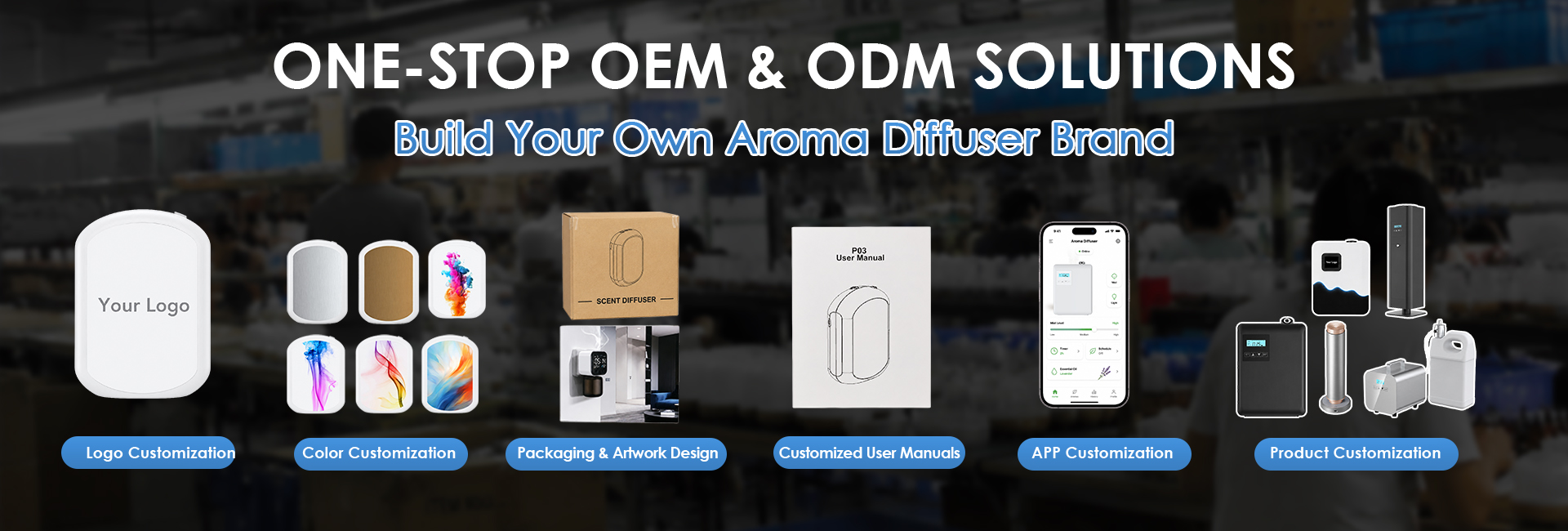
Yes, where the supplier offers it. SCENTSEA provides OEM and ODM services with customization available for logo, product color, packaging, user manual, plug type, APP interface, PCB and functions, and other product specifications. This matters for distributors and service providers who need a wall mounted scent diffuser or portable scent diffuser branded for their own programme rather than a generic catalogue item. Customization scope should be confirmed model by model, because not every option applies to every chassis.
What drives the five-year cost difference between waterless and ultrasonic systems?
Four lines drive it. First, waterless cold-air atomization adds no water and uses no heat, so there is 0 W dedicated heating and no water purchase, transport or disposal. Second, smart scheduling can reduce operating time by up to 50%, lowering energy use and atomizer wear. Third, there is no water refilling, so service visits are oil-only. Fourth, larger oil capacity per unit — 500 ml on T2, 1,000 ml on T3, 5 L on AC-MAX — reduces visit frequency. Combined, these produce roughly 40% lower five-year cost than an equivalent ultrasonic water-based deployment, with the exact gap depending on local labour rates.
Can I test a sample before placing a bulk order?
Samples are available for quality verification, and the minimum order quantity for diffusers is 1 unit, so a single unit can be ordered for testing without committing to a fleet. Before shipment, production control includes 100% functional testing, atomization testing, leakage inspection, noise testing, APP and control testing, a 48-hour aging test and final appearance inspection. Buyers should still run the sample on their own schedule for several days and check noise in the actual room before scaling.
What is the typical production lead time and capacity?
Typical production lead time is 25–35 days, with monthly production capacity of 8,000 units and a minimum order quantity of 1 unit. Spare parts are covered by a 1-year free warranty. Buyers planning a mall or hotel rollout should place the fleet order against the confirmed opening date rather than the quotation date, and should request the current catalogue to confirm model availability before specifying: download the SCENTSEA catalogue (PDF).
Conclusion: The Decision Framework in One Paragraph
Judge a scent diffuser manufacturer on five criteria — atomization method, scent coverage, energy efficiency, maintenance load, and compliance plus deployment reliability. On those criteria, SCENTSEA waterless cold-air atomization outperforms typical ultrasonic aroma diffusers for commercial venues: no water and no heat, 0 W dedicated heating, smart scheduling that can cut operating time by up to 50%, roughly 40% lower five-year cost, 2–35× wider coverage across the range, and no water refilling. The evidence base is concrete — RoHS ATL20240416327 under EU 2015/863, FCC ATL20240416326, EMC ATL20240416325, and a United States shopping mall running 30 T2 units for five years. Then match the venue: P03 and P01 for toilets, elevators and corridors, P02 for small shops, T2 for mall and hotel floors, SC19 where a display screen adds value, T3 for large areas, and AC-MAX for ducted buildings. Ultrasonic water-based units remain appropriate for small home fragrance use, not for continuous commercial scenting.
Next step: request a sample or a project quote
Share your venue types, room volumes, mounting constraints and target schedule, and SCENTSEA will propose a model mix across T2, SC19, P03, P02, T3 or AC-MAX, confirm customization options, and issue a quotation with the matching compliance documents.
Website: www.scent-sea.com | Email: jimmy@scent-sea.com | WhatsApp / Tel: +86 19928719703
Catalogue: SCENTSEA CATALOG (PDF)
Have Questions or Need More Details?
Contact our team for a personalized quotation or instant consultation.
Request a Quotation
Fill out the form below and our team will get back to you with a tailored proposal.
WhatsApp Direct Chat
Prefer to chat in real-time? Message us on WhatsApp for instant assistance & quick answers.
- Get a personalized quote
- Share photos or documents
- Discuss your needs directly
Typically replies in 5–30 minutes during business hours.