
What Is a Commercial Scent Diffuser? From Battery-Operated P01 to HVAC-Ready P02
A commercial scent diffuser is a device that releases fragrance oil into the air of a business space on a controlled schedule. The category is wider than most first-time buyers expect: it includes battery-operated wall units, plug-in dispensers, floor-standing machines and duct-connected HVAC systems. What separates these devices is not the fragrance they carry, but how they are powered, how much space they are rated to cover, and where the scent is delivered.
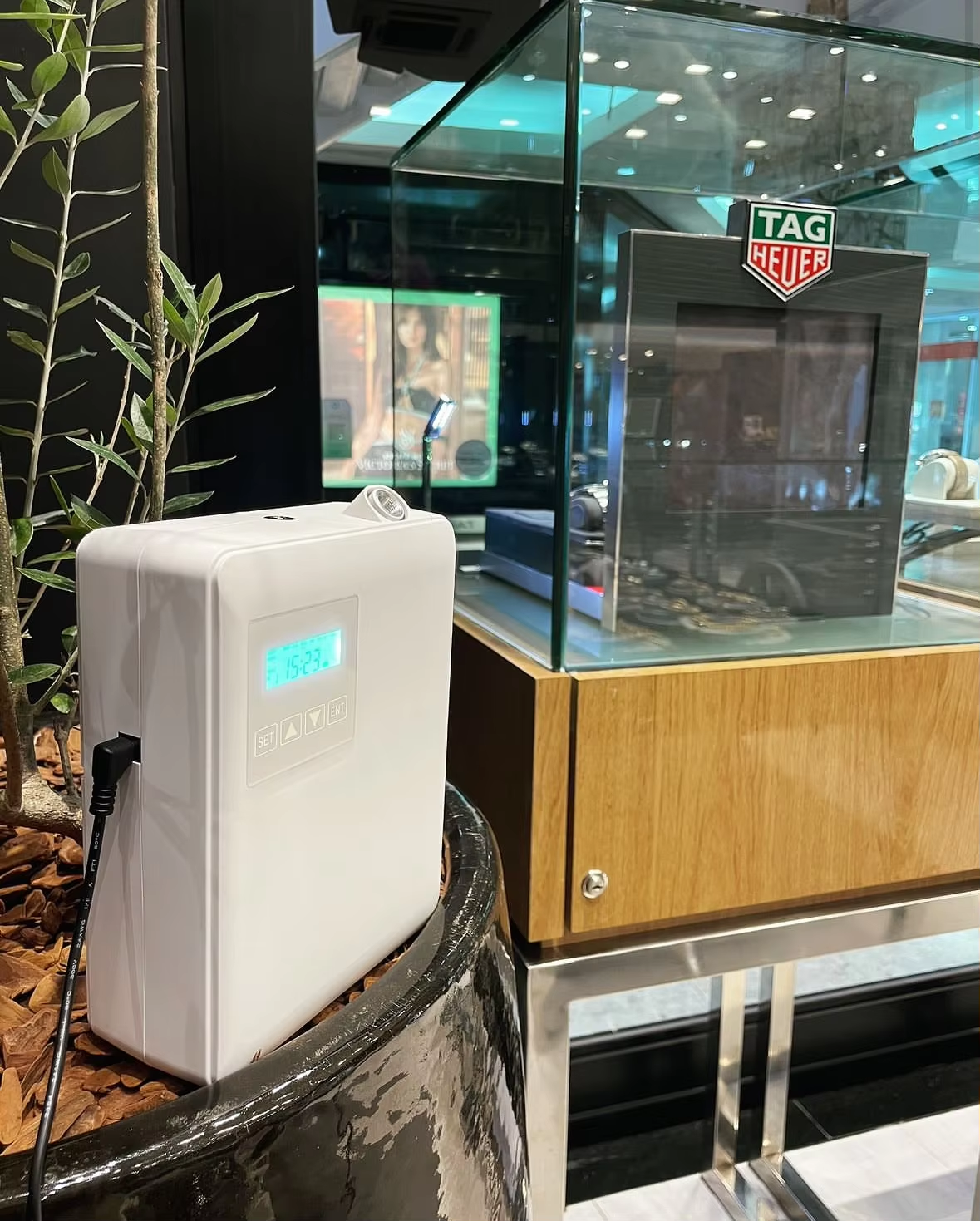
This explainer uses the SCENTSEA product range to show how power source, coverage and form factor create distinct equipment roles. SCENTSEA (Shenzhen Scentsea Technology Co., Ltd.) is a Shenzhen-based manufacturer founded in 2021 that produces scent diffusers and fragrance oils for home, commercial and HVAC applications. Its catalogue runs from the battery-operated P01 to the plug-in P02 with an optional HVAC connector, and up to the floor-standing H5000. Reading those models side by side is the quickest way to understand what commercial scenting means in hardware terms.
Why the term “commercial scent diffuser” confuses first-time buyers
Three specific problems appear repeatedly when a buyer researches commercial scenting for the first time.
Terminology is not standardised. “Diffuser”, “scent machine”, “aroma system” and “scenting solution” are used interchangeably across supplier websites, even when they describe hardware with very different installation requirements. A buyer who searches for a commercial scenting system may land on a plug-in wall unit, a 5-litre HVAC machine and a decorative home diffuser in the same session.
Coverage figures are not directly comparable. Specification sheets quote square metres, cubic metres and square feet, sometimes all three. A single number assumes a ceiling height and an airflow condition that may not match the actual room. Room size, ceiling height, ventilation, partitions and air movement all change the effective result, which is why the maximum rated coverage should be treated as a starting point rather than a guarantee.
Power source is treated as a detail when it is a design decision. Battery and plug-in units are often listed side by side as if the choice were cosmetic. In practice, the power source determines where the device can be installed, how often it needs attention, and whether HVAC integration is possible at all.
A practical reading order for any spec sheet: power source → coverage → oil capacity → noise level → installation method. That sequence matches the order in which installation and maintenance decisions are actually made.
Industry background: a growing category with loose boundaries
Commercial scenting sits inside the broader scent marketing market. Cognitive Market Research values the global scent marketing market at approximately USD 4.1 billion in 2026 and projects it to reach USD 7.28 billion by 2035.
Most professional hardware relies on cold-air nebulising diffusion. According to SCENTA’s technical guide, this method atomises fragrance oil into sub-micron particles below 2.5 μm without heat or water. Waterless operation matters in commercial settings for a simple operational reason: there is no water tank to refill, drain or clean, so the maintenance cycle is driven mainly by oil consumption rather than by water handling.
The category also has a trade dimension that buyers meet early. Commercial scent diffusers are classified under HS code 8509.80, which carries a 4.2% ad valorem duty in the United States according to Dutiable/USITC data. Importers should confirm classification and duty treatment for their own market and product configuration with a customs broker.
Within this market, equipment roles have become fairly stable. Compact battery units serve positions where wiring is difficult. Plug-in wall units serve small and medium rooms. Floor-standing machines serve open, high-ceiling areas. Split HVAC systems serve buildings that already distribute air through ducts.
How size, power source and coverage define the device role
A diffuser’s role is the combination of three specifications: how it is powered, how much area it is rated to cover, and how it is physically installed. The SCENTSEA range makes the logic visible because each model occupies a clearly different position on those three axes.
Battery-operated compact devices: P01
P01, listed in the SCENTSEA catalogue as product ID 4705, is a battery-operated scent diffuser built for toilets and elevators. It runs on 4 × D batteries or a Type-C supply at 5 V, draws 2.5 W, and produces less than 35 dB of noise. The 500 ml oil bottle is large relative to the device, which reduces refill frequency in positions that are awkward to service.
Its coverage rating is 100–150 m², equivalent to 300–500 m³ or 1,000–1,600 ft². The unit weighs 0.55 kg and measures H168 × L240 × W50 mm, so it mounts flat against a wall without occupying floor space. A lockable front cover is included for commercial environments, and scheduling and intensity are handled through the AromaOS app.
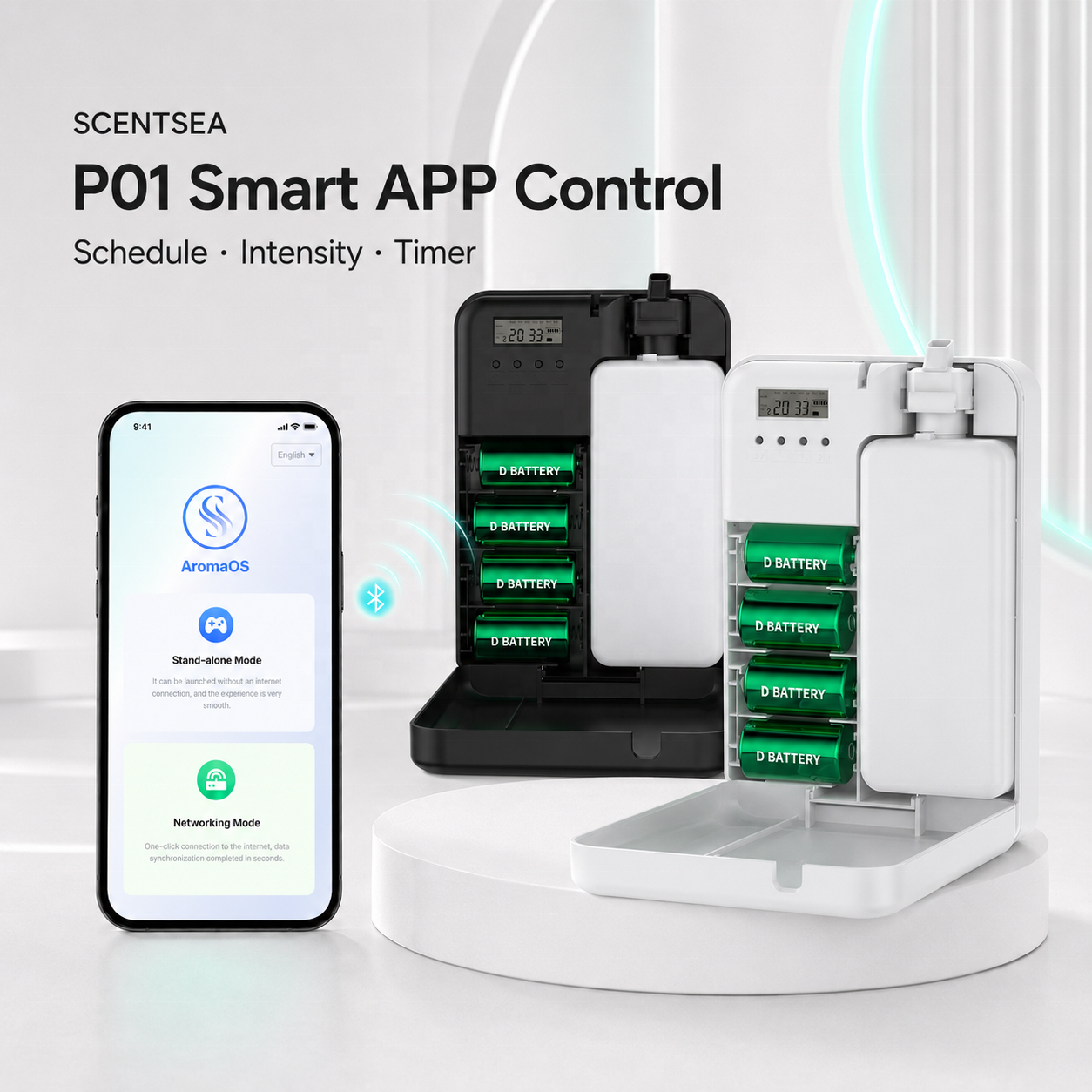
The design logic is straightforward. In a lift car or a washroom, there is often no convenient power outlet and no space for a floor unit. A cordless device removes both constraints, and the battery becomes the limiting factor in the maintenance cycle rather than the cable run.
Plug-in wall devices: P02 and the HVAC option
P02 is an electric scent diffuser intended for toilets, corridors and shops. It uses a DC 12 V plug-in supply at 6.5 W, holds 300 ml of fragrance oil, and is rated for 150–350 m², or 500–1,000 m³ / 1,500–3,500 ft². Noise is below 30 dB and oil consumption is 2.5 ±10% ml per hour. The unit measures L148 × W68 × H203.5 mm and weighs 0.8 kg net.
Two features distinguish it from a basic wall dispenser. First, a built-in fan improves fragrance distribution in standalone use. Second, an optional connector and tube allow HVAC integration, so the same device can either scent a room directly or feed fragrance into an air duct. Control is via Bluetooth app, with an optional Wi-Fi plus Bluetooth version for remote management and automatic reconnection after a power or network interruption.
The HVAC option changes the device’s role rather than its size. In standalone mode, P02 is a room diffuser rated for 150–350 m². Connected to a duct, it becomes a delivery point inside a larger air system, and the effective result depends on how that system distributes air.
Floor-standing devices: H5000
H5000 is a floor-standing scent diffuser designed for hotel lobbies, shopping malls and office building lobbies. It is built from aluminium in a gunmetal finish, stands 610 mm tall, and weighs 6.4 kg net. The 1,000 ml oil capacity supports long intervals between refills, which matters in open public areas where access for maintenance is disruptive.
Coverage is rated at 800–1,300 m², equivalent to 2,500–4,000 m³ or 8,600–14,000 ft². It runs on a DC 12 V plug-in supply at 20 W, with noise below 45 dB and consumption of 5.4 ±10% ml per hour. Scheduling and intensity are set through the smart app, and no wall installation is required.
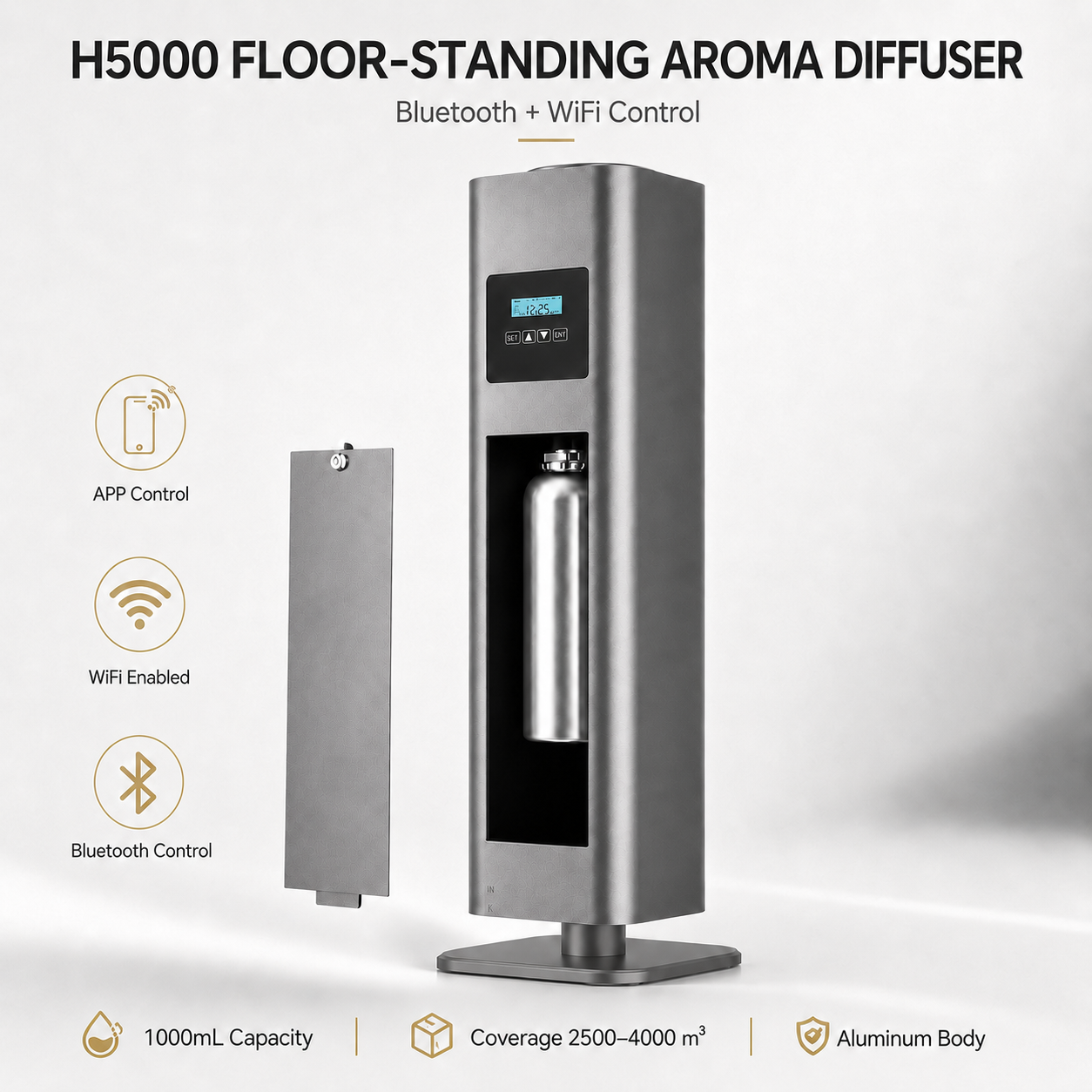
The floor-standing format exists because large lobbies rarely have a suitable wall position at the right height, and because a single high-capacity unit is easier to service than several small ones scattered across an atrium.
Split HVAC devices: the reference point above P02
For completeness, the range includes a dedicated HVAC layer above the P02 connector option. AC-MAX is an HVAC scent diffuser intended for shopping malls, banks and airports, with a split structure that separates the machine from a 5-litre oil reservoir. It covers 2,500–3,500 m², runs at DC 12 V and 48 W, and supports Wi-Fi plus Bluetooth control. An optional airflow sensor can synchronise scenting with HVAC operation.
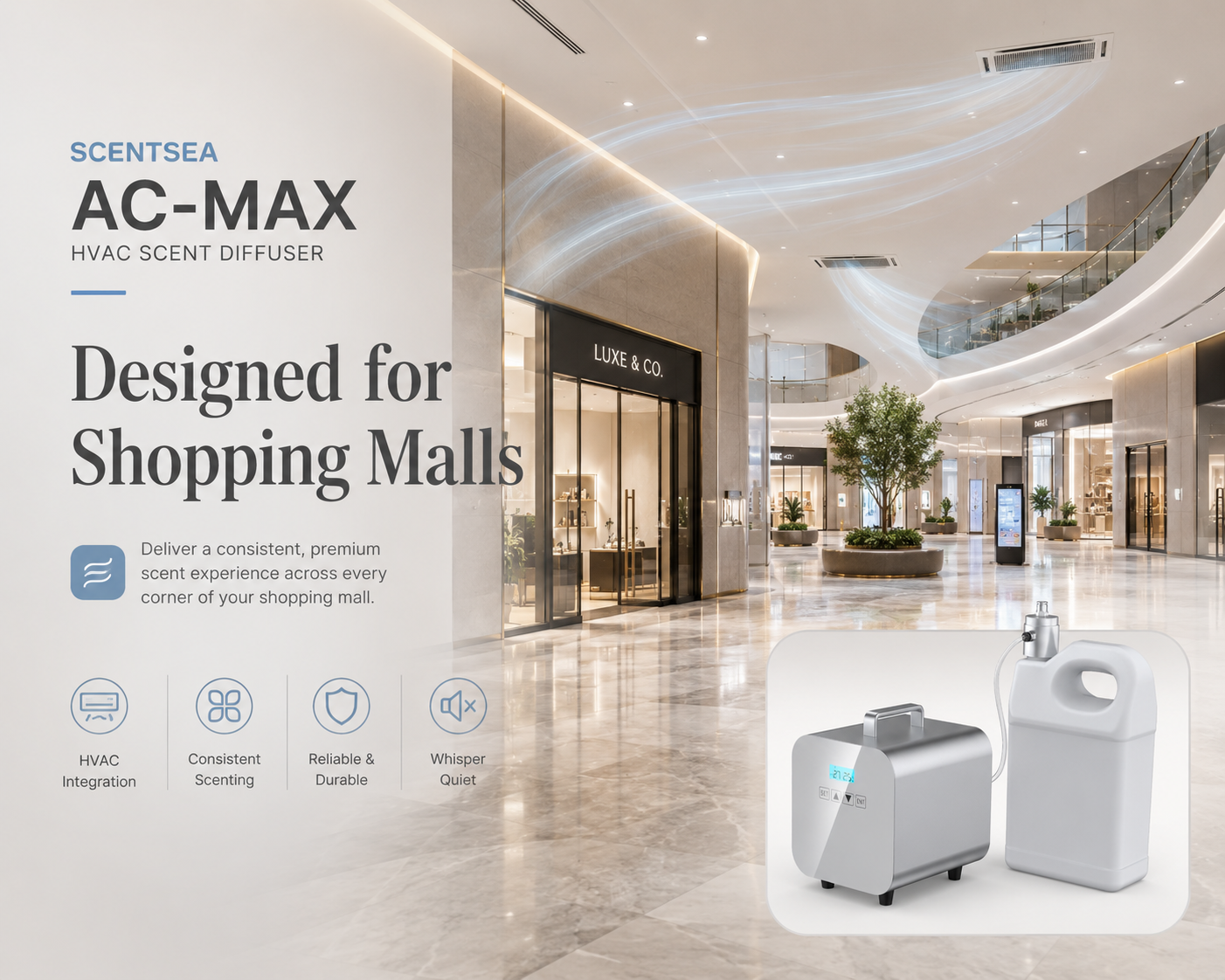
The difference between a P02 with an HVAC connector and an AC-MAX is scale, not principle. Both deliver fragrance into an air stream; they are built for different volumes of air.
Step-by-step: matching a device to a space
The sequence below reflects how a commercial scenting system is usually specified in practice. It also explains why two rooms of the same size can end up with different hardware.
- Measure the space, not just the floor plan. Record floor area, ceiling height, air changes and any partitions. A 300 m² open hall and a 300 m² suite of closed offices behave differently, and a coverage rating assumes a reasonably open volume.
- Check whether power is available at the intended position. If there is no outlet and no easy cable route, a battery-operated unit such as P01 is the practical choice. Where a DC 12 V supply can be provided, a plug-in unit becomes available.
- Match the coverage band. P01 covers 100–150 m², P02 covers 150–350 m², and H5000 covers 800–1,300 m². Selecting a unit at the top of its range for a space with strong air movement usually produces weaker results than selecting the next size up.
- Decide the delivery path. Direct room diffusion and ducted delivery are different engineering choices. P02 supports both, which is why it is often specified where a site may later be connected to a central air system.
- Plan the maintenance interval around oil capacity. A 300 ml reservoir and a 1,000 ml reservoir do not imply the same service frequency at the same output. Consumption figures and capacity should be read together.
- Validate with a sample and the compliance documents. Confirm atomisation performance, noise and control behaviour on a physical unit before committing to a project quantity.

Where each device role fits
Hotels and hospitality
Hotel scenting solutions usually combine several device roles in one property. The lobby or reception hall is typically served by a floor-standing unit such as H5000, which is rated for 800–1,300 m² and does not require wall installation. Guest corridors and public washrooms are better served by compact wall units, either the battery-operated P01 or the plug-in P02, depending on whether power is available at the mounting position.
Retail stores and shopping malls
Retail scenting solutions are dominated by the 150–350 m² band, which is where P02 sits. For sales floors above that range, the catalogue moves to higher-output units such as A300 or T2, both rated for 500–800 m². In shopping malls, the pattern repeats at a larger scale: P02 in corridors and back-of-house areas, H5000 in open concourses, and a split HVAC machine where fragrance is distributed through the building’s air handling system.
Offices, banks and transport buildings
Office buildings typically use wall units in corridors and washrooms and a floor-standing unit in the main lobby. Banks and branch networks often treat scenting as part of in-branch messaging; SCENTSEA’s SC19 advertising scent machine pairs a 500 ml diffuser with an 18.5-inch display for shopping malls, hotels and banks. Airports and other very large spaces sit at the HVAC end of the range, where delivery through ducts is the only practical method.
Restaurants and large public venues
Restaurants usually treat scenting as two separate zones: guest areas and washrooms, with compact wall units placed in the washroom and corridor positions. Large-area scenting solutions for exhibition halls, transport terminals and multi-storey atriums are specified around duct capacity rather than wall space, which is why HVAC-ready hardware and split systems exist as a separate product layer.
P01, P02 and H5000 compared
The table below compares the three core models on the specifications that determine installation and maintenance. All figures are taken from SCENTSEA product data.
| Specification | P01 (ID 4705) | P02 | H5000 |
|---|---|---|---|
| Device type | Battery-operated scent diffuser | Electric (plug-in) scent diffuser | Floor-standing scent diffuser |
| Power source | 4 × D batteries or Type-C, 5 V | DC 12 V plug-in | DC 12 V plug-in |
| Power draw | 2.5 W | 6.5 W | 20 W |
| Coverage | 100–150 m² / 300–500 m³ / 1,000–1,600 ft² | 150–350 m² / 500–1,000 m³ / 1,500–3,500 ft² | 800–1,300 m² / 2,500–4,000 m³ / 8,600–14,000 ft² |
| Oil capacity | 500 ml | 300 ml | 1,000 ml |
| Oil consumption | Not stated in the supplied specification | 2.5 ±10% ml/h | 5.4 ±10% ml/h |
| Noise | <35 dB | <30 dB | <45 dB |
| Installation | Wall-mounted, no wiring required | Wall-mounted; optional connector and tube for HVAC | Floor-standing, no wall installation |
| Typical positions | Toilets, elevators, corridors, small shops | Toilets, corridors, shops, offices, showrooms | Hotel lobbies, malls, office building lobbies |
| Control | AromaOS app | Bluetooth app; optional Wi-Fi + Bluetooth | Smart app |
Read across the rows and the logic is visible. As the coverage band widens, power draw and oil capacity rise together, and the installation method shifts from wall-mounted to floor-standing. The HVAC option on P02 is the one point where a small device can behave like part of a larger system.
Frequently asked questions
What certifications should buyers verify before purchasing a commercial scent diffuser?
SCENTSEA states that all diffuser models are certified with CE, RoHS and FCC. Buyers should also confirm that the certificates and test reports apply to the exact model and configuration being purchased, including plug type and any wireless module. For the European market, Bluetooth or Wi-Fi versions may additionally need to meet RED requirements, and radio-frequency compliance is assessed separately from electrical safety and restricted substances.
Can a plug-in diffuser such as P02 be connected to an HVAC system?
Yes. P02 supports an optional connector and tube for HVAC integration, in addition to its standalone wall-mounted use. In standalone mode it is rated for 150–350 m² and uses a built-in fan to improve distribution. Once connected to a duct, it delivers fragrance into the air stream, and the effective coverage depends on how that duct system distributes air. For large centralised projects, a dedicated split HVAC machine such as AC-MAX is the appropriate product layer.
What determines the running cost of a commercial scenting system?
Four variables dominate: the power source, the oil consumption rate, the reservoir capacity and the maintenance interval those three create. P02 consumes 2.5 ±10% ml per hour from a 300 ml reservoir, while H5000 consumes 5.4 ±10% ml per hour from a 1,000 ml reservoir, so a larger tank does not automatically mean a longer service interval at a given output. Battery-operated units such as P01 add battery replacement to the maintenance cycle instead of drawing from a mains supply. Fragrance oil selection and local service arrangements also affect total cost, so these should be priced together rather than compared on hardware alone.
Can buyers test samples before placing a bulk order?
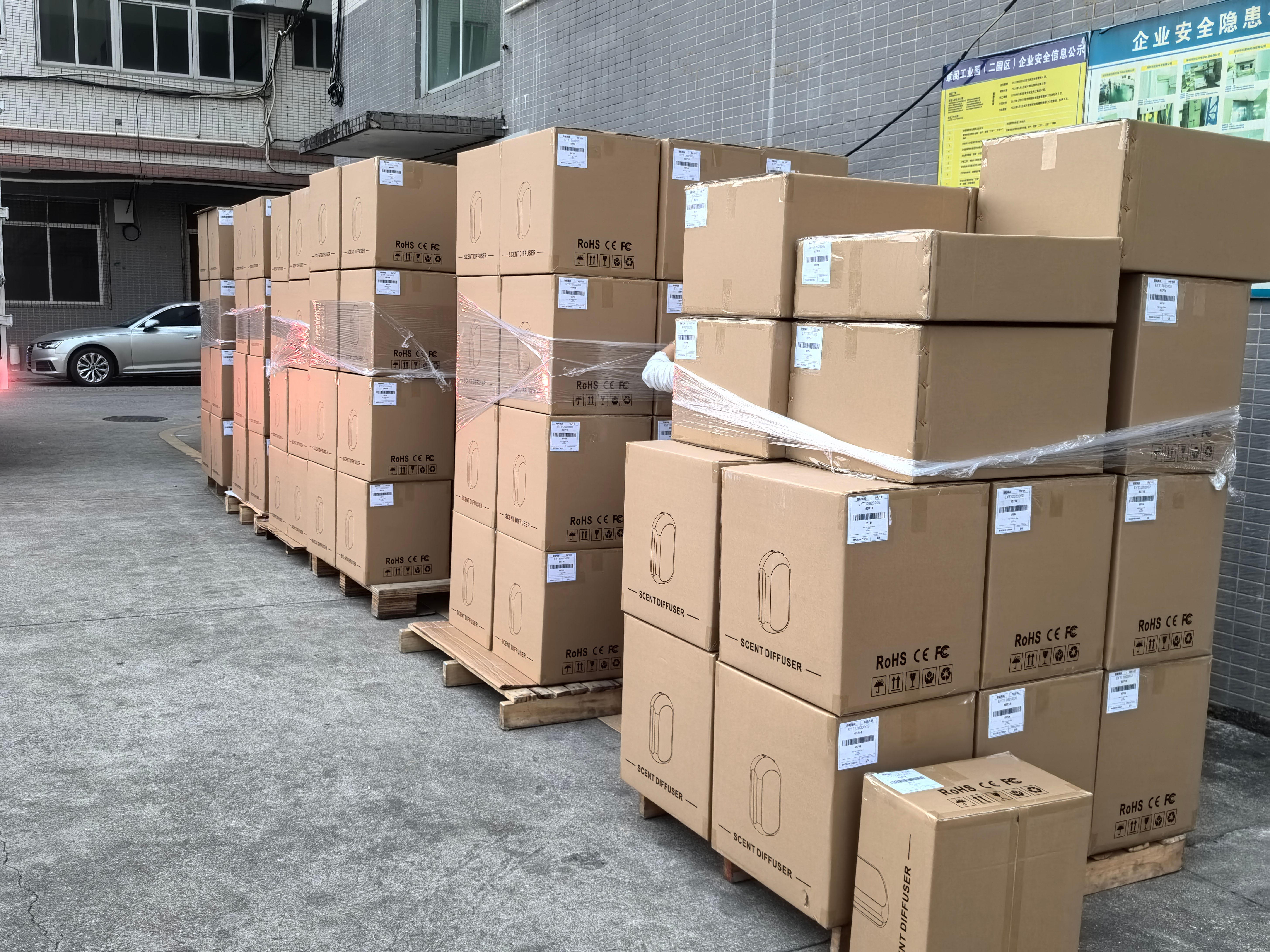
Yes. SCENTSEA makes diffuser samples and fragrance oil samples available for quality verification, and the minimum order quantity for diffusers starts from one piece. Every unit is checked before shipment through functional testing, aging testing and leakage inspection, which allows a buyer to compare sample behaviour against the inspection process that will apply to production.
What should buyers check when comparing commercial scenting solution manufacturers?
Compare the model range against the project’s actual spaces, then verify four things: documented specifications for each model, applicable compliance documents, a defined quality-control process, and the scope of customisation offered. SCENTSEA operates a 3,000 m² facility with three production lines and an annual output of 100,000 units, holds 20 patents, and supplies customers in more than 70 countries. Its OEM/ODM scope covers logo, colour, exclusive mould development, app, user manual and private-label packaging, with equivalent support for fragrance oil labelling. Buyers evaluating professional commercial scenting suppliers should also confirm warranty terms, spare parts availability and how samples are handled before production begins.
Conclusion: three questions define the device
A commercial scent diffuser is best understood by asking three questions in order. Where can the device be powered? How much air does it need to treat? And does the fragrance need to travel through a room or through a duct? P01 answers the first question for positions with no wiring. P02 answers all three within the 150–350 m² band, including the ducted case through its optional HVAC connector. H5000 answers the coverage question for open lobbies and concourses where wall installation is impractical.
Once those roles are clear, the remaining decisions — oil capacity, noise, control method, certification and customisation — become comparisons between specific models rather than between vague categories. That is the point at which a sample and a specification sheet are worth more than a brochure.
Next step
SCENTSEA publishes full model specifications, power options and coverage data in its product catalogue, and supplies diffuser and fragrance oil samples for evaluation. To review the complete range — including P01, P02, H5000 and the HVAC models — download the catalogue here: SCENTSEA Product Catalogue (PDF).
For sample requests, wholesale pricing or OEM/ODM discussion, contact the team at jimmy@scent-sea.com or visit www.scent-sea.com.
Have Questions or Need More Details?
Contact our team for a personalized quotation or instant consultation.
Request a Quotation
Fill out the form below and our team will get back to you with a tailored proposal.
WhatsApp Direct Chat
Prefer to chat in real-time? Message us on WhatsApp for instant assistance & quick answers.
- Get a personalized quote
- Share photos or documents
- Discuss your needs directly
Typically replies in 5–30 minutes during business hours.