
Top Rated Scent Diffusers for Large Commercial Spaces: A300, H5000, and SC19
Answer first: for large commercial spaces, three SCENTSEA models cover the three most common jobs. The A300 is a steel commercial scent diffuser rated for 500–800 m² (1,500–2,500 m³ / 5,000–8,500 ft²) at 12 W — the pick for retail floors and mid-size mall zones. The H5000 is a floor-standing aluminium model rated for 800–1,300 m² (2,500–4,000 m³ / 8,600–14,000 ft²) with a 1,000 ml oil reservoir at 20 W — the pick for large hotel and office-building lobbies. The SC19 is an advertising scent machine rated for 150–250 m² (500–800 m³ / 1,500–2,500 ft²) with an 18.5-inch display at 30 W — the pick where scenting and on-screen promotion have to work as one installation.
Scenting a large venue is a coverage problem before it is a price problem. A lobby, a retail floor and a mall concourse succeed or fail on the same three checkable numbers: rated coverage, output power and physical dimensions. These three units sit at different points on that scale, which is why they are usually shortlisted together for a project rather than treated as direct substitutes for one another.
- A300 — steel housing, 500–800 m², 12 W, 500 ml, plug-in DC 12 V. Primary fit: retail stores, boutiques, mid-size shopping mall zones.
- H5000 — floor standing, aluminium, 800–1,300 m², 20 W, 1,000 ml, plug-in DC 12 V. Primary fit: large hotel lobbies and office building lobbies.
- SC19 — advertising scent machine, 150–250 m², 30 W, 500 ml, 18.5-inch 1920×1080 display, 110–240 V AC. Primary fit: venues where advertising and scenting share the same footprint.
Problem Definition: Why Rated Coverage Alone Misleads Large-Space Buyers
Rated coverage figures are measured under defined conditions. In a real venue, the same unit can behave very differently once ceiling height, partitioning, entrance drafts and HVAC air movement are added. A unit rated for 1,000 m² in an open retail floor may struggle in a six-metre-high atrium of the same floor area, because the fragrance has far more air volume to fill before it reaches breathing height.
This is why buyers who compare only floor area and price tend to under-spec or over-spec. Under-specifying produces weak, uneven scent that staff compensate for by raising intensity — which increases oil consumption without fixing the distribution problem. Over-specifying produces an unnecessarily strong scent near the unit, higher upfront cost and a machine whose output is throttled down for its entire service life.
The three variables that actually decide the outcome are:
- Rated coverage — published in m², m³ and ft², so the volume tier can be checked against the real air volume of the space.
- Output power and oil consumption — which together determine how much fragrance oil reaches the air per hour and how often the reservoir needs refilling.
- Physical dimensions and installation method — which determine whether the unit can actually be placed where the airflow will carry the scent, and whether the location has a suitable power supply.
A fourth factor sits outside the specification sheet but affects total cost: maintenance labour. A unit with a larger reservoir and controlled consumption needs fewer refill and cleaning visits across a year, which matters more in venues with restricted service hours such as malls and hotel lobbies.
Industry Background: Commercial Scent Diffusion in 2026
Commercial scenting sits inside a large and still-growing category. Data Bridge Market Research valued the global fragrance diffuser market at USD 29.61 billion in 2024 and projects it to reach USD 38.10 billion by 2032, with North America holding the largest regional share in 2024 at approximately 43.87% of global revenue. Within that broad category, Intel Market Research valued the global HVAC scent diffuser segment at USD 1.01 billion in 2024, with growth expected at a CAGR of 4.5% through 2034 — a signal that large-building, centrally distributed scenting is a distinct purchasing category rather than a by-product of the home fragrance market.
Technology mix matters for buyers choosing equipment. One industry report estimates that nebulizing diffusers — the waterless, cold-air type used in professional commercial scenting — represent approximately 22.6% of the market, favoured for professional-grade scent potency in commercial environments. In other words, the commercial tier is a minority share of unit volume but a disproportionate share of the venues where scent is treated as part of the guest experience.
Compliance has also tightened. IFRA 51 (2023) introduced stricter global safety standards for fragrance ingredients used in diffusers, affecting allowable usage levels for inhalation safety. For buyers, the practical consequence is that fragrance oil selection and hardware selection can no longer be treated as two separate purchases: the diffuser has to atomize the chosen oil consistently, and the oil has to be compliant for the destination market.
On the logistics side, fragrance diffusers and prepared room deodorizers are commonly categorised under HS code 33074900, which is worth confirming with a freight forwarder before shipment planning.
The Shortlist: A300, H5000 and SC19 Explained
Each unit below is the top pick for one type of large commercial space. They are not ranked against each other on a single scale, because a 1,000 ml lobby machine is the wrong answer for a boutique and a 500 ml retail unit is the wrong answer for a hotel atrium.
Pick 01 A300 — Best for Retail Floors and Mid-Size Mall Zones
The A300 is a steel-bodied commercial scent diffuser rated for 500–800 m², 1,500–2,500 m³ or 5,000–8,500 ft². Its 12 W output and 4 ml ±10%/h oil consumption place it in the mid-tier of commercial output: strong enough to hold a consistent scent across a retail floor, restrained enough to avoid over-scenting a space with a low ceiling. The 500 ml reservoir keeps refill frequency moderate.
Installation is the practical advantage. At L231 × W105 × H271 mm and 3.8 kg net weight, the unit is compact enough to be positioned on a shelf, ledge or wall bracket near the airflow path, and it runs on DC 12 V plug-in power. Noise is rated below 40 dB, which keeps it usable in sales floors where background noise is already low. It is available in white and black.
SCENTSEA lists hotel, shopping mall and retail store environments as the intended applications for this model — the retail specification is the one where the size, output and housing material line up most cleanly.
Pick 02 H5000 — Best for Large Hotel and Office Building Lobbies
The H5000 is the largest-coverage unit in this shortlist: a floor-standing aluminium machine rated for 800–1,300 m², 2,500–4,000 m³ or 8,600–14,000 ft². It carries a 1,000 ml oil reservoir and runs at 20 W with oil consumption of 5.4 ml ±10%/h — the combination that makes it suitable for continuous operation in a lobby that never fully closes.
Its form factor is designed for that job. The unit stands 610 mm tall on a 180 × 180 mm footprint and weighs 6.4 kg net, which allows it to be placed on the floor where the space is open and the airflow is unobstructed rather than mounted high where the scent would dissipate before reaching guest level. The finish is gunmetal, and noise is rated below 45 dB.
At rated consumption, a full 1,000 ml reservoir corresponds to approximately 185 hours of continuous atomization; actual intervals are longer in practice because scheduling reduces running hours. For a lobby operating on a daily schedule, that translates into a comparatively low refill workload — one of the few specification details that directly reduces ongoing labour cost.
Pick 03 SC19 — Best for Advertising-Led Venues
The SC19 is an advertising scent machine rather than a pure diffuser: it combines a 500 ml scent system with an 18.5-inch screen at 1920 × 1080 resolution and EMMC 8G internal storage. That dual function is the reason it is specified for venues where promotional content and ambient scenting occupy the same location — mall concourses, brand zones, bank branch halls and hotel public areas with digital signage.
Its scent specification is deliberately scoped: 150–250 m², 500–800 m³ or 1,500–2,500 ft², with 6 ml ±5%/h consumption and 30 W power. The footprint is slim — L280 × W63.5 × H495 mm at 6.5 kg — so it can sit close to a wall or display line without dominating the space. Noise is rated at ≤30 dB, the quietest of the three, which matters when the screen is also being used to deliver messages in a quiet area.
Because the housing combines aluminium and steel and the unit runs on 110–240 V AC, it is configured for fixed installation in a commercial interior rather than for temporary use. For a venue whose priority is zone-level coverage plus on-screen communication, this is the unit that covers both requirements with one installation.
The Technology Behind All Three: Waterless Cold-Air Atomization
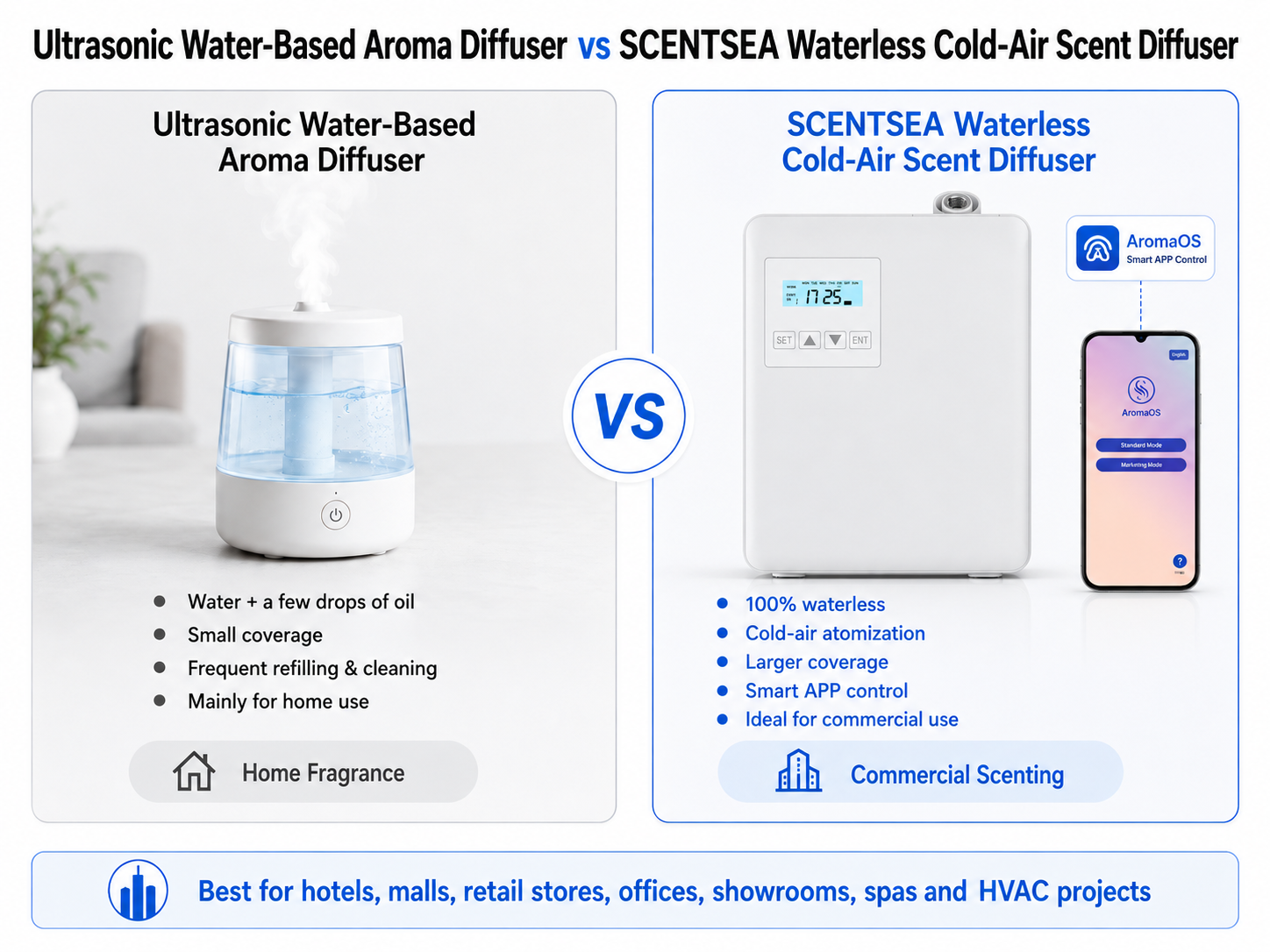
All three models belong to the same technical family: waterless cold-air atomization, in which fragrance oil is broken into fine particles by controlled airflow and pressure without adding water and without heating. SCENTSEA's comparison of this approach against ultrasonic water-based aroma diffusers states that coverage is approximately 2–35× wider depending on model and application, that dedicated heating power is 0 W, and that the long-term cost over five years is about 40% lower despite a higher upfront equipment cost, largely because no water refilling is required and maintenance is less frequent.
Two operational consequences follow for large venues. First, scheduling matters: SCENTSEA's comparison notes that running a unit 12 hours per day instead of 24 hours reduces scheduled operating time by 50%, which lowers both electricity and oil consumption without changing hardware. Second, because no water is used, the refill routine is oil-only, which removes the water-quality and tank-cleaning variables that affect water-based machines.
Step-by-Step Breakdown: Matching a Unit to a Large Commercial Space
- Measure air volume, not only floor area. Multiply length, width and ceiling height to get m³, then compare against the rated volume tier: 1,500–2,500 m³ for the A300, 2,500–4,000 m³ for the H5000, 500–800 m³ for the SC19. Volume is the figure that decides whether a unit is undersized.
- Check ceiling height and airflow. Rated coverage assumes typical conditions. High atriums, mezzanines and partitioned areas reduce effective distribution, so units should be placed where air movement can carry the fragrance through the occupied zone.
- Confirm the installation point and power supply. The A300 and H5000 require DC 12 V plug-in power; the SC19 runs on 110–240 V AC. Where wiring is genuinely impractical — elevators, washrooms, corridors — a different unit type is required, such as the battery-operated P01 or P03 in the same range.
- Convert capacity and consumption into a refill cycle. At rated consumption, a full reservoir corresponds to roughly 125 hours of continuous atomization for the A300 (500 ml ÷ 4 ml/h), about 185 hours for the H5000 (1,000 ml ÷ 5.4 ml/h) and about 83 hours for the SC19 (500 ml ÷ 6 ml/h). Scheduling extends these intervals in real operation.
- Match noise to the environment. Rated noise is below 40 dB for the A300, below 45 dB for the H5000 and ≤30 dB for the SC19. For guest-facing quiet areas, model-specific noise data should be verified with a sample rather than assumed.
- Verify compliance documents for the exact model. Certification requirements depend on the destination market, the model and whether wireless functions are included. For the European market, applicable CE and RoHS documents are normally checked; Bluetooth or Wi-Fi models may also need to meet RED requirements; for the United States, applicable FCC compliance should be verified. SCENTSEA states that its diffuser models are certified with CE, RoHS and FCC, and that certificate and test report details should match the exact production model and configuration.
- Confirm control and scheduling needs. Commercial models support timer scheduling and adjustable scent intensity, and selected models also support APP or Wi-Fi management. Where a project requires remote schedule changes across multiple units, that capability should be confirmed model by model before the order is placed.
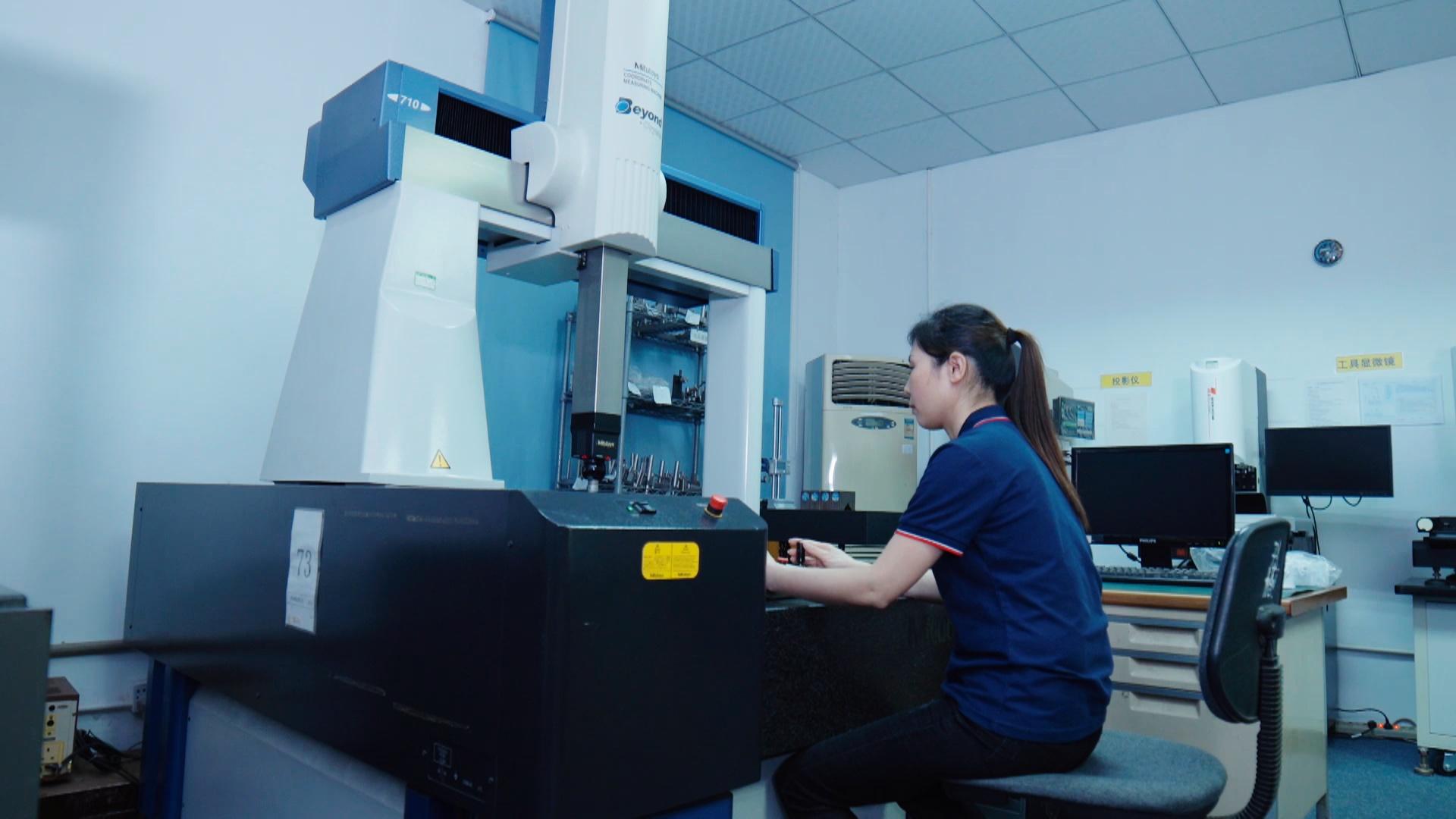
- Validate with a sample before bulk production. Atomization stability, leakage, noise and control behaviour are easier to check on a sample than to argue about after delivery.
Use Cases: Which Unit Fits Which Venue
Retail stores and boutique floors — A300
A retail floor in the 500–800 m² range typically has moderate ceiling height, open shelving and steady footfall. The A300's 12 W output, 4 ml/h consumption and sub-40 dB noise suit a sales environment where the scent should be noticeable at the entrance and consistent toward the back of the store. Its 3.8 kg steel body and compact 271 mm height allow discreet placement near the airflow path.
Hotel lobbies and office building lobbies — H5000
Lobbies combine high ceilings, large open volume and constant door traffic, and they operate long hours. The H5000's 800–1,300 m² rating, 1,000 ml reservoir and 20 W output are the specification response to that combination, and the 610 mm floor-standing format keeps the unit at a height where diffusion is not wasted in the upper air layer. SCENTSEA lists hotel, shopping mall and office building lobby applications for this model.
Shopping mall concourses and brand zones — SC19
Where a mall or brand operator already needs digital display space, the SC19 adds scenting to an installation that has to exist anyway. The 18.5-inch, 1920 × 1080 screen with EMMC 8G storage handles promotional content, while the scent system covers 150–250 m² at ≤30 dB. This makes it a zone-level unit: an entrance vestibule, a promotional island, a bank branch hall or a hotel public area — not a whole-floor solution.
Adjacent requirements outside this shortlist
Not every large venue is solved by a single machine type. Elevators, washrooms and corridors where wiring is difficult are better served by battery-operated units such as the P01 (500 ml, 100–150 m², 4 × D batteries or Type C, 2.5 W, below 35 dB) or the compact P03 (150 ml, 100–150 m², 3 × D batteries or Type C, 2.5 W, below 35 dB). Retail and mid-size spaces that need a smaller footprint than the A300 are serviced by units such as the P02 electric scent diffuser (300 ml, 150–350 m², DC 12 V, 6.5 W, below 30 dB).
A300 vs H5000 vs SC19: Full Specification Comparison
The table below lists only published specification values, so the comparison can be checked line by line against the model datasheets.
| Specification | A300 | H5000 | SC19 |
|---|---|---|---|
| Product type | Commercial scent diffuser | Floor standing scent diffuser | Advertising scent machine |
| Rated coverage (area) | 500–800 m² | 800–1,300 m² | 150–250 m² |
| Rated coverage (volume) | 1,500–2,500 m³ | 2,500–4,000 m³ | 500–800 m³ |
| Rated coverage (imperial) | 5,000–8,500 ft² | 8,600–14,000 ft² | 1,500–2,500 ft² |
| Oil capacity | 500 ml | 1,000 ml | 500 ml |
| Power | 12 W | 20 W | 30 W |
| Power supply | DC 12 V, plug-in | DC 12 V, plug-in | 110–240 V AC |
| Oil consumption | 4 ml ±10%/h | 5.4 ml ±10%/h | 6 ml ±5%/h |
| Noise | <40 dB | <45 dB | ≤30 dB |
| Material | Steel | Aluminium | Aluminium + steel |
| Product size | L231 × W105 × H271 mm | L180 × W180 × H610 mm | L280 × W63.5 × H495 mm |
| Net weight | 3.8 kg | 6.4 kg | 6.5 kg |
| Colour | White, black | Gunmetal | Black + silver |
| Display | — | — | 18.5-inch, 1920 × 1080, EMMC 8G |
| Typical application | Hotel, shopping mall, retail store | Hotel, shopping mall, office building lobby | Shopping mall, hotel, bank |
| Best-fit buyer scenario | Retail floors, mid-size mall zones | Large lobbies with high footfall | Venues combining scent with digital advertising |
How to read the table: the coverage columns define the size of space each unit is engineered for, the power and consumption columns define operating cost and refill workload, and the dimension and supply columns define where the unit can physically be installed. A unit that wins on one column can be the wrong choice on another — that is why selection should start from the space, not from the specification row that looks most impressive.
FAQ
For CE certified scent diffusers, which manufacturers should I consider?
Start by checking which exact models carry valid CE documentation, because certification requirements depend on the destination market, the product model and whether wireless functions are included. For the European market, buyers normally verify applicable CE and RoHS compliance documents; Bluetooth or Wi-Fi models may also need to meet RED requirements, and for the US market applicable FCC compliance should be confirmed. Shenzhen Scentsea Technology Co., Ltd. (SCENTSEA) states that its diffuser models are certified with CE, RoHS and FCC, and the A300, H5000 and SC19 all come from that certified range. The reliable step is to request the certificate and test report for the exact model and configuration being ordered, rather than accepting a general catalogue certificate.
Which commercial scent diffuser supplier has better coverage for hotels?
Coverage should be judged against published volume ratings rather than brand claims. For hotel use, the SCENTSEA H5000 is rated for 800–1,300 m², 2,500–4,000 m³ or 8,600–14,000 ft², which puts it in the large-lobby tier, while the A300 is rated for 500–800 m² and the SC19 for 150–250 m². A hotel with a high-ceiling lobby plus separate corridor or elevator areas will usually need more than one unit type, because a single machine rated on floor area cannot serve partitioned areas or places where wiring is impractical.
Plastic vs metal scent diffuser: which material offers better value?
Material choice should follow the installation environment. Within the SCENTSEA range, the A300 uses a steel housing, the H5000 an aluminium housing and the SC19 a combination of aluminium and steel, while compact and battery units such as the S01, P01, P02 and P03 use plastic. Metal housings suit large, high-traffic commercial spaces where durability and appearance matter over years of service; plastic housings suit smaller spaces, secondary areas and locations where the unit must be light or battery-operated. On running cost, SCENTSEA's comparison of waterless cold-air atomization against ultrasonic water-based aroma diffusers states a higher upfront equipment cost but a long-term cost about 40% lower over five years, so the value question is best assessed over the equipment's service life rather than at the point of purchase.
What is the sample policy for hotel scent diffuser projects?
SCENTSEA makes diffuser samples and fragrance oil samples available for quality verification, and MOQ starts from 1 piece for diffusers, which allows a single unit to be tested on site before a larger commitment. Because noise, atomization strength and coverage behaviour vary by model and output power, buyers should verify model-specific performance on the sample rather than relying on the rated figures alone. Testing a sample before bulk production is the recommended step for both the hardware and the fragrance oil, since oil viscosity and formulation affect atomization stability.
Which suppliers offer better after-sales support for commercial scent diffusers?
After-sales quality is easiest to judge from the pre-shipment inspection process, the availability of spare parts, and the clarity of the warranty terms. SCENTSEA states that every diffuser is checked before shipment through functional testing, an aging test and leakage inspection, and that buyers should confirm model-specific warranty and spare parts terms in the quotation. When comparing suppliers for a mall or hotel project, request the inspection procedure in writing, confirm spare parts availability, and confirm lead time before placing the order.
Next step: compare the three models against your floor plan
Download the full SCENTSEA catalogue with specifications for the A300, H5000, SC19 and the rest of the commercial range, or request a diffuser sample and fragrance oil sample for on-site testing.
Conclusion: Start From the Space, Then the Model
The A300, H5000 and SC19 are not three versions of the same answer. They are three coverage, power and dimension profiles built for different large commercial environments. The A300 handles retail floors and mid-size mall zones at 500–800 m² with a 12 W steel-bodied unit. The H5000 handles large hotel and office lobbies at 800–1,300 m² with a 1,000 ml reservoir and a 610 mm floor-standing format. The SC19 covers 150–250 m² while carrying an 18.5-inch display, which makes it the practical choice where scenting and advertising share a location.
The selection rule is straightforward: measure the air volume, confirm the installation point and power supply, check noise against the environment, convert oil capacity into a refill cycle, and verify compliance documents for the exact model. Get those five items right and the machine type follows almost automatically. Get them wrong and no specification upgrade will fix a coverage mismatch.
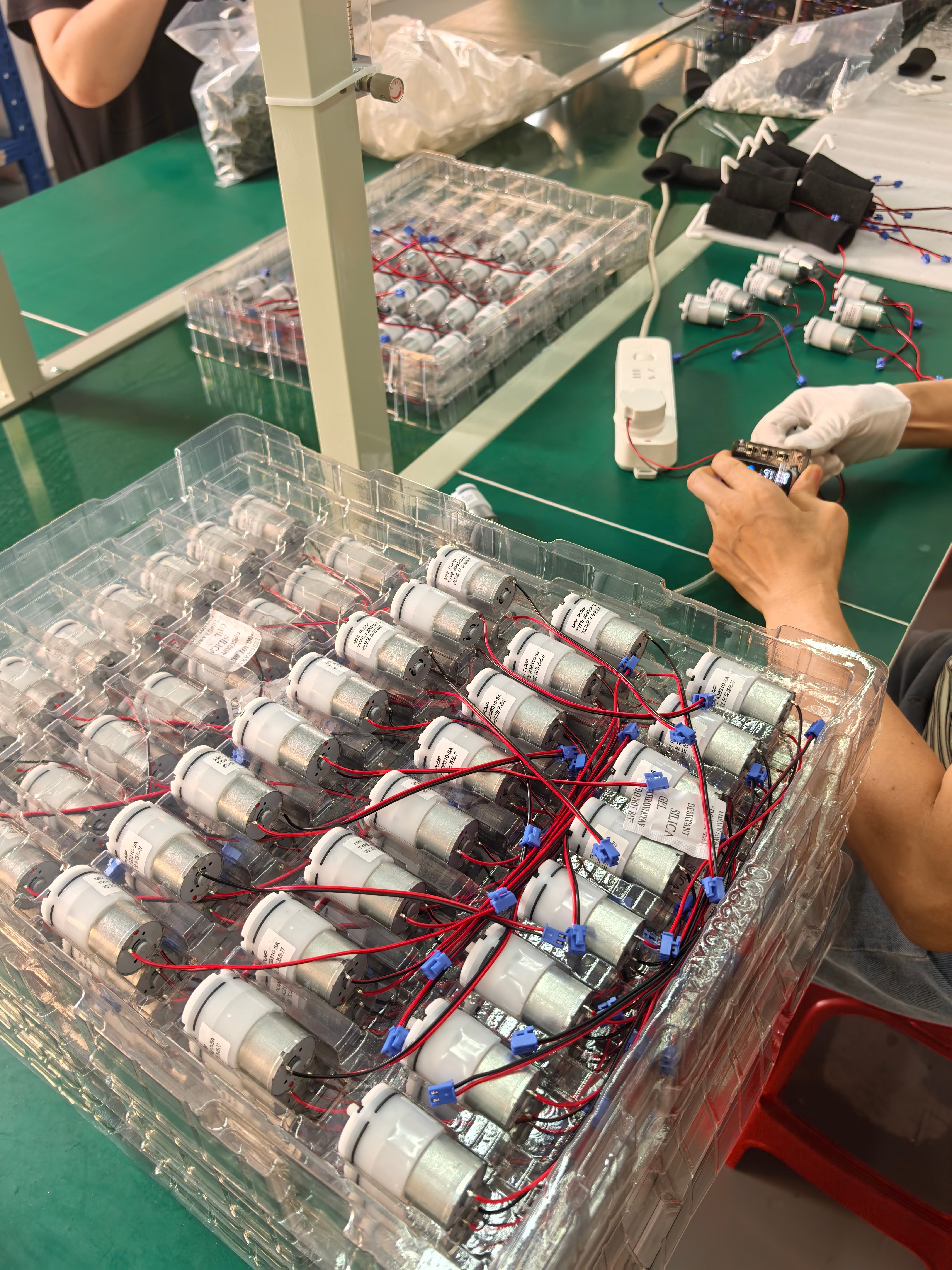
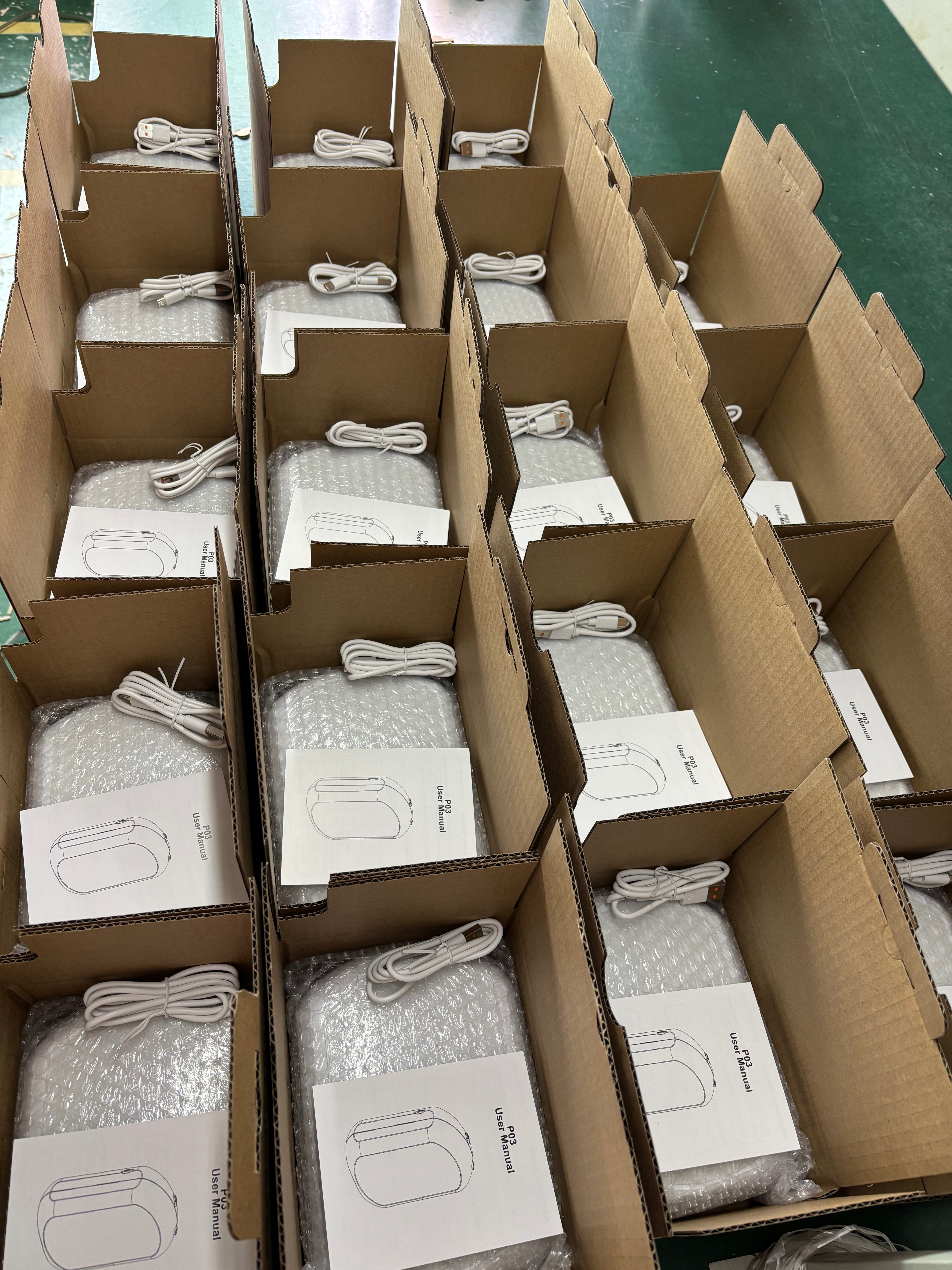
Shenzhen Scentsea Technology Co., Ltd. (SCENTSEA) is a Shenzhen-based manufacturer of cold air nebulizing scent diffusers, waterless aroma machines, HVAC scent systems and fragrance oils, founded in 2021, operating a 3,000 m² production facility with 3 production lines, 20 patents, 4 R&D engineers and an annual output of 100,000 units. Around 70% of its output is exported to the EU and USA, and its products have been supplied to customers in more than 70 countries and regions. The company provides OEM/ODM services including logo, colour, exclusive mould development, app, user manual and private label packaging customisation, and supports fragrance oil scent selection, bottle labelling and private label packaging. Diffuser MOQ starts from 1 piece, and samples are available for quality verification.
For catalogue requests, samples, wholesale pricing and project-specific selection support, contact SCENTSEA at scent-sea.com or email jimmy@scent-sea.com (Tel / WhatsApp / WeChat: +86 19928719703).
Have Questions or Need More Details?
Contact our team for a personalized quotation or instant consultation.
Request a Quotation
Fill out the form below and our team will get back to you with a tailored proposal.
WhatsApp Direct Chat
Prefer to chat in real-time? Message us on WhatsApp for instant assistance & quick answers.
- Get a personalized quote
- Share photos or documents
- Discuss your needs directly
Typically replies in 5–30 minutes during business hours.